
Imagine waking up to the rhythmic sound of a steady drip against your bedroom floor after a typical Oxfordshire downpour. For many homeowners, the roof remains out of sight and out of mind until a storm exposes a hidden weakness, leading to the stress of emergency repairs and potential damp issues. We understand that choosing between traditional slate, concrete tiles, or modern rubber systems can feel confusing when you’re simply looking for a reliable way to keep your property dry. Finding high-quality weather resistant roofing Oxford solutions is about more than just aesthetics; it’s about building a shield that stands up to our region’s specific frost-thaw cycles and heavy rainfall.
You deserve the peace of mind that comes from knowing your home is secure, regardless of the forecast. This guide will help you protect your property with expert advice on durable materials and essential preventative maintenance. We’ll explore the lifespan of different systems, from the 30-year reliability of concrete tiles to the 50-year durability of EPDM rubber, and show you how to spot failing guttering or porous tiles before they become a disaster. By the end, you’ll have a clear path toward a leak-free home that maintains its value for decades to come.
Key Takeaways
- Understand how Oxfordshire’s damp winters and humidity levels affect roof longevity and why a multi-layered defence is essential.
- Compare traditional slate and clay with modern EPDM rubber systems to find the most effective weather resistant roofing Oxford solution for your property.
- Identify critical vulnerable points, such as ridge tiles and chimney mortar, to prevent internal damp before it causes structural rot.
- Learn a simple seasonal inspection routine to spot slipped tiles and ensure guttering is clear of debris for optimal water management.
- Discover the long-term benefits of using premium materials and proven installation techniques to secure a fully guaranteed, leak-free home.
What Defines Weather Resistant Roofing in Oxford?
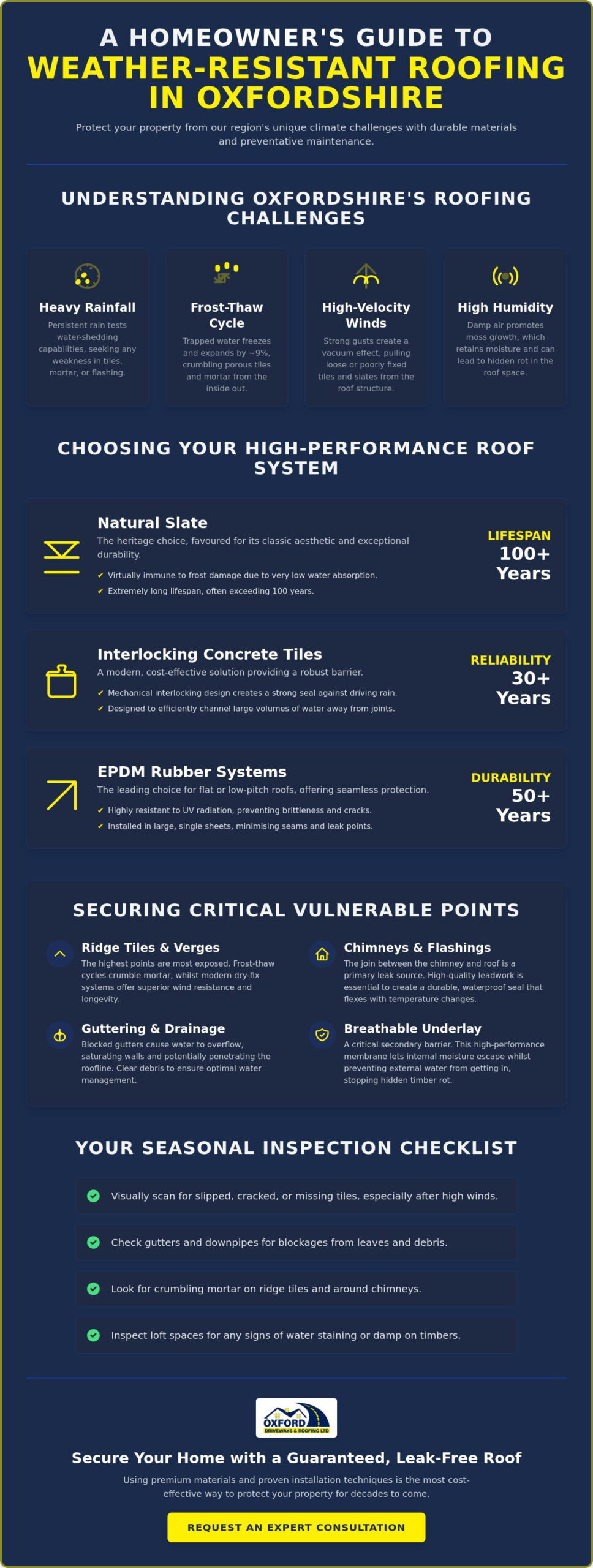
Weather resistance isn’t just about keeping the rain out; it’s a comprehensive performance standard. Truly weather resistant roofing Oxford homeowners can rely on must withstand a diverse range of environmental pressures, including heavy rainfall, high-velocity winds, intense UV exposure, and biting frost. In our region, the challenges are particularly nuanced. High humidity levels and persistently damp winters mean that moisture doesn’t just fall from the sky; it hangs in the air, seeking out any porous surface or hairline crack.
A robust system relies on more than just the visible outer layer. Modern installations include a high-performance breathable underlay. This membrane allows internal moisture from the home to escape whilst preventing external water ingress. Without this balanced system, condensation can build up within the roof space, leading to hidden timber rot. When choosing between various commercially available roofing materials, it’s vital to consider how each component interacts to create a stable environment. Taking a preventative approach to weatherproofing is always more cost-effective than waiting for a leak to appear. Small maintenance tasks today prevent the structural damage and high costs associated with reactive emergency repairs tomorrow.
The Impact of Oxfordshire’s Frost-Thaw Cycle
In Oxford’s city centre, many properties feature beautiful but porous heritage bricks and traditional mortar. These materials are particularly susceptible to the frost-thaw cycle. When water penetrates these surfaces during a wet afternoon and then freezes overnight, it expands by approximately 9%. This internal pressure causes tiles to delaminate and mortar to crumble. Over several winters, this process significantly weakens the roof’s integrity. The frost-thaw cycle is a primary cause of ridge tile failure in the UK, often leading to loose components that pose a safety risk during high winds.
Wind Uplift and Storm Protection
Homes in more exposed areas like Faringdon or the higher ground around Abingdon face significant wind uplift. This occurs when high-speed air creates a vacuum effect, literally pulling loose slates or tiles away from the rafters. To counter this, modern weather resistant roofing Oxford standards prioritise mechanical fixing. Unlike older methods that relied solely on the weight of the tile or brittle mortar, mechanical fixings secure every element directly to the structure. We also recommend dry-verge systems, which provide a neat, mortar-free finish to the roof edges. These systems offer superior resistance to wind gusts and prevent pests from nesting in the roofline, ensuring your home remains secure during the most turbulent Oxfordshire storms.
High-Performance Materials for Durable Roofing Systems
Selecting the right materials is the cornerstone of weather resistant roofing Oxford properties require for long-term security. Whilst much of our focus is often on rain and frost, your roof must also withstand the intense UV radiation of hot UK summers. Materials that lack UV stability can become brittle and crack over time, leading to unexpected failures during the following winter. High-quality leadwork remains the industry standard for protecting valleys and chimney flashings because of its exceptional durability and ability to expand and contract without losing its integrity. Using these proven materials ensures a stable barrier that protects your home from the top down.
Slate and Tile: The Pitched Roof Standard
Natural slate is often favoured by homeowners in heritage areas because of its incredibly low water absorption rate. This characteristic makes it virtually immune to frost damage, as there is very little moisture within the stone to expand when temperatures drop. Alternatively, clay tiles provide a classic aesthetic whilst offering excellent water-shedding properties that improve with age. For many modern homes, interlocking concrete tiles provide a robust barrier against driving rain by creating a mechanical seal between each unit. These tiles are designed to channel water away from the joints even during heavy storms. High-quality roofing materials must be paired with correct overlap measurements to ensure water runoff. Adhering to professional standards, such as those outlined in the guidance for Health and safety in roof work, ensures that these heavy materials are installed securely and correctly.
Modern Flat Roof Waterproofing
Flat roofing technology has advanced significantly, moving away from traditional felt to more resilient systems. GRP fibreglass is a popular choice for extensions and garages because it creates a completely seamless, cold-applied surface that eliminates the risk of joint failure. It is incredibly tough and can easily withstand light foot traffic. When looking for weather resistant roofing Oxford solutions for flat structures, EPDM rubber is a favourite amongst professionals due to its remarkable flexibility. It can stretch and return to its original shape as the building naturally settles or as temperatures fluctuate between seasons. With a lifespan often reaching up to 50 years, it represents a significant upgrade over older systems. You can find more detail on these systems in our guide to flat roof waterproofing Oxford.
If you’re considering a more permanent solution for your property, our team specialises in new roof installation using these high-performance materials to ensure your home remains protected for decades.
Securing the Vulnerable Points: Ridges, Chimneys, and Guttering
A truly robust roof is only as strong as its weakest joint. Whilst we have explored the durability of primary materials like slate and EPDM, the real test of weather resistant roofing Oxford homes face is at the junctions. The roofline and the ridge serve as the first line of defence against wind uplift and driving rain. If these areas are compromised, even the highest quality tiles cannot prevent water from reaching your timber rafters. Maintaining these vulnerable points is essential for long-term property protection and structural stability.
Ridge Tile and Chimney Maintenance
In older parts of the city, such as Botley or the historic centre, many roofs still rely on traditional mortar bedding to secure ridge tiles. Over time, the frost-thaw cycle causes this mortar to crack and fall away, leaving the apex of your home exposed. We often recommend a transition to modern dry-fix ridge systems. These systems provide a mechanical bond that does not perish or crack, ensuring your ridge tiles remain secure during heavy storms. This upgrade is a key part of adhering to UK building regulations for roofing, which prioritise structural integrity and moisture resistance.
Chimneys represent another common source of internal damp. When the mortar between bricks fails, water seeps into the stack and travels down into the living spaces, causing unsightly stains and structural rot. In many cases, professional chimney rebuilding is the only way to restore a watertight seal for older Oxfordshire properties. Timely ridge tile replacement and chimney care seal the very peak of your home, stopping leaks before they can damage your ceiling joists.
The Importance of Efficient Guttering and Downpipes
Water management does not end at the tiles. Efficient guttering and downpipes are critical for directing thousands of litres of rainwater away from your home’s foundations. If your gutters are blocked by autumn leaves or have developed sagging joints, water will spill onto the external masonry. This constant saturation leads to penetrating damp and can eventually undermine the building’s walls. Choosing the right system is vital for total exterior protection:
- Seamless aluminium: Eliminates the joints where most leaks occur.
- High-grade uPVC: Offers a cost-effective, UV-stable solution that resists cracking.
- Deep-flow profiles: Essential for handling the intense deluges common in recent UK winters.
Regularly clearing debris and checking for leaks ensures your drainage system functions as intended. For homeowners seeking comprehensive care, investing in property maintenance services Oxford helps identify these minor issues before they necessitate a full roof replacement. Maintaining your guttering is just as important as the tiles themselves in creating a weather-resistant shield for your property.
Oxfordshire Homeowner Checklist: Preparing for Winter
Proactive care is the most effective way to maintain the weather resistant roofing Oxford properties need to survive a harsh winter. As the “shoulder seasons” of autumn and spring arrive, taking a small amount of time to assess your property can prevent a minor issue from becoming a mid-winter crisis. We recommend a methodical approach to this inspection to ensure no detail is overlooked.
- Ground-level visual check: Use binoculars to inspect the roofline from the pavement. Look for slipped slates, crooked tiles, or gaps in the ridge line that suggest mortar failure.
- Guttering and downpipes: Clear away autumn leaves and moss that have accumulated. Blocked drainage causes water to pool, which can lead to ice dams and heavy pressure on the fascia boards.
- Flashings and seals: Pay close attention to the leadwork around chimneys and skylights. These should be flush against the surface without any lifting or visible cracks.
- The loft test: Head into the attic on a bright day. If you can see pinpricks of light, water will eventually find its way in. Check for dark water staining on the felt or timber rafters.
- Age assessment: If your roof is over 20 years old, it is approaching a point where materials like traditional felt or older concrete tiles may begin to perish. Organising a professional survey provides a clear picture of the remaining lifespan.
Spotting Early Signs of Roof Damp
Early-stage damp often reveals itself through a distinct musty smell in the loft space before any visible drips appear. You might notice that the insulation feels slightly heavy or that condensation is forming on the underside of the roof deck. It is important to distinguish between a minor leak caused by a single slipped tile and systemic issues that might require professional roof damp proofing services intervention. For those with extensions, check for “spongy” sections on flat roofs. A healthy EPDM or GRP surface should feel firm underfoot; any give or “bouncing” suggests that water has bypassed the waterproof layer and is rotting the timber deck beneath.
When to Call a Professional
Whilst cleaning your own gutters is a standard maintenance task, structural roofing work is inherently dangerous and requires specialist equipment. DIY attempts often lead to further damage, such as cracked tiles caused by incorrect ladder placement. A professional brings the expertise to identify the root cause of a problem rather than just treating the symptom. A guaranteed repair offers far better value than a temporary “patch” job that may fail during the next heavy storm. Investing in skilled intervention ensures your home remains a stable, secure environment.
If you have noticed any of these warning signs during your inspection, our team can provide a thorough new roof installation or repair service to restore your property’s integrity before the weather turns.
Expert Weather Resistant Roofing with Oxford Driveways and Roofing
At Oxford Driveways And Roofing Ltd., we don’t believe in temporary fixes that merely mask underlying issues. Our philosophy centres on providing a permanent shield for your property through a combination of premium materials and time-tested installation techniques. We understand that your home is your most significant investment, and ensuring it is protected by high-quality weather resistant roofing Oxford homeowners can trust is our primary mission. Our approach is built on transparency and precision, ensuring that every project meets the highest industry standards for durability and safety.
We provide a comprehensive range of services designed to address every aspect of your roof’s health. Whether you’re facing an urgent repair after a storm or planning a complete flat roof installation Oxfordshire, our team brings a steady, reliable hand to the task. We remain dedicated to serving homeowners across Oxford, Abingdon, and Swindon, offering the local expertise needed to navigate the specific environmental challenges of our region.
Our Commitment to Quality and Durability
Selecting materials is a task we take incredibly seriously. We don’t just pick off-the-shelf solutions; we choose components specifically for their ability to handle Oxfordshire’s humidity and temperature swings. Our installation process is methodical and thorough, walking through each stage from the initial inspection to the final seal. This disciplined approach ensures that every layer, from the breathable membrane to the final ridge tile, is perfectly aligned and secured for maximum longevity. This attention to detail extends beyond the roofline. As block paving specialists Oxford residents rely on, we can coordinate your roofing project with other exterior improvements, ensuring a consistent standard of craftsmanship and a safe, guaranteed outcome across your entire property.
Securing Your Property for the Long Term
Providing peace of mind is at the heart of our service. We know that the fear of a failing roof can be a significant source of stress, especially during the wettest months of the year. That’s why we offer fully guaranteed installations that provide long-term security and protect your home’s value. By choosing a professional team that prioritises stability and proven methods, you’re investing in the future of your home. A secure roof is the foundation of a stable property, acting as the primary guard against the elements.
Don’t wait for a minor leak to become a costly disaster. Protect your favourite investment with a roof designed for ultimate durability. We invite you to contact our team today for a professional assessment and a detailed quote tailored to your property’s specific needs. Let us help you achieve a leak-free home and the peace of mind you deserve.
Secure Your Home Against the Oxfordshire Elements
Protecting your property from our unpredictable local climate requires a proactive approach and a commitment to quality. We’ve explored how specific challenges like the frost-thaw cycle can undermine traditional mortar; whilst modern materials like EPDM rubber and natural slate provide the durability needed for the long term. Achieving weather resistant roofing Oxford homeowners can rely on involves more than just a surface fix; it’s about securing every ridge tile, chimney, and guttering joint to create a unified shield against the damp.
By focusing on preventative care and professional installation, you ensure your home remains dry and maintains its value for decades. As local Oxford experts since our inception, we use only premium-grade weatherproofing materials to deliver results that stand up to the heaviest storms. All our workmanship is fully guaranteed, providing you with the peace of mind that your investment is in safe hands. We invite you to Contact Oxford Driveways and Roofing for a Free Weather-Resistance Assessment today. Taking this step now ensures your home is prepared for whatever the Oxfordshire weather brings next.
Frequently Asked Questions
What is the most weather-resistant roofing material for an Oxford home?
Natural slate and EPDM rubber are widely considered the most durable options for our local climate. Natural slate is favoured for pitched roofs due to its exceptionally low water absorption rate, which makes it virtually immune to frost damage. For flat structures, EPDM rubber provides a seamless, flexible barrier that can withstand extreme temperature fluctuations without cracking or perishing. Both materials are excellent choices for weather resistant roofing Oxford homeowners can rely on for several decades.
How often should I have my roof inspected for weather resistance?
We recommend a professional inspection at least once a year, ideally during the autumn months. This timing allows you to identify and repair minor issues, such as slipped tiles or blocked guttering, before the heavy rain and frost of winter arrive. Regular assessments are a proactive way to ensure your property remains watertight and to avoid the high costs associated with emergency structural repairs.
Can a flat roof really be 100% waterproof in heavy British rain?
Modern flat roofing systems are completely impermeable when installed to professional standards. Systems like GRP fibreglass and EPDM rubber eliminate the vulnerable joints found in traditional felt, creating a single, seamless waterproof skin. When these systems are installed with the correct “fall” to ensure water runs off into the guttering, they provide a reliable defence against even the most intense UK downpours.
What are the signs that my chimney needs rebuilding due to weather damage?
Visible signs include “spalling,” where the brick faces begin to flake off, or white salt deposits known as efflorescence on the masonry. If you notice damp patches on the internal chimney breast or find chunks of mortar in your gutters, the stack’s structural integrity is likely compromised. In these cases, chimney rebuilding is often necessary to restore a permanent, watertight seal and prevent further internal damp issues.
How much does it cost to make a roof weather-resistant in Oxfordshire?
The total investment varies significantly based on the size of the roof, the complexity of the structure, and the materials you choose. Whilst premium options like natural slate or high-performance rubber systems require a higher initial outlay, their longevity often makes them the most cost-effective choice over forty or fifty years. We suggest a professional survey to provide an accurate assessment based on your property’s specific requirements.
Is ridge tile replacement necessary if I don’t have a leak yet?
Replacing ridge tiles is a vital safety measure if the original mortar is cracking or missing, even if you haven’t noticed a leak. Cracked mortar allows wind to get beneath the tiles, creating an uplift effect that can blow tiles off during a storm. Transitioning to a modern dry-fix system provides a mechanical bond that stays secure regardless of the weather, preventing both water ingress and potential property damage.
How does damp proofing for walls relate to my roofing system?
Your roofing and guttering systems act as the primary shield that keeps your external walls dry. If water spills from blocked gutters or seeps through porous tiles, it can saturate the masonry and eventually overwhelm your internal damp proofing layers. A robust roof ensures that moisture is directed away from the building, allowing your damp proof course to function effectively without being bypassed by external saturation. For a deeper understanding of how moisture infiltrates through the roof structure itself, our guide to roof damp proofing services in Oxfordshire explains the key differences between penetrating damp and condensation.
Will a new roof improve my home’s energy efficiency during winter?
A new roof installation significantly improves thermal retention by incorporating high-performance insulation and breathable membranes. Modern systems must comply with Building Regulations Part L, which sets strict standards for energy efficiency and air-tightness. By reducing the amount of heat that escapes through the top of your home, you’ll enjoy a more comfortable living environment and lower energy bills during the coldest months.