
How many times can you patch a leaking seam before the repair itself becomes a wasted investment? For many homeowners across Oxfordshire, the sound of rain against a flat extension often brings a sense of anxiety rather than comfort. Identifying exactly when to replace a flat roof is the difference between a secure, energy-efficient home and a mounting series of expensive, temporary fixes that fail to address the underlying structural risks.
We understand the stress of recurring leaks and the confusion surrounding modern roofing materials. This guide identifies the critical warning signs of total failure and explains why choosing a full replacement is often the most professional path to a leak-free home. You will learn how high-performance systems like EPDM and GRP can transform your property’s thermal efficiency whilst meeting the 2026 building regulations. We’ll walk you through the decision-making process to ensure you choose the best material for your budget and secure a long-term guarantee for your peace of mind.
Key Takeaways
- Understand the distinct lifespans of traditional felt versus modern EPDM and GRP systems to avoid the structural damage caused by long-term neglect.
- Identify the five critical warning signs that signal exactly when to replace a flat roof before minor leaks lead to significant timber rot.
- Compare the long-term value of modern materials to see how choosing the right system can improve thermal efficiency and lower your home’s maintenance costs.
- Apply the ‘25% Rule’ to determine if a repair is a sensible fix or if a full replacement provides better long-term security for your budget.
- Learn why a professional site survey is vital for compliance with 2026 building regulations and securing a comprehensive installation guarantee.
Understanding the Lifespan of Modern Flat Roof Systems
A home’s roof acts as its primary shield against the elements, yet the flat portions of a property are frequently overlooked until water begins to drip into the living space. Understanding the expected longevity of your installation is the first step in deciding when to replace a flat roof before the underlying timber structure suffers irreversible damage. Whilst many homeowners assume a flat roof is a permanent fixture, every material has a finite service life dictated by its chemical composition and the environmental stresses it endures. Ignoring these timelines often leads to “out of sight, out of mind” neglect, which can result in saturated insulation and costly joist rot.
Average Lifespans by Material Type
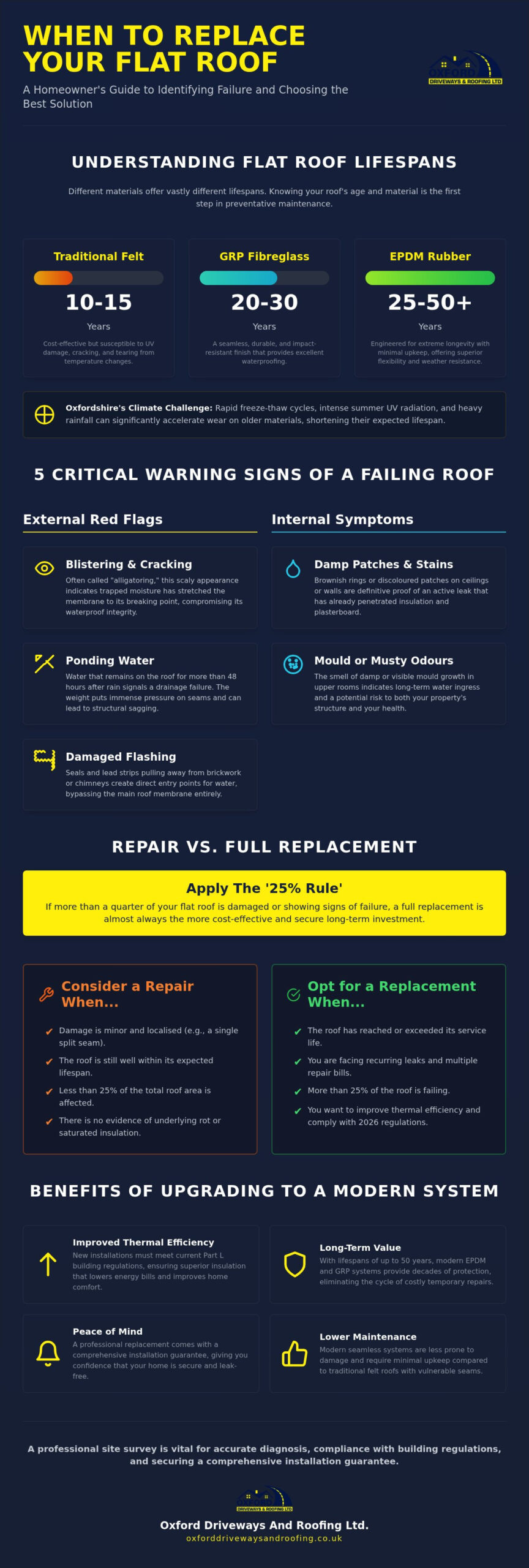
Different systems offer varying levels of durability, and knowing which one you have is vital for maintenance planning. Traditional bitumen felt, whilst cost-effective, typically offers 10 to 15 years of reliable service before the layers begin to separate or crack. In contrast, modern EPDM rubber membranes are engineered for extreme longevity, often providing 25 to 50 years of protection with minimal upkeep. GRP fibreglass systems provide a seamless, impact-resistant finish with an expected lifespan of 20 to 30 years. Identifying when to replace a flat roof often starts with checking the age of these materials against these industry benchmarks.
How Oxfordshire Weather Accelerates Wear
The local climate in the Thames Valley presents unique challenges that can shorten these expected timelines. Oxfordshire often experiences rapid temperature fluctuations where heavy frosts are followed by quick thaws. This cycle causes older felt membranes to expand and contract violently, leading to split seams and surface “alligatoring.”
- UV Degradation: During hotter UK summers, older membranes suffer from intense UV exposure, which turns once-flexible bitumen brittle and prone to snapping.
- Organic Growth: Amongst the damp, shaded areas common in Oxford and Abingdon, moss and lichen growth can take hold. These organisms retain moisture against the roof surface, accelerating the breakdown of the protective mineral layer.
- Standing Water: The heavy rainfall patterns seen in recent years can lead to “ponding,” where water sits for more than 48 hours, putting immense hydraulic pressure on ageing seams.
With the 2026 building standards prioritising thermal efficiency, a failing roof is no longer just a structural concern; it’s a financial drain. Upgrading to a modern system isn’t just about stopping a leak. It’s about ensuring your home remains energy-efficient and compliant with current Part L regulations, which require significantly better insulation values than those found in older installations.
5 Critical Warning Signs Your Flat Roof is Failing
Identifying the exact moment a roof transitions from “aged” to “failed” is vital for preventing permanent structural damage to your property. Whilst some issues are merely cosmetic, others indicate that the core integrity of the building is at risk. Recognising these indicators helps homeowners decide when to replace a flat roof before a minor drip evolves into a major renovation project. Professional assessment often reveals that surface-level symptoms are actually the result of deep-seated failures within the roof’s core layers.
External Red Flags: Blistering, Cracking, and Ponding
The most visible indicators of failure occur on the external surface. Blistering, often referred to as “alligatoring” due to the cracked, scaly appearance of the bitumen, occurs when moisture becomes trapped beneath the membrane. As the sun heats the roof, this moisture expands, stretching the material until it loses its waterproof properties and begins to split. Once these cracks appear, the membrane’s ability to protect the timber deck is compromised.
Ponding is another significant concern for homeowners. If you notice standing water that remains on the surface for more than 48 hours after rainfall, your roof’s drainage or structural fall has failed. This isn’t just a nuisance; the weight of the water puts immense hydraulic pressure on the seams and can lead to joist deflection. Additionally, keep a close eye on the flashing around the edges. If the seals or lead strips are pulling away from the brickwork, water will inevitably find its way behind the membrane during the next Oxfordshire downpour.
Internal Symptoms: Damp Patches and Mould
Often, the most serious damage happens where you cannot see it. Brown rings or damp patches on your ceiling are the first signs of an active leak that has already bypassed the insulation. If you notice a persistent musty odour in an upstairs room or extension, it’s likely that your insulation is saturated. Once insulation becomes wet, it loses its thermal properties and creates a breeding ground for mould, which can affect the air quality within your home.
A sagging ceiling is the most urgent warning sign of all. This suggests that the structural timber joists have weakened due to prolonged moisture exposure and may no longer be safe. At this stage, determining when to replace a flat roof becomes a matter of safety rather than just maintenance. If you are noticing these signs, arranging a professional roofing survey can provide the clarity needed to decide between a targeted repair and a full system upgrade.
Local environmental factors amongst the leafy areas of Oxford and Abingdon also play a role. Blocked guttering and downpipes are common culprits for accelerated decay. When debris prevents water from escaping, it backs up onto the flat surface, soaking the fascia boards and finding gaps in the roof’s perimeter that would otherwise remain dry.
Modern Flat Roofing Materials: EPDM, GRP, and Felt
Once you have identified the warning signs discussed earlier, the next step in deciding when to replace a flat roof involves selecting a material that aligns with your property’s specific requirements. Modern roofing technology has advanced significantly, moving away from the fragile membranes of previous decades toward high-performance systems engineered for longevity. Selecting the right system for a flat roof installation Oxfordshire homeowners can trust requires an understanding of how each material performs under the unique environmental stresses of the Thames Valley.
EPDM Rubber vs GRP Fibreglass
EPDM (Ethylene Propylene Diene Monomer) has become a “fit and forget” favourite amongst professionals due to its extreme flexibility. Because it is a synthetic rubber, it can stretch and contract without cracking, which is a vital attribute for managing Oxfordshire’s rapid temperature shifts. Research indicates that properly installed EPDM membranes have an expected service life of 38 years, with some installations lasting up to 50 years. It is cold-applied, meaning there is no need for open flames during the installation process, making it a safe and efficient choice for residential extensions.
GRP (Glass Reinforced Plastic), commonly known as fibreglass, offers a different set of advantages. It creates a completely seamless, high-strength surface that is incredibly resistant to physical impact. This makes GRP the ideal choice for areas that experience foot traffic, such as balconies or roofs used for maintenance access. Whilst it typically has a service life of 20 to 30 years, its aesthetic appeal and variety of colour finishes make it a popular option for modern architectural designs. However, GRP requires a strictly dry installation window to allow the resins to cure correctly, making professional timing essential.
Advanced Multi-Layer Felt Systems
You shouldn’t confuse modern felt with the thin, brittle versions used in the 1990s. Today’s high-performance “torch-on” felt systems consist of three distinct layers of bitumen reinforced with polyester. These layers are fused together to create a robust, thick barrier that is far more resilient to UV degradation than its predecessors. Whilst EPDM and GRP are often favoured for primary living spaces, modern felt remains a highly cost-effective and reliable choice for outbuildings, garages, and sheds. It provides a dependable 15-year lifespan when installed by specialists who understand the precision required for heat-welded seams.
The total “cost per year” of your roof is heavily dictated by this material choice. Whilst a traditional felt roof may have a lower initial outlay, the 50-year potential of an EPDM system often provides better long-term value for a family home. Regardless of the material, professional installation is the most critical factor. High-tech membranes rely on precision detailing around chimneys, skylights, and drainage outlets to perform as intended. When these details are handled with expert skill, you ensure that your investment is protected by a long-term guarantee and remains leak-free for decades.
Repair vs Full Replacement: Calculating the Best Value
Deciding between a targeted fix and a complete overhaul is often a matter of financial logic rather than just structural necessity. A professional guideline frequently used by specialists is the ‘25% Rule’. If the cost of a temporary repair exceeds one quarter of the price of a total system upgrade, it is usually more sensible to opt for the latter. Identifying when to replace a flat roof involves looking beyond the surface membrane and assessing the health of the timber deck and joists beneath. If water has been seeping through for months, the structural integrity of the wood may be compromised, making a simple patch both ineffective and potentially dangerous.
The Hidden Costs of Recurring Repairs
Homeowners often fall into the trap of “patchwork” maintenance, where a series of small fixes are applied over several years. Whilst a single call-out might seem affordable, the cumulative cost of multiple repairs often approaches the investment required for a new, guaranteed installation. This approach also creates a “false economy” because every failed patch increases the risk of internal ceiling damage and saturated insulation. Beyond basic protection, a modern, professionally installed roof adds immediate kerb appeal and resale value. If you are planning to sell your property in the future, a certified, high-performance system provides a significant advantage during the home survey process, offering the buyer peace of mind that the property is structurally sound.
Energy Efficiency and Building Regulations (Part L)
One of the most compelling reasons to choose a full replacement in 2026 is the significant improvement in thermal performance. Under current Building Regulations, specifically Part L, approval is required when replacing more than 25% of a roof area. This trigger necessitates an upgrade to modern insulation standards to achieve a U-value of 0.15 W/m²K for new elements or 0.16 W/m²K for renovated ones. By opting for a ‘warm roof’ configuration, where high-performance rigid PIR boards are installed on top of the timber deck, you can dramatically reduce heat loss and lower your monthly energy bills.
Ensuring your project complies with Oxford City Council building control is a standard part of a professional installation. This legal compliance is vital for the long-term stability of your home’s value. To receive a clear, expert assessment of your property’s specific needs and a breakdown of the most cost-effective path forward, you can book a professional flat roof survey today. This step replaces guesswork with a disciplined, technical evaluation of your roof’s condition.
Choosing a Professional Flat Roof Specialist in Oxford
Selecting the right contractor is as vital as choosing the correct material. A local roofing repairs Oxfordshire expert brings a deep understanding of regional architecture, from the period extensions in North Oxford to the modern developments in Abingdon. Determining exactly when to replace a flat roof requires more than a casual glance from the ground or a “satellite quote” based on aerial photography. A reliable specialist will always insist on a physical site survey to assess the nuances of your property’s structural health and drainage requirements.
What to Expect During a Professional Survey
A thorough inspection goes beneath the surface membrane to identify hidden issues that could compromise a new installation. We use core sampling to examine the existing layers, checking for trapped moisture or failed insulation that might not be visible from above. This process also allows for a detailed structural timber assessment. Identifying joist rot before work begins prevents unexpected costs and ensures the new system is built on a stable foundation. Finally, a professional drainage analysis identifies whether the roof’s “fall” needs adjusting to prevent the ponding issues mentioned in previous sections, ensuring water is directed efficiently toward the guttering.
This technical data is the only reliable way to confirm when to replace a flat roof. Without a physical core sample, a contractor is simply guessing at the condition of your roof deck, which can lead to structural failure even with a brand-new membrane.
Guaranteeing Peace of Mind with Quality Materials
At Oxford Driveways And Roofing Ltd, we prioritise the use of premium-grade membranes specifically engineered for the Oxfordshire climate. These materials are chosen for their ability to withstand rapid temperature shifts and heavy rainfall whilst maintaining their flexibility. A “20-year warranty” is only as strong as the firm that provides it; choosing a local, established specialist ensures that you have a reliable point of contact for future maintenance or inspections. When reviewing your options, ensure your written quotation includes a comprehensive final checklist:
- Detailed breakdown of the chosen membrane and insulation thickness.
- Confirmation of Building Regulations (Part L) compliance.
- Specific plans for improving drainage falls and guttering outlets.
- A clear, long-term guarantee covering both materials and workmanship.
- Waste disposal and site clearance procedures.
Our approach at Oxford Driveways And Roofing Ltd is built on transparency and technical precision. We act as a steady guide through the entire process, from the initial core sample to the final seal. By combining proven methods with high-quality descriptors of craftsmanship, we ensure that your property maintenance is handled with the skill and care it deserves, providing a safe and guaranteed outcome for every project.
Secure Your Home’s Future with a Durable Flat Roof
Deciding when to replace a flat roof shouldn’t be a matter of guesswork or temporary patches. By identifying early warning signs like persistent ponding or internal damp, you can intervene before structural timber rot necessitates much more expensive renovations. Modern systems like EPDM and GRP offer a level of durability and thermal efficiency that far exceeds traditional felt, providing a stable, leak-free environment for decades whilst complying with the latest building standards.
At Oxford Driveways And Roofing Ltd, we bring decades of experience across Oxfordshire and Swindon to every project. We prioritise your peace of mind by using only premium-grade materials and providing fully guaranteed roofing systems that are built to last. Our methodical approach ensures that every installation is handled with precision and professional care. Book your professional flat roof survey in Oxford today to receive a thorough technical assessment of your property. We look forward to helping you protect your home with a solution that offers long-term reliability and value.
Frequently Asked Questions
How long should a flat roof last in the UK?
The lifespan of a flat roof in the UK depends heavily on the materials used and the quality of the installation. Traditional bitumen felt typically offers 10 to 15 years of service, whereas modern EPDM rubber membranes can last up to 50 years. GRP fibreglass systems generally provide between 20 and 30 years of protection. Factors such as Oxfordshire’s temperature fluctuations and regular maintenance will also influence these timelines.
Can you patch a flat roof or must it be replaced?
A single, localised puncture can often be patched if the surrounding membrane and the timber deck beneath are in good condition. However, if you are experiencing recurring leaks or if the damage covers more than 25% of the surface area, it’s usually more cost-effective to opt for a full replacement. Determining when to replace a flat roof often comes down to whether the structural integrity of the joists has been compromised by moisture.
Is ponding water on a flat roof always a sign of failure?
Standing water that remains on the surface for more than 48 hours after rainfall is a definite indicator of a drainage or structural issue. This “ponding” puts immense hydraulic pressure on the roof’s seams and can lead to the deflection of the timber joists. Whilst small puddles that evaporate quickly are common, persistent ponding suggests that the roof’s “fall” is insufficient and professional intervention is required to prevent leaks.
How much does it cost to replace a flat roof in Oxford?
The total investment for a replacement depends on several variables, including the dimensions of the roof, the choice of high-performance material, and the condition of the existing timber deck. Additionally, modern building regulations may require an upgrade to your insulation thickness, which affects the final quote. We provide detailed, written quotations following a physical site survey to ensure all structural requirements and drainage improvements are accounted for.
Do I need planning permission to replace my flat roof?
In most cases, replacing an existing flat roof does not require planning permission as it is considered a “permitted development.” However, you will likely need Building Regulations approval if you are replacing more than 25% of the roof area or making structural changes. This ensures the project meets current standards for fire safety and thermal efficiency, particularly regarding the mandatory insulation upgrades required in 2026.
What is the best material for a flat roof in 2026?
The best material depends on how you intend to use the space. EPDM rubber is widely considered the most durable “fit and forget” solution due to its extreme flexibility and 50-year potential lifespan. If the roof will be used as a balcony or requires high impact resistance for foot traffic, GRP fibreglass is often the superior choice. Both materials offer significantly better long-term value than traditional felt systems.
Can I install a flat roof myself to save money?
Whilst DIY kits are available, professional installation is strongly recommended to ensure the system is fully waterproof and compliant with local building codes. Modern membranes like GRP and EPDM require precise detailing around chimneys and edges to perform correctly. A professional installation also comes with a long-term guarantee, which is essential for protecting your home’s resale value and providing peace of mind for decades to come.
Does a new flat roof improve home insulation?
Yes, a new installation is an excellent opportunity to significantly improve your home’s thermal efficiency. By installing a ‘warm roof’ system, where rigid insulation boards are placed above the timber deck, you can eliminate cold spots and reduce heat loss. This not only makes your home more comfortable but also lowers your heating bills and ensures your property meets the 2026 Part L energy requirements.