Why does one contractor’s quote for a new surface seem like a bargain whilst another specialist insists on a significantly higher investment for the same square footage? It is a common source of stress for Oxfordshire homeowners who simply want a reliable, attractive entrance to their property. You likely recognise that a cheap installation often leads to yellowing surfaces or cracking within a few seasons, yet the wild variation in the resin driveway cost per m2 makes it difficult to budget with confidence.
We understand that peace of mind comes from transparency and technical expertise. In this guide, we provide a clear breakdown of the factors that dictate a professional 2026 installation, from the importance of UV-stable materials to essential SUDS-compliant drainage. You will discover how to identify a quality specification that protects your home from flooding and ensures your investment remains weed-free and durable for years to come. We also address the vital question of whether your existing driveway can serve as a stable base, helping you avoid the pitfalls of “cowboy” groundwork and ensuring a result that truly enhances your home’s kerb appeal.
Key Takeaways
- Understand the vital difference between resin bound and resin bonded systems to ensure your project remains SUDS-compliant and avoids potential drainage penalties.
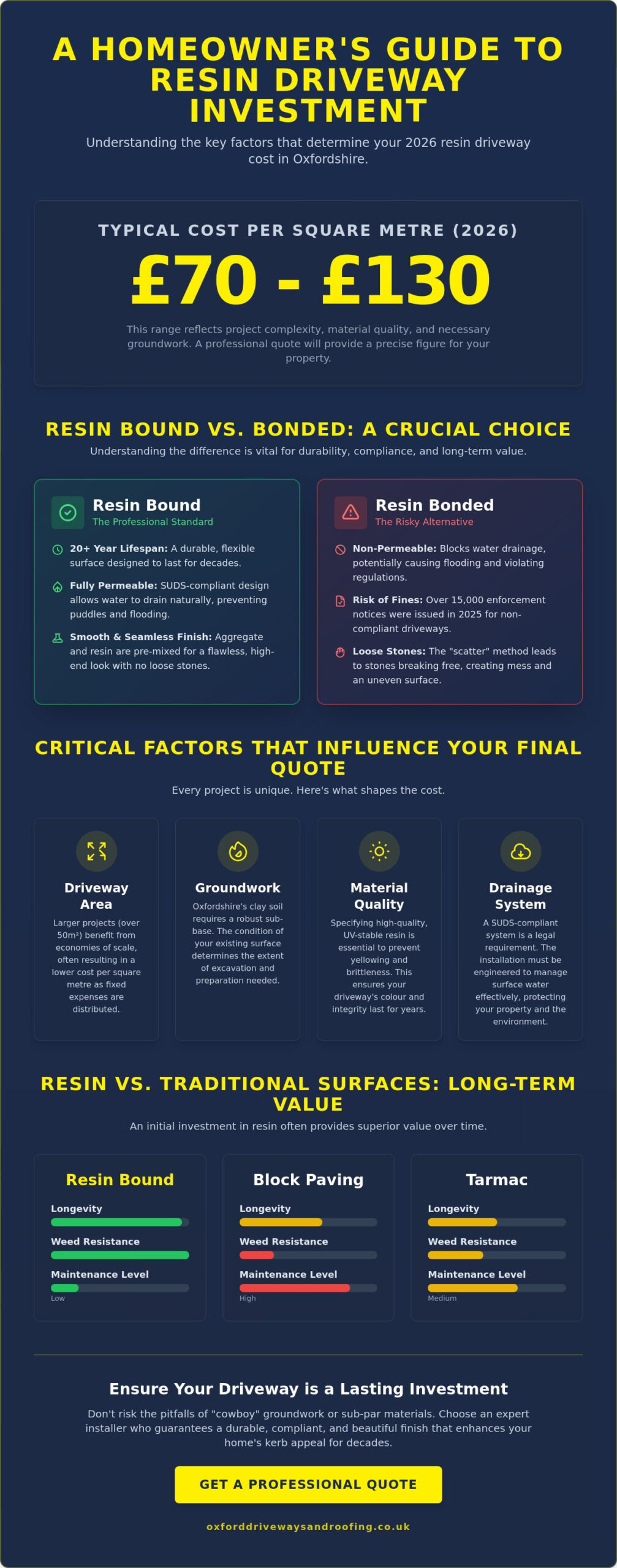
- Learn why the average resin driveway cost per m2 fluctuates between £70 and £130, and how larger Oxfordshire projects can benefit from economies of scale.
- Discover why specifying UV-stable resin and high-quality aggregates is essential to prevent your surface from yellowing or becoming brittle over time.
- Compare resin against traditional tarmac and block paving to see how reduced maintenance costs and weed resistance provide superior long-term value.
- Identify the critical red flags to watch for when selecting an installer to ensure your groundwork is engineered for lasting stability and performance.
What is a Resin Bound Driveway and Why do Costs Vary?
A resin bound driveway represents the pinnacle of modern surfacing technology, combining aesthetic beauty with high-performance durability. This system is created by mixing specialised natural aggregates with a clear polyurethane resin. This mixture is then hand-trowelled onto a prepared base to create a smooth, seamless finish. When exploring what is resin-bound paving, it’s essential to understand that the final result is a solid, permeable surface that allows water to drain naturally into the ground.
The resin driveway cost per m2 is rarely a fixed figure because every Oxfordshire property presents unique environmental challenges. In 2026, we see a clear shift towards higher-quality, UV-stable materials that prevent the unsightly yellowing often seen in older or cheaper installations. Homeowners now prioritise eco-friendly, sustainable solutions that complement the architectural character of their homes whilst providing a functional, low-maintenance space for vehicles.
Resin Bound vs. Resin Bonded: The Price Gap
One of the most frequent points of confusion for homeowners is the difference between “bound” and “bonded” systems. The primary reason for the price gap lies in the installation method and material volume. Resin bound systems involve mixing the stone and resin together before laying, which ensures every piece of aggregate is fully coated. This creates a permeable, SUDS-compliant surface that manages heavy rainfall effectively.
In contrast, resin bonded systems are a “scatter” method where resin is spread over a base and loose stones are thrown on top. Whilst this might result in a lower initial resin driveway cost per m2, it is not permeable and often leads to loose stones migrating into your home or street. In 2025, over 15,000 enforcement notices were issued to UK homeowners for driveways that did not comply with SUDS drainage regulations, highlighting the legal and financial risks of choosing non-permeable bonded systems for larger front garden areas.
Why Quality Resin is a 20-Year Investment
A professional resin installation is designed to last for decades, far outperforming traditional gravel or tarmac. The flexibility of the resin allows it to withstand temperature fluctuations without cracking, a common issue in the UK’s varied climate. Because the surface is tightly bound, it remains naturally weed-resistant and “puddle-free” during the wettest winter months. At Oxford Driveways And Roofing Ltd., we focus on the precision of the installation process to ensure your driveway remains a long-term asset. This methodical approach provides peace of mind, knowing that the structural integrity of your property’s entrance is guaranteed for years to come.
Resin Driveway Cost per m2: 2026 Price Benchmarks
Setting a realistic budget for a property renovation requires precision. For a professionally installed surface in 2026, the typical resin driveway cost per m2 ranges between £70 and £130. This variation reflects the complexity of the project, the quality of the resin used, and the specific requirements of the site. A comprehensive quote from a specialist should cover everything from the initial site preparation and skip hire to the skilled labour required for a hand-trowelled finish.
Oxfordshire homeowners face a unique environmental challenge: the prevalence of heavy clay soil. Unlike sandy or loamy ground, clay retains significant moisture and expands or contracts with the seasons. This characteristic necessitates a deeper, more robust sub-base to prevent the surface from shifting. Ensuring your sub-base is engineered correctly is vital for meeting UK sustainable drainage standards. Without this attention to local ground conditions, even the highest quality resin could eventually fail due to sub-surface instability.
Estimated Costs by Driveway Size
The total area of your project significantly influences the rate you will be quoted. Larger projects often benefit from “economies of scale,” where the fixed costs of equipment and transport are spread across a greater surface area.
- Small drives (up to 20m2): These often carry the highest cost per metre. Fixed expenses like skip hire and plant mobilisation remain the same regardless of the size, making small installations less cost-effective on a unit basis.
- Standard family drives (50m2): This size is generally considered the “sweet spot” for value. It allows for efficient material usage and labour scheduling, often resulting in a more balanced resin driveway cost per m2.
- Large estates (100m2+): Significant savings are found here. Bulk material orders and the ability for a team to work continuously over several days allow for a reduced per-metre rate.
The Impact of Existing Surfaces
The condition of your current driveway is perhaps the most significant variable in your final quote. The most cost-effective scenario involves overlaying resin onto an existing concrete or tarmac base that is in excellent structural condition. This avoids the heavy costs associated with full excavation and waste removal.
However, if your current driveway consists of loose gravel or paving slabs, these must be removed. Slabs are prone to individual movement, which would cause the resin above to crack. A full excavation and the installation of a new, stable sub-base will increase the fee but is the only way to guarantee a 20-year lifespan. If you are unsure about the condition of your current base, a professional site survey is the most reliable way to determine your specific resin bound driveway requirements.
Critical Factors That Influence Your Final Quote
While the structural base and total area provide the foundation of your estimate, the specific material choices can shift the resin driveway cost per m2 significantly. A quote that seems lower than the industry average usually indicates a compromise on the grade of resin or stone used. In 2026, the focus has moved beyond just basic functionality to long-term colour preservation and bespoke aesthetics that require a more precise technical specification. For a broader perspective on how resin compares to other options, our guide to durable driveway materials provides a comprehensive 2026 comparison for UK homeowners.
Beyond the materials, the logistical reality of your property plays a role. Oxfordshire is known for its historic architecture and narrow residential lanes, which can occasionally restrict the movement of heavy machinery or material deliveries. If our team has to manually transport aggregate over long distances from the roadside to your driveway, the additional labour time will be reflected in the final estimate. Similarly, intricate design choices such as bespoke colour blends or complex geometric patterns require a higher degree of precision and hand-trowelling time compared to a single-colour, straight-run installation.
The Importance of UV Stability in 2026
The choice between UV-stable and non-UV resin is perhaps the most critical technical decision you will make. UV-stable resin is formulated with aliphatic polyurethane, a high-grade chemical binder that remains clear even under intense sun exposure. In contrast, non-UV (aromatic) resin is a cheaper alternative that undergoes a chemical reaction when exposed to sunlight, causing the surface to turn a muddy yellow or brown colour. This process also makes the binder brittle, leading to surface cracking and stone loss. Because we prioritise longevity and kerb appeal, Oxford Driveways And Roofing Ltd. only utilise premium UV-stable resins, ensuring your driveway maintains its original colour and structural flexibility for its entire lifespan.
Edging and Finishing Touches
Because a resin bound surface is hand-laid at a depth of roughly 15mm to 18mm, it requires a solid perimeter to “butt” against. Without a firm edge, the material can fray or crack at the borders. You can choose from several functional and decorative options, including aluminium strips, timber, or natural stone. Many homeowners find that a decorative border provides the perfect finishing touch whilst reinforcing the driveway’s structure. If you are looking for inspiration on how to frame your new entrance, our Block Paving Specialists Oxford page showcases how different brick styles can create a striking contrast with a smooth resin finish. Incorporating these elements will naturally affect the resin driveway cost per m2, but the added durability and aesthetic appeal are often considered a wise investment by local property owners.
Aggregate Choice and Budget
The type of stone you select also dictates the final price. Standard aggregates like flint, quartz, and pea shingle are widely available and cost-effective. However, if you desire a premium look using crushed marble or semi-precious stones, the material costs will rise. We suggest choosing a blend that complements the local Oxfordshire stone found in your home’s masonry to create a harmonious, high-end appearance.
Resin vs. Alternatives: Is it Worth the Premium?
Choosing a new driveway involves weighing the immediate outlay against future upkeep. Whilst the initial resin driveway cost per m2 is often higher than traditional methods, the investment pays dividends through structural stability and reduced maintenance. Homeowners in Oxfordshire frequently find that the premium paid for a resin bound surface is recovered over a decade. This is largely because the material resists weeds and remains permeable, eliminating the need for expensive drainage repairs or chemical weed killers.
Beyond the day-to-day functionality, the environmental impact of your choice matters. Because resin bound systems are SUDS-compliant, they help mitigate local flood risks by allowing water to return directly to the water table. This is a significant advantage in areas of Oxford prone to heavy runoff. Additionally, a professionally finished resin driveway can add up to 10% to your home’s market value, making it as much a financial strategy as a property improvement.
Resin vs. Block Paving
Installation time for resin is typically faster than block paving, provided the weather remains dry. Whilst block paving offers a classic look, it requires regular re-sanding and is highly susceptible to weed growth between the joints. Resin provides a seamless, modern aesthetic that remains completely weed-free. If you prefer the look of traditional paving but want the benefits of resin, you can always combine the two by using blocks for decorative borders. This provides the best of both worlds: the structural integrity of resin with the timeless character of paving.
Resin vs. Tarmac
Tarmac is often viewed as a functional, budget-friendly option, but it lacks the luxury appeal of resin. In the peak of a UK summer, tarmac can soften and retain significant heat; resin stays noticeably cooler and maintains its rigid structure. With over 40 aggregate blends available, resin allows for a level of personalisation that tarmac simply cannot match. It transforms a boring black entrance into a bespoke feature that complements your home’s unique character. When you consider that resin doesn’t suffer from the “scuffing” common with tarmac, the long-term visual superiority is clear. To see how resin, tarmac, and block paving compare across longevity, weather resistance, and total value, our detailed guide on durable driveway materials for UK homeowners offers an in-depth 2026 breakdown.
If you are ready to upgrade your property’s entrance with a high-performance surface, you can contact us for a professional resin bound driveway installation tailored to your Oxford home.
Choosing an Expert Resin Installer in Oxfordshire
Selecting the right contractor is the final, most critical step in protecting your property investment. Whilst the resin driveway cost per m2 is a major consideration, the cheapest quote often masks a lack of local experience. In Oxfordshire, particularly in areas like Faringdon and Swindon where ground conditions vary between chalk and heavy clay, an installer must understand how to engineer a base that resists seasonal movement. Without this specific regional knowledge, even a high-grade surface will eventually succumb to the pressure of shifting ground and moisture retention.
Red flags are often easy to spot if you know what to look for during the consultation phase. A quote that is significantly lower than others usually points to a contractor skipping vital sub-base preparation or using inferior materials. If an installer refuses to provide a written estimate after a physical inspection or cannot demonstrate a portfolio of local work in Botley or Abingdon, it is a clear sign to proceed with caution. We recommend always verifying that your chosen specialist holds comprehensive public liability insurance and provides a clear, transparent breakdown of the work involved.
Our Local Oxfordshire Installation Process
The approach at Oxford Driveways And Roofing Ltd. is methodical and transparent, designed to alleviate the stress of property maintenance. We begin every project with a detailed site survey to assess your property’s existing drainage and sub-base integrity. This step is essential for ensuring that your new drive complies with all current UK environmental standards and building regulations. Once the technical specification is agreed upon, we organise the delivery of high-grade aggregates and premium resins specifically chosen for their durability. On the day of installation, our professional crew works with precision to ensure a seamless finish that meets our exacting standards of craftsmanship.
Secure Your Property Investment
We believe that a new driveway should provide long-term peace of mind rather than recurring maintenance headaches. This is why we offer robust guarantees that reflect our confidence in our materials and our methodical installation process. Throughout the duration of the project, our team manages all waste removal and ensures the site remains clean and safe for your family. By choosing a specialist who prioritises stability and longevity, you are ensuring that the resin driveway cost per m2 represents a true value-for-money investment in your home’s future.
If you are ready to transform your property’s entrance with a surface built to last, Contact Oxford Driveways And Roofing Ltd. for a bespoke quote today. Our team is ready to provide the expert guidance and technical skill required for a flawless installation.
Investing in a Lasting Entrance for Your Oxford Home
Investing in a high-quality surface is about more than just immediate aesthetics; it’s about ensuring structural stability for decades to come. We have explored how the resin driveway cost per m2 is influenced by the precision of the groundwork and the grade of materials selected. By prioritising UV-stable aliphatic resins and a robust sub-base specifically engineered for Oxfordshire’s unique clay soil conditions, you avoid the common pitfalls of surface cracking and unsightly discolouration.
At Oxford Driveways And Roofing Ltd., we focus on delivering peace of mind through every stage of your project. Our installations feature premium UV-stable materials as standard and are supported by our expert local knowledge of regional ground conditions. We provide fully guaranteed workmanship to ensure your property remains a source of pride for years. If you’re ready to enhance your home’s kerb appeal with a durable, weed-free finish, Get a Professional Resin Driveway Quote in Oxfordshire today. We look forward to helping you create a safe, beautiful, and lasting entrance to your home.
Frequently Asked Questions
Is planning permission required for a resin driveway in Oxford?
Planning permission is generally not required for a resin bound driveway because the surface is fully permeable. This compliance with Sustainable Urban Drainage Systems (SUDS) regulations means water drains naturally into the ground rather than overwhelming public sewers. You only need to seek council permission if your project involves installing a new dropped kerb or altering access to a public highway.
How long does a resin bound driveway actually last?
A professionally installed resin bound driveway can last up to 25 years when maintained correctly. Its longevity is rooted in the flexibility of the high-quality polyurethane binder, which allows the surface to withstand temperature fluctuations without cracking. By choosing a specialist who prioritises sub-base integrity, you ensure the installation remains a stable and durable feature of your property for decades.
Can I lay resin over my existing concrete driveway to save money?
You can overlay resin on an existing concrete or tarmac base provided the surface is structurally sound and free from significant movement. This method can help lower the initial resin driveway cost per m2 by eliminating the need for full excavation and waste disposal. We always conduct a thorough site survey to verify that your existing base is suitable for a long-term installation.
How much maintenance does a resin driveway require compared to block paving?
Resin driveways require significantly less maintenance than block paving because the seamless, hand-trowelled surface prevents weeds from taking root. Whilst block paving often needs regular re-sanding and intensive cleaning to remove moss from joints, a resin surface only needs an occasional sweep and a light power wash. This ease of care makes it an ideal choice for busy Oxfordshire homeowners.
Is resin bound surfacing slippery when wet or icy?
Resin bound surfaces are not slippery because the natural texture of the aggregate provides inherent grip for tyres and footwear. During the installation process, we often broadcast a fine layer of crushed glass or sand over the wet resin to enhance slip resistance further. Because the material is permeable, water does not sit in puddles, which significantly reduces the risk of ice patches forming in winter.
Can resin driveways be repaired if they get damaged?
Resin driveways can be repaired by carefully cutting out the affected area and infilling it with a fresh mixture of matching aggregate and resin. Whilst a skilled installer can achieve a very close match, the repair may be slightly visible depending on how much the original surface has weathered. We suggest keeping a small amount of the original stone to ensure the best possible colour consistency for future touch-ups.
How long do I need to wait before driving on a new resin surface?
You can typically walk on the new surface after 8 to 12 hours, but you should wait at least 48 hours before driving or parking vehicles on it. The exact curing time depends on the temperature and humidity levels during the installation. Giving the resin adequate time to bond ensures the surface reaches its full structural strength and prevents any indentations from heavy vehicle use.
Why is UV stability so important for my driveway quote?
UV stability is essential because it prevents the resin binder from yellowing and becoming brittle when exposed to sunlight. Investing in a higher resin driveway cost per m2 for UV-stable materials ensures your driveway retains its original colour and remains flexible over time. Without this protection, the surface will eventually crack and degrade, leading to expensive repairs that far outweigh the initial savings of cheaper resins.