Did you know that even the most expensive surface material will fail within a few years if the foundation beneath it isn’t engineered for Oxfordshire’s specific soil and weather? While many homeowners focus solely on the top layer, the secret to durable driveway materials lies in the invisible sub-base and strict drainage compliance. We understand how frustrating it is to watch a significant investment succumb to cracking tarmac, sinking blocks, or stubborn weed growth between joints. You want a surface that enhances your property’s kerb appeal whilst remaining functional for decades. It’s about more than just aesthetics; it’s about the peace of mind that comes from a stable, reliable installation.
In this guide, we’ll show you how to achieve a finish that lasts over 20 years and meets all local drainage regulations without the stress of constant maintenance. We will compare the longevity, weather resistance, and total value of resin-bound, block paving, and tarmac surfacing to help you make a confident choice for your home. By the end, you’ll understand which options provide the best protection against the elements whilst adding genuine value to your property.
Key Takeaways
- Learn how to identify durable driveway materials that can withstand Oxfordshire’s unique clay soil and the UK’s challenging frost-thaw cycles.
- Compare the structural integrity of block paving with the seamless, permeable benefits of resin-bound systems to suit your specific parking needs.
- Identify the key maintenance tasks that protect your investment and ensure your driveway remains functional and attractive for 20 years or more.
- Understand the critical role of professional groundwork and sub-base preparation in preventing common issues like sinking, cracking, and poor drainage.
- Discover how to select a material that complements your home’s architectural style whilst ensuring full compliance with local Sustainable Urban Drainage Systems (SUDS) regulations.
What Defines Durable Driveway Materials in the UK?
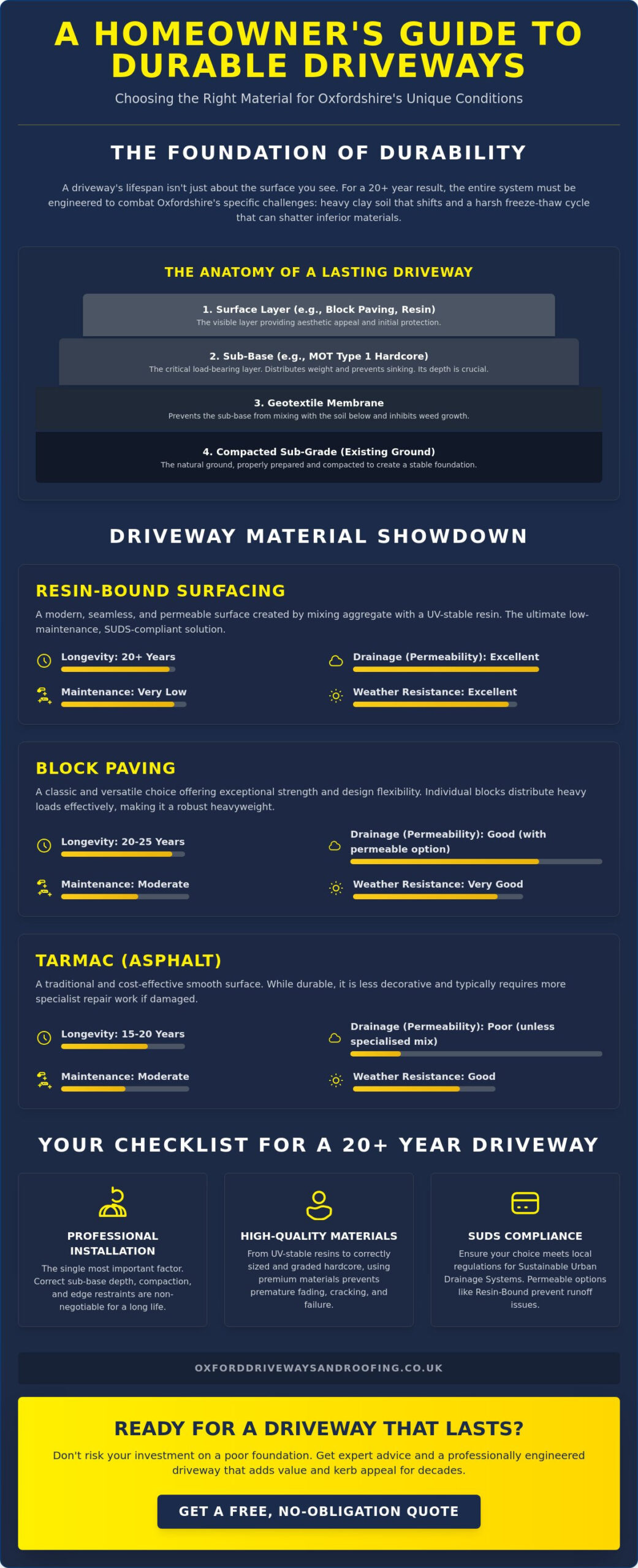
True durability isn’t just about a surface that looks good on the day of installation; it’s about a material’s capacity to withstand the relentless pressure of heavy vehicles and the volatility of the British weather. When we talk about durable driveway materials, we’re referring to a surface that maintains its structural integrity against heavy loads, UV exposure, and the cycle of temperature fluctuations. It’s a balance of strength, flexibility, and resistance to external factors like oil spills or chemical erosion that could otherwise degrade the finish.
For homeowners in Oxfordshire, the challenge is compounded by the region’s heavy clay soil. This type of ground is notorious for shifting as moisture levels change, which can cause rigid surfaces to buckle or crack if they aren’t installed with precision. Selecting the right material requires looking beyond the initial aesthetic and evaluating how a surface will behave over twenty years of use. A truly resilient driveway is a complete system where the visible surface is only as strong as the correctly engineered sub-base beneath it.
The Role of Load-Bearing Capacity
Modern family vehicles, particularly heavy SUVs and electric cars, place significant stress on a driveway. Whilst the surface material provides the finish, it’s the sub-base that performs the heavy lifting by distributing that weight across the ground. When you see a driveway “sinking,” it’s rarely the material itself that has failed; instead, the underlying foundation has shifted because it wasn’t sufficiently compacted or reinforced. Load-bearing capacity is the measure of how effectively a driveway assembly supports and distributes weight to prevent structural deformation or surface depressions over time.
Weather Resistance and the UK Climate
The UK’s climate presents a specific set of challenges, most notably the freeze-thaw cycle. During winter, water enters microscopic pores in a surface, freezes, and expands. This process can shatter inferior concrete mixes or cause poor-quality stones to flake and crumble. High-quality driveway materials must also offer UV stability to prevent the sun’s rays from making the surface brittle or causing colours to fade over time. Effective surface water management is equally vital, as consistent puddling leads to erosion and weakens the essential bond between the surface material and the sub-base. Without proper drainage and weather resistance, even the most expensive stone will eventually succumb to the elements.
Comparing the Most Durable Driveway Materials
Selecting the right surface involves weighing aesthetic appeal against long-term resilience. Whilst many options exist, only a few qualify as truly durable driveway materials capable of surviving decades of use. Each material has distinct mechanical properties that dictate its performance under stress. Understanding these differences is the first step toward a stable, long-lasting investment for your home.
Block Paving: The Versatile Heavyweight
Block paving remains a gold standard for many UK homeowners. When installed by block paving specialists Oxford, these driveways can easily achieve a 20-25 year lifespan. The individual units provide exceptional strength by distributing weight across a wide area. One of the greatest benefits is the ease of repair. If a single block is damaged by an accidental oil spill or heavy impact, it’s easily replaced without disturbing the rest of the drive. We always prioritise the use of high-quality kiln-dried sand for joint stability to ensure the blocks remain locked in place and resistant to shifting.
Resin-Bound Surfaces: Durability Meets Drainage
Resin-bound surfaces are a modern triumph of engineering. It’s vital to distinguish between resin-bound, which is permeable and durable, and resin-bonded, which is simply a thin layer of stone stuck to a base. Resin is frequently cited amongst the low maintenance driveways Oxford residents prefer because it resists weed growth and remains porous. Using UV-stable resins is a non-negotiable standard for our team. This prevents the surface from turning yellow or becoming brittle under the sun. When considering driveway materials and style, resin offers a seamless finish that complements contemporary architecture perfectly.
Tarmac and Asphalt: The Flexible Traditionalist
Tarmac is often overlooked but remains a powerhouse of durability. Modern tarmacadam mixes are designed to resist “scuffing” from power steering, a common issue with older formulations. Its inherent flexibility allows the surface to accommodate slight ground movements in clay-heavy areas without immediate cracking. It’s often the most reliable choice for steep inclines and heavy-use areas where sheer utility is the priority. If you’re unsure which surface suits your specific usage, our team can provide a professional assessment of your site’s requirements.
Concrete is another high-strength contender, though it requires expert joint placement to manage expansion and contraction. Without these precision-cut joints, the rigid nature of concrete leads to unsightly cracks during temperature shifts. Whether you choose the modular strength of block paving or the seamless flexibility of tarmac, the goal is always a surface that provides peace of mind for years to come.
The Maintenance vs. Longevity Trade-off
Investing in durable driveway materials is only the first step toward a long-lasting property entrance. Whilst we pride ourselves on the structural integrity of our installations, no surface is entirely maintenance-free. Longevity is a partnership between expert engineering and consistent, simple care. We’ve seen that neglect is the primary cause of premature failure; even the most robust materials can succumb to the elements if they aren’t looked after correctly.
A proactive approach prevents minor issues from escalating into structural damage. For example, allowing debris to accumulate on a resin surface can eventually clog the pores that facilitate drainage. Similarly, ignoring the early signs of weed growth in block paving joints can lead to significant lifting over time. By understanding the specific needs of your chosen material, you ensure that your driveway remains a stable and attractive asset for decades rather than years.
Preventing Structural Failure Through Care
Moss and algae growth are common challenges in the damp UK climate. Beyond being an eyesore, these organic growths trap moisture against the surface and create significant slip hazards. In block paving installations, the inter-lock strength of the driveway relies on the sand between the joints. If this sand is washed away or displaced by roots, the blocks lose their stability. We recommend a regular programme of re-sanding to maintain this essential bond. For many of our clients, applying a professional sealant can extend the life of the surface by up to five years, providing a protective barrier against oil stains and weather erosion.
Drainage and SuDS Compliance
Standing water is the silent killer of driveway foundations. When water pools on the surface, it eventually finds its way into the sub-base, where it can soften the ground and cause the sinking or “rutting” that ruins a driveway’s profile. This is why drainage is a legal priority. The Government guidance on permeable surfacing outlines strict rules for front gardens to prevent urban flooding. Selecting durable driveway materials like resin-bound aggregates helps you stay compliant because the surface is naturally porous. This allows rainwater to filter directly into the earth, which reduces the pressure on local Oxford drainage systems during heavy downpours and protects the underlying layers of your driveway from water-related degradation. For a deeper understanding of how to meet these requirements, our guide to permeable driveway solutions Oxford homeowners need covers SuDS compliance in full detail.
Choosing the Right Material for Your Property
Selecting the perfect surface requires a pragmatic assessment of how you live and the physical characteristics of your land. Whilst the look of your home is vital for kerb appeal, the choice of durable driveway materials must be dictated by your typical daily usage. A household with three heavy SUVs or electric vehicles requires a different structural approach than a single-car driveway. We also consider the architectural style of your home; period properties often benefit from the traditional look of block paving, whilst modern builds are perfectly complemented by the seamless finish of resin-bound systems.
Budgeting for longevity is equally important. Whilst the initial resin driveway cost per m2 may be higher than some traditional options, the minimal maintenance and 20-year lifespan often make it the most economical choice over time. It is about viewing the installation as a long-term investment in your property’s value rather than just a quick surface fix.
Topography and Sloping Drives
If your property sits on an incline, material choice becomes even more critical for safety and stability. Loose gravel is entirely unsuitable for slopes because the stones inevitably migrate to the bottom of the hill, leading to erosion and exposed patches. Hand-trowelled resin-bound surfacing provides a smooth, grippy alternative that stays exactly where it is laid. We also integrate strategic drainage channels at the base of sloping drives. This prevents water from pooling against your home or overwhelming the public highway, ensuring your installation remains compliant with local regulations.
Soil Types and Ground Stability
Oxfordshire’s heavy clay soil presents a unique engineering challenge known as “heave.” Clay expands and contracts significantly based on its moisture content, which can cause rigid driveways to shift or crack if not properly supported. To counter this, we often install a deeper sub-base than the standard 150mm to provide a more stable platform. We also utilise high-quality geo-textile membranes between the soil and the sub-base. These layers prevent the aggregates from mixing with the soft clay beneath, which is a major cause of sinking and uneven surfaces in our local area.
Our specialists can help you determine the most appropriate durable driveway materials for your specific site conditions.
Why Professional Installation is the Key to Durability
The selection of premium stone or resin is only half the battle in creating a surface that lasts. Even the most durable driveway materials will inevitably fail if the groundwork beneath them is poorly executed. We’ve seen many instances where high-quality blocks or resin have been laid on inadequate foundations, leading to rapid sinking, cracking, and water retention. At Oxford Driveways And Roofing Ltd, we believe that true craftsmanship is found in the layers you cannot see, as these provide the essential stability for everything above ground.
Our approach is rooted in the principle that professional intervention prevents costly future failures. By adhering to rigorous technical standards, we eliminate the risks associated with shifting soil and heavy vehicle use. We ensure that every project we undertake meets or exceeds British Standards for residential groundwork, providing you with a surface that remains level, stable, and attractive for decades. This commitment to precision is what transforms a standard installation into a long-term property investment.
These principles of high-quality construction are universal; for example, industry professionals such as Cascade Outdoor Services apply similar rigorous standards to hardscaping and structural outdoor projects to ensure they withstand the elements over time.
Our Proven Installation Process
Success begins with a methodical excavation. We remove the existing surface and sub-soil to a depth that ensures a solid foundation, typically increasing this depth when working with Oxfordshire’s challenging clay profiles. Once excavated, we install a high-quality sub-base consisting of MOT Type 1 crushed aggregate. This material is compacted in layers to create a dense, load-bearing platform that resists movement. Precision edging is then installed using a concrete haunching technique; this contains the durable driveway materials and prevents the lateral spreading that often causes driveways to “unravel” at the perimeter over time.
The Oxford Driveways And Roofing Guarantee
We understand that a new driveway is a significant commitment. To provide complete peace of mind, we stand by our work with comprehensive structural guarantees that reflect our confidence in our methods. Our team only utilises premium-grade components, from UV-stable resins that resist brittleness to high-strength paving blocks designed for maximum impact resistance. We don’t just aim for a beautiful finish; we aim for a guaranteed outcome that protects your home’s kerb appeal and functionality for the next twenty years and beyond. If you are ready to upgrade your property with a surface built to last, contact our Oxford driveway experts for a free quote today. Our specialists are here to guide you through the technical requirements and help you choose the most reliable solution for your home.
Investing in a Lifetime of Kerb Appeal and Stability
Selecting between resin, block paving, or tarmac is a significant decision that impacts both your property’s value and your daily convenience. We’ve explored how the longevity of your installation depends on matching durable driveway materials to your specific usage and the unique challenges of Oxfordshire’s clay soil. A stable sub-base and strict adherence to drainage regulations remain the absolute foundation of any successful project. Whilst the aesthetic finish is important, ensuring your material choice suits your home’s topography is what guarantees a surface that remains functional for decades.
As a local family-run business, we possess expert knowledge of Oxford ground conditions and the technical precision required for a lasting finish. We’re specialists in block paving, resin, and tarmac surfacing, providing fully guaranteed workmanship on every project we undertake. Our team is dedicated to alleviating the stress of property maintenance by delivering results that stand the test of time. We believe every homeowner deserves the peace of mind that comes from a high-quality, professional installation that’s built to endure.
Request a Free Quote for Your Durable Driveway in Oxford
We look forward to helping you transform your property with a surface that offers both lasting beauty and structural reliability.
Frequently Asked Questions
Which driveway material lasts the longest in the UK?
Block paving and resin-bound systems are the market leaders for longevity in the British climate. When installed with a professional sub-base, these durable driveway materials can easily exceed 25 years of service. Block paving offers the advantage of individual unit strength, whilst resin-bound provides a flexible, seamless surface that resists the cracking often seen in traditional concrete. Both options provide a stable, long-term solution for any Oxfordshire home.
What is the most cost-effective durable driveway material?
Tarmac is widely considered the most cost-effective option for homeowners seeking a balance between initial price and performance. It provides a resilient, smooth surface that handles heavy vehicle use well and is particularly efficient for surfacing larger areas. Whilst the initial investment is lower than resin, its lifespan is slightly shorter, usually requiring a refresh after 15 to 20 years to maintain its structural integrity.
Can I install a new driveway over an existing concrete surface?
You can often install a resin-bound surface over existing concrete, provided the original base is structurally sound and free from significant cracks. This “overlay” method is a popular way to update a property’s appearance without the disruption of a full excavation. However, our specialists always conduct a thorough site assessment first. We must ensure the old concrete won’t shift or heave, which could cause the new surface to fail prematurely.
Is resin-bound more durable than block paving?
Both materials offer exceptional durability, but they perform differently depending on your specific needs. Resin-bound is prized for its permeable, seamless finish and modern aesthetic, making it ideal for drainage compliance and a smooth look. Block paving is a modular system, which means it can be easily repaired if a single area is damaged. This provides a level of versatility that seamless surfaces cannot match for long-term maintenance.
How do I prevent my driveway from sinking or cracking?
The most effective way to prevent sinking or cracking is to ensure the sub-base is engineered to the correct depth using compacted MOT Type 1 aggregate. In the clay-heavy soils found across Oxford, we often recommend a deeper foundation and the use of geo-textile membranes. These professional techniques ensure the weight of your vehicles is distributed evenly, protecting the durable driveway materials from structural failure and uneven settlement.
Do I need planning permission for a new durable driveway?
You generally don’t need planning permission if you use permeable surfacing or if rainwater is directed to a lawn or border to drain naturally. The “5 Square Metre Rule” states that planning permission is required for laying traditional, impermeable driveways larger than five square metres that do not have a provision for water to run to a permeable area. Using porous resin-bound systems is a reliable way to ensure full compliance with these regulations.
What is the best material for a sloping driveway in Oxford?
Resin-bound and tarmac are the superior choices for sloping properties because they are fixed, high-grip surfaces. Unlike loose gravel, which inevitably migrates downhill and creates dangerous ruts, these materials are hand-trowelled or rolled into place to provide a stable finish. This ensures your driveway remains safe for both vehicles and pedestrians during wet or icy weather, whilst also preventing the erosion of the underlying foundation.
How often should I maintain my driveway to ensure its longevity?
We recommend a simple maintenance routine at least once a year to preserve your driveway’s structural integrity. This includes a gentle power wash to remove moss and debris, alongside a check for any displaced jointing sand in block paving. Promptly removing weeds and treating accidental oil spills prevents long-term erosion. Consistent care ensures your investment remains in peak condition for its full intended lifespan, which can add up to 10% to your property’s value.