If you’re still viewing your flat roof as just a temporary waterproof patch, you’re likely ignoring the structural and thermal performance your home actually needs in 2026. Most homeowners in the region are understandably frustrated by the cycle of ‘patch and pray’ repairs on ageing felt surfaces. It’s exhausting to deal with recurring leaks or the sight of pooling water after a typical Oxfordshire downpour. You deserve a professional solution that doesn’t require a bucket every time the weather turns.
We understand that investing in a flat roof installation Oxfordshire is about more than just staying dry; it’s about long-term peace of mind and improved thermal efficiency. In this comprehensive guide, we’ll explore the most durable materials like EPDM rubber and GRP fibreglass that offer proven lifespans of 25 to 40 years. You’ll learn how modern systems meet the latest Part L building regulations for insulation, ensuring your room stays warm whilst your energy bills stay low. We will walk you through the material benefits and local weather resilience factors to ensure your next roofing project is a permanent success.
Key Takeaways
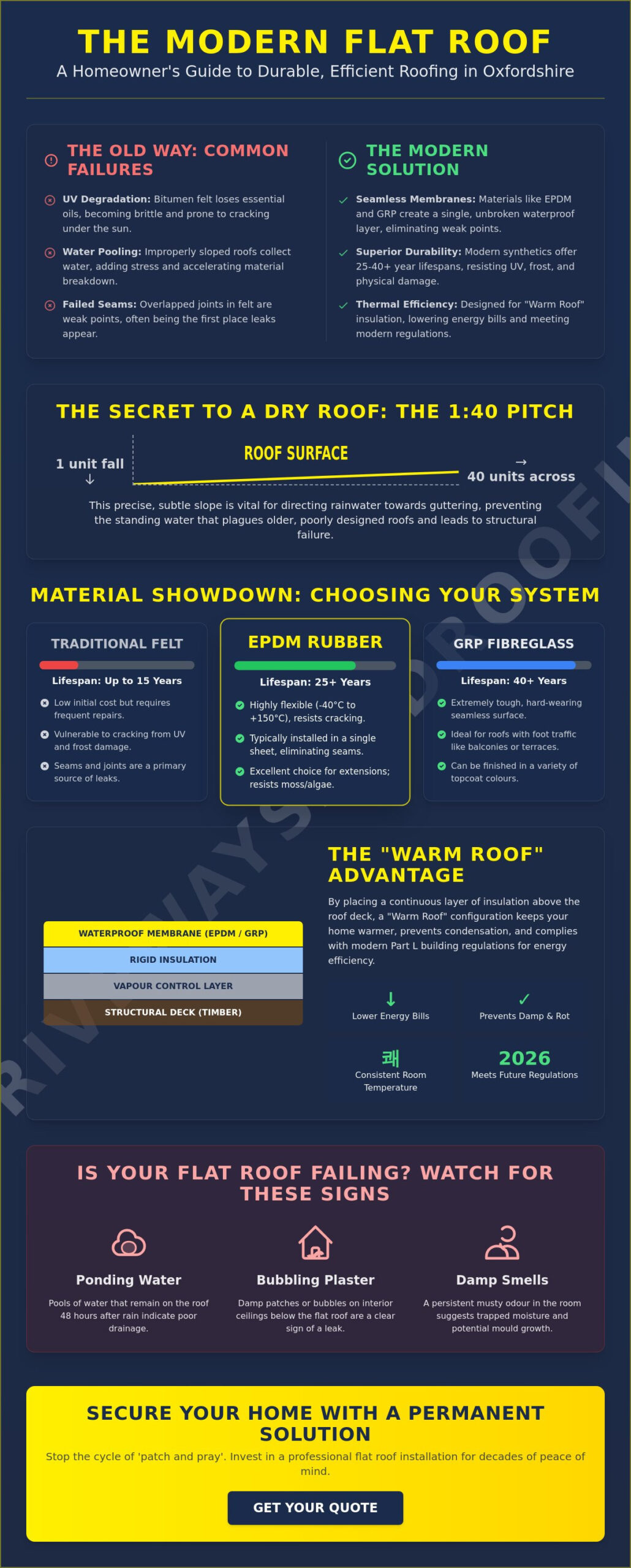
- Learn how a precise 1:40 pitch prevents water pooling and protects your home from the structural failures common in older, flatter designs.
- Compare the durability and flexibility of EPDM rubber against the hard-wearing, seamless finish of GRP fibreglass to choose the right system for your property.
- Discover how a “Warm Roof” configuration improves thermal performance and helps your home comply with the latest 2026 energy efficiency regulations.
- Understand why assessing structural decking and drainage is a vital first step for any professional flat roof installation Oxfordshire.
- Gain clarity on the shift from traditional bitumen felt to modern synthetic membranes that offer a maintenance-free lifespan of 25 years or more.
Why Modern Flat Roof Installation is Essential for Oxfordshire Homes
A flat roof isn’t actually level. It’s a common misconception that leads to significant issues if homeowners don’t understand the engineering required for a dry property. For a successful flat roof installation Oxfordshire homeowners must ensure their structure incorporates a slight pitch, typically at a ratio of 1:40. This subtle slope is vital for directing rainwater towards the guttering system, preventing the standing water that often plagues older, poorly designed roofs on kitchen extensions or garden offices across the county.
In the Thames Valley, our local climate poses specific challenges. High humidity levels and frequent frost-thaw cycles during winter can be brutal on inferior materials. When moisture gets trapped and then freezes, it expands, causing brittle materials to crack and fail. This is why we’ve seen a definitive shift away from traditional bitumen felt towards high-performance synthetic membranes that remain flexible even in sub-zero temperatures. Whether it’s a garage conversion in Abingdon or a new extension in Oxford, your roof needs to handle these environmental stresses without compromising the room below. Choosing weather resistant roofing Oxford specialists who understand these local frost-thaw cycles is essential for a long-lasting result.
The Evolution of Flat Roofing Materials
Traditional felt roofing relies on layers of bitumen that, over time, lose their oils under UV exposure. This makes the surface rigid and prone to cracking, especially amongst older properties. Modern alternatives have revolutionised the industry by introducing modern flat roof systems that use seamless or heat-welded technology. These systems eliminate the vulnerable joints where leaks typically begin, providing a much higher standard of protection. A flat roof pitch is technically defined as the slight angle of the roof surface designed to ensure gravity-fed drainage into the building’s water disposal system. By prioritising these advanced materials, we provide a solution that withstands the elements for decades rather than years.
Signs Your Current Oxfordshire Roof Needs Replacing
Identifying failure early can save you from expensive structural repairs later. Look for “ponding,” where water sits in large pools on the surface long after a downpour has stopped. If you notice bubbling plaster on your extension’s ceiling or a persistent damp smell, moisture has already breached the outer membrane. Left unaddressed, this water eventually reaches the structural timbers, leading to rot that compromises the entire roof’s safety. It’s much safer to address these issues during a planned flat roof installation Oxfordshire rather than waiting for an emergency failure that could damage your home’s interior. Understanding the full range of flat roof waterproofing Oxford options available to you is the best way to ensure these warning signs are dealt with using a permanent, high-performance solution.
Comparing the Best Flat Roofing Systems: EPDM, GRP, and Felt
Selecting the correct material for your flat roof installation Oxfordshire depends entirely on your property’s specific needs and your long-term goals. Whilst traditional materials have evolved, the introduction of high-performance synthetic membranes has changed the landscape of property maintenance. You are no longer limited to short-term fixes; instead, you can choose systems designed to last between 20 and 50 years. Matching the material to the environmental challenges of your specific site is the first step toward a leak-free investment.
EPDM Rubber: The Flexible All-Rounder
EPDM (Ethylene Propylene Diene Monomer) is a synthetic rubber membrane that has become a favourite for residential extensions. It is particularly effective for Oxfordshire homes surrounded by mature trees because the smooth surface naturally resists moss and algae growth. We prioritise a single-sheet installation process whenever possible. This approach avoids the seams and joints that are traditionally the weakest points of any roof. EPDM remains flexible from -40°C to +150°C, which means it can expand and contract during rapid temperature shifts without ever cracking or tearing. If you are looking for a reliable, low-maintenance solution, our flat roof systems provide the stability your home requires.
GRP Fibreglass: The Toughest Surface
GRP (Glass Reinforced Polyester) is frequently the preferred choice for roofs that need to double as balconies or walkways. It is a cold-applied liquid resin that cures into a single, seamless, and incredibly hard-wearing skin. Because it is so rigid, it can withstand significant foot traffic without the risk of punctures. One of the primary aesthetic advantages is the ability to choose different topcoat colours, allowing the roof to blend perfectly with traditional Oxfordshire stone or modern masonry. It’s important to note that GRP requires a completely dry installation window to cure correctly, making professional timing essential for a successful bond.
Modern Torch-on Felt: High-Performance Bitumen
Traditional felt has a reputation for failing, but modern torch-on systems are a different class of product altogether. These systems use multiple layers of bitumen reinforced with strong polyester, providing a much higher level of puncture resistance than older versions. The Bitumen Flat Roofing Association sets the standards for these installations, ensuring they provide a reliable barrier against the British weather. Whilst felt typically offers a lifespan of around 20 years, it remains a cost-effective and viable choice for garage conversions and outbuildings where a 50-year rubber membrane might be unnecessary. By choosing a high-quality bitumen system, you still benefit from modern waterproofing technology at a more accessible price point.
Thermal Efficiency: Warm Roof vs Cold Roof Standards
A modern roof acts as a thermal shield for your home, far exceeding the capabilities of the basic waterproofing layers used in decades past. When you arrange a flat roof installation Oxfordshire, the most critical decision you will make involves the placement of your insulation. This choice dictates how well your home retains heat during a Thames Valley winter and how effectively it stays cool during the increasingly hot summers we’ve seen in recent years. By upgrading your thermal performance now, you aren’t just fixing a leak; you’re future-proofing your property against rising energy costs and stricter environmental standards.
The “Warm Roof” design has become the industry standard for high-performance residential extensions. In this configuration, we place rigid insulation boards directly on top of the structural roof deck, with the waterproof membrane then applied over the insulation. This keeps the entire structure of the roof at the same temperature as the interior of your house. In contrast, a “Cold Roof” places insulation between the joists, leaving the deck exposed to external temperatures. Whilst a cold roof is often cheaper to install, it requires a mandatory 50mm ventilation gap to prevent moisture buildup. Without this precise airflow, timber rot becomes a significant risk, which is why the warm roof is almost always our recommended solution for long-term stability.
Building Regulations and Compliance
Compliance with Building Regulations is not optional for a professional flat roof installation Oxfordshire. Under Part L of the current regulations, any homeowner replacing more than 50% of a roof’s surface area is legally required to upgrade the insulation to meet modern thermal standards. For retrofits in 2026, this typically means achieving a U-value of 0.16 W/m²K. We ensure all our projects meet these criteria, which is vital for your property’s EPC rating. A higher EPC rating is a tangible asset if you ever decide to sell your home in Oxford or Abingdon, as buyers increasingly prioritise energy-efficient properties that are ready for the Future Homes Standard coming in 2027.
Energy Savings and Condensation Control
A primary benefit of the warm roof system is the total elimination of interstitial condensation. This occurs when warm, moist air from your kitchen or bathroom meets a cold surface inside the roof structure, leading to hidden mould and structural decay. By keeping the deck warm, we remove this dew point entirely. This setup also provides a perfect foundation for natural light integration. If you’re planning to install roof lanterns or skylights, the structural integrity of a warm roof ensures these features are well-insulated and leak-free. The result is a bright, comfortable living space that costs significantly less to heat and maintain over its 25-year lifespan.
Planning Your Installation: Drainage, Decking, and Weather
A successful flat roof installation Oxfordshire depends on the hidden components that sit beneath the waterproof membrane. Whilst the surface material provides the shield, the structural decking and drainage plan provide the stability. In the Thames Valley, persistent dampness and local limestone dust can accelerate the decay of older timber structures if they aren’t properly protected. We never install a new system over a failing foundation; instead, we conduct a thorough assessment of the existing joists to ensure your investment remains secure for decades.
Managing the installation timeline requires a disciplined approach to the UK’s unpredictable weather. We monitor local forecasts closely to identify dry windows for stripping and re-decking. Protecting your home’s interior is our absolute priority. By working methodically in sections, we ensure that your property remains watertight throughout the entire process, preventing any risk of internal water damage during the transition.
Structural Decking Options
We utilise OSB3 (Oriented Strand Board) as our primary decking material because it is specifically engineered to resist moisture in humid environments. During the stripping phase, it is common to find “blown” or water-damaged timber where previous leaks have saturated the wood. Identifying and replacing these compromised sections is a vital part of a professional flat roof installation Oxfordshire. Your roof must be capable of supporting significant loads, including heavy snowfall and the weight of professionals during future maintenance visits, which is why we only use premium-grade boards fixed with precision.
Optimising Drainage and Guttering
To achieve the necessary 1:40 pitch mentioned earlier in this guide, we install bespoke firring strips. These tapered lengths of timber are fixed to the joists to create a consistent fall. This ensures water moves efficiently towards your guttering solutions, preventing the ponding that leads to membrane stress and moss growth. For many Oxfordshire homes, external drainage is the most reliable option, as it keeps water entirely away from the internal structure. We often coordinate with our Oxfordshire property maintenance services to upgrade fascias and downpipes at the same time, providing a complete water management system that protects your walls from damp.
If you’re concerned about the state of your current roof deck or drainage, you can request a structural roof assessment from our local specialists to identify the best path forward for your home.
Why Choose Oxford Driveways And Roofing Ltd. for Your Flat Roof?
Selecting the right partner for your flat roof installation Oxfordshire is a decision that affects your property’s value and your daily comfort for decades. Oxford Driveways And Roofing Ltd. positions itself as a steady, reliable expert in a field where homeowners often feel overwhelmed by technical jargon and conflicting advice. Our team provides local expertise across Oxford, Abingdon, Swindon, and the wider Oxfordshire area, bringing a disciplined approach to every project. We understand that you aren’t just buying a roof; you’re investing in the long-term protection of your home and family.
Our commitment to premium-grade materials and proven installation techniques ensures that your investment is protected from the first day. Oxford Driveways And Roofing Ltd. doesn’t believe in shortcuts or temporary fixes that lead to the recurring leaks described earlier in this guide. Instead, we focus on providing fully guaranteed results that offer long-term peace of mind. This dedication to quality means your new roof will remain maintenance-free and thermally efficient for 25 years or more, regardless of what the Thames Valley weather delivers.
The Trusted Specialist Approach
Our role as a trusted specialist means Oxford Driveways And Roofing Ltd. prioritises stability over speed. We combine specific roofing expertise with a broad knowledge of property maintenance, allowing us to spot issues like chimney decay or gutter failure that others might miss. This thoroughness creates a sense of consistency across our work, from the initial inspection to the final seal. We use premium GRP and EPDM systems for maximum longevity. By focusing on these high-performance materials, we ensure your new roof remains a durable, weather-resistant asset built specifically for the Oxfordshire climate. For a broader perspective on durable material choices and preventative maintenance strategies, our guide to weather resistant roofing Oxford homeowners rely on covers everything from traditional slate to modern rubber systems.
While we focus on serving the Oxfordshire region, these high technical standards are shared by leading contractors across the country; for instance, you can learn more about I R. Wilson Roofing and their specialist approach to both flat and pitched roofing solutions.
Get Your Professional Oxfordshire Flat Roof Quote
Oxford Driveways And Roofing Ltd. believes that transparency is the only way to build lasting trust with our clients. This is why our quoting process begins with a comprehensive physical site survey rather than a vague phone estimate. We take the time to inspect your structural timbers and drainage falls, ensuring that the price we provide is final and inclusive of any necessary structural work. We don’t like surprises, and we know you don’t either. Our quotes are clear, detailed, and free from hidden costs.
For those undertaking a complete exterior transformation, we can coordinate our efforts with our block paving specialists Oxford to ensure your home’s kerb appeal matches its structural integrity. This joined-up approach simplifies the renovation process and ensures a consistent standard of craftsmanship across your entire property. You can contact the team at Oxford Driveways And Roofing Ltd. today to arrange a free, no-obligation assessment and discover how a professional flat roof installation Oxfordshire provides the ultimate peace of mind for your home.
Securing Your Property with a Lifetime Roofing Solution
Upgrading your home’s exterior is a significant step toward long-term structural stability. By choosing the correct pitch and a high-performance membrane, you move away from the stress of recurring repairs and into the security of a maintenance-free future. Whether you prioritise the flexibility of EPDM rubber or the reinforced strength of GRP fibreglass, your next flat roof installation Oxfordshire should be a permanent investment in your property’s comfort and thermal efficiency. We don’t believe in temporary fixes.
Our expert local Oxfordshire contractors are ready to guide you through every stage of the process, from structural decking assessments to final waterproofing. We combine fully guaranteed workmanship with premium grade EPDM and GRP materials to ensure your home remains dry and warm for decades. Rely on proven methods and professional standards to deliver a result that lasts. You can take the first step today by contacting our specialists for a detailed assessment of your current roof’s condition. For a deeper understanding of the systems and standards that keep your home protected, our comprehensive guide to flat roof waterproofing Oxford homeowners rely on covers everything from EPDM and GRP comparisons to the latest BS 6229:2025 regulations.
Request a Free Flat Roof Survey in Oxfordshire
Frequently Asked Questions
How long does a modern flat roof installation take in Oxfordshire?
A standard residential flat roof installation Oxfordshire typically takes between one and three working days to complete. This timeframe includes the removal of old materials, a thorough structural inspection, and the application of the new waterproof system. Whilst larger extensions or complex commercial projects may require additional time, we always prioritise leaving your property watertight and secure at the end of each working day.
What is the most durable material for a flat roof in the UK?
GRP fibreglass is widely considered the most durable material for the UK climate, often providing a lifespan of 40 years or more. Its seamless, rigid surface is incredibly resistant to physical impact and UV degradation. EPDM rubber is another highly durable alternative, offering excellent flexibility and a proven lifespan of over 30 years, making both systems superior to traditional bitumen options.
Do I need planning permission for a new flat roof in Oxford?
Most flat roof replacements fall under permitted development rights and don’t require formal planning permission in Oxford. You should, however, consult with the local council if your property is located within a conservation area or if you’re significantly increasing the roof’s height to accommodate modern insulation. All new installations must still adhere to Building Regulations regarding thermal performance and structural integrity.
Can I walk on my flat roof after a GRP fibreglass installation?
You can safely walk on a GRP fibreglass roof once the resin has fully cured. This material is specifically engineered for its strength and impact resistance, which makes it the ideal choice for balconies, walkways, or roofs that require regular access for maintenance. Its hard-wearing finish ensures that occasional foot traffic won’t compromise the waterproof seal or lead to punctures.
Is EPDM rubber roofing better than traditional felt?
EPDM rubber roofing is generally superior to traditional felt because it’s installed as a single, seamless sheet that eliminates vulnerable joints. Unlike older bitumen products, EPDM remains flexible during extreme temperature shifts and doesn’t become brittle when exposed to prolonged UV rays. This makes it a far more reliable choice for a modern flat roof installation Oxfordshire compared to traditional felt systems.
How much does a new flat roof cost per square metre in Oxfordshire?
The cost per square metre for a new flat roof depends on the material selected, the total surface area, and whether the underlying structural decking requires replacement. GRP fibreglass and EPDM rubber often require a higher initial investment than felt, but they offer significantly better long-term value due to their extended lifespans. We recommend a physical site survey to provide a precise quote tailored to your home’s specific requirements.
What is a “Warm Roof” and why is it recommended for extensions?
A “Warm Roof” is a design where the insulation is placed on top of the structural roof deck, keeping the entire structure at the same temperature as the interior. This method is highly recommended for extensions because it eliminates the risk of interstitial condensation and hidden timber rot. It provides the most efficient thermal barrier, helping to keep your living space warm in winter and cool in summer.
How do I prevent pooling water on my flat roof?
Preventing pooling water requires the installation of firring strips to create a consistent pitch of at least 1:40 towards the gutters. These tapered timber lengths ensure that gravity directs rainwater efficiently into your drainage system. If your current roof suffers from “ponding,” it’s usually an indication that the structural fall is insufficient or the decking has sagged, requiring professional correction during the re-roofing process.