
A driveway without professional edging isn’t just unfinished; it’s a structural liability that risks the long-term integrity of your entire entrance. You’ve likely noticed how some local driveways begin to “spread” or sink at the margins, often leading to stubborn weed growth and poor drainage that can eventually undermine the sub-base. It’s a common frustration for homeowners who want their property to maintain its crisp, premium appearance through every season without the constant worry of shifting stones or crumbling borders.
Selecting the right driveway edging options Oxford property owners have available is about more than just aesthetics; it’s about providing a permanent anchor for your paving whilst significantly enhancing kerb appeal. Whether you’re aiming to match the timeless character of traditional Cotswold stone or seeking a sleek, modern finish for a resin-bound surface, the right border acts as the essential “frame” for your home. In this 2026 guide, we’ll examine the most durable materials on the market, explain how precision-laid edging simplifies drainage management, and help you navigate the technical choices that ensure your driveway remains a stable, high-value asset for years to come.
Key Takeaways
- Understand how professional edging acts as a vital structural restraint to prevent lateral shift and protect your driveway’s sub-base from water damage.
- Explore the most durable driveway edging options Oxford homeowners can choose, from timeless natural stone setts to versatile concrete kerbs.
- Learn how to select materials that complement Oxford’s unique architectural heritage, including specific requirements for city centre conservation areas.
- Discover why Oxfordshire’s clay-heavy soil necessitates robust foundations and integrated drainage to ensure your borders remain level and secure.
- Gain insight into the importance of expert groundwork and precision haunching to guarantee the long-term stability of your driveway’s perimeter.
Why Driveway Edging is Essential for Oxford Properties
The longevity of a driveway depends heavily on the structural “frame” that surrounds it. In Oxfordshire, where our weather varies from heavy winter rain to dry summer spells, the ground beneath our homes is constantly in motion. Without a robust perimeter, even the most expensive surfacing will eventually fail. When exploring driveway edging options Oxford residents must prioritise stability; a well-installed edge acts as a permanent restraint that keeps every stone or resin particle exactly where it belongs. It protects the vital sub-base from water ingress, which is the leading cause of driveway collapse during the colder months when trapped moisture freezes and expands.
A professional border also serves as a critical line of defence against nature. Without a defined barrier, lawn grass and persistent weeds will naturally encroach upon your new surface, leading to root damage and a messy appearance. By choosing a high-quality edging material, you ensure a clean, maintenance-free finish that preserves the structural integrity of your investment whilst significantly increasing the perceived value of your property. It’s a simple addition that provides peace of mind, knowing your entrance is built to withstand both the elements and heavy daily use.
Structural Integrity and Preventing Lateral Shift
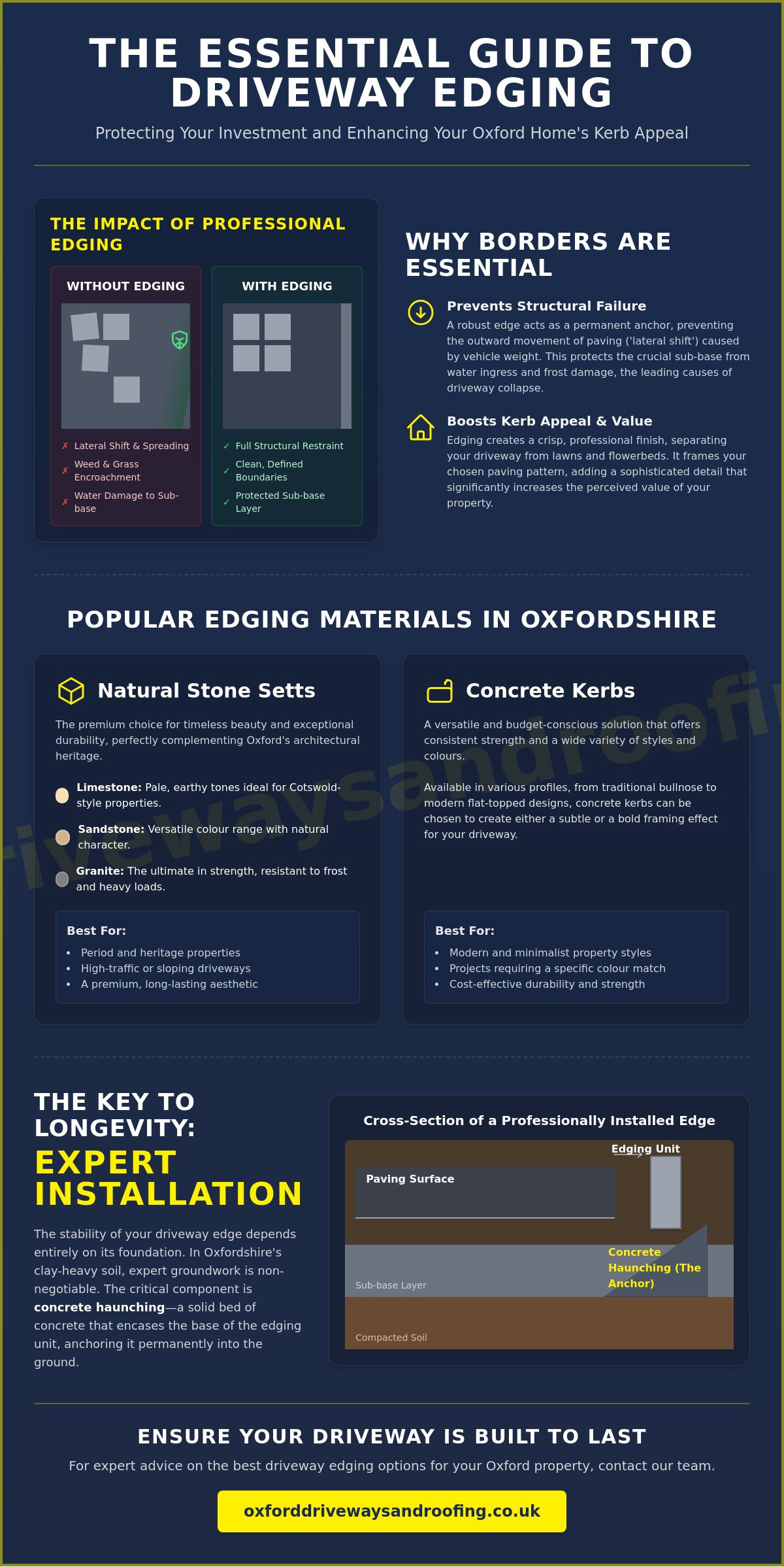
When a vehicle drives over a paved surface, it exerts a horizontal force that seeks to push the materials away from the centre. If the edges are weak, the entire structure begins to spread, causing gaps to appear and the interlocking strength of the paving to vanish. Lateral shift is the outward movement of paving units under load. To prevent this, we use concrete haunching, where the edging units are set into a deep bed of concrete that acts as an immovable anchor. This is particularly vital for permeable paving materials, which require a stable environment to facilitate natural drainage without the risk of the sub-layers shifting over time.
Defining Boundaries and Enhancing Kerb Appeal
A driveway should be a source of pride, providing a welcoming entrance to your home. Edging creates a crisp visual transition that separates your parking area from flower beds or lawns, giving the entire front garden a manicured, professional look. It allows you to showcase the specific block paving patterns for driveways you’ve chosen by framing the design like a piece of art. For many Oxford homeowners, using a contrasting colour or a different texture for the border provides a sophisticated, high-end finish. This attention to detail signals to potential buyers that the property has been maintained to the highest possible standards.
Popular Materials for Driveway Edging in Oxfordshire
When selecting from the various driveway edging options Oxford homeowners have available, the choice of material often dictates both the lifespan and the aesthetic success of the project. A well-chosen border doesn’t just hold the driveway in place; it complements the masonry of your home and the local landscape. In Oxfordshire, where architectural styles range from medieval stone to modern minimalist, the material you select must be capable of withstanding local soil conditions whilst providing a clean, permanent finish.
Natural stone setts remain a favourite amongst our clients for their unrivalled durability and timeless appearance. Unlike manufactured products that may fade, natural stone develops character over time. For those seeking a more modern or budget-conscious solution, concrete kerbs offer versatility without sacrificing strength. It’s also vital to ensure your material choice aligns with UK government guidance regarding surface water management, particularly if you’re installing a non-permeable driveway over five square metres.
Natural Stone Setts: Limestone, Sandstone, and Granite
Limestone setts are an ideal choice for properties in North Oxford, Headington, or nearby Abingdon. Their pale, earthy tones harmonise perfectly with the famous Cotswold stone found throughout the region. If your driveway faces heavy daily use or is situated on a steep incline, granite setts provide the ultimate structural solution. Granite is incredibly dense and resistant to frost damage, ensuring the edges won’t crack or shift under the weight of multiple vehicles. Sandstone offers a warmer, more textured finish that suits traditional cottage-style gardens, providing a softer transition between the driveway and your lawn or flower beds.
Concrete Kerbs and Decorative Rope Edging
For many contemporary homes, hydraulically pressed concrete kerbs are the standard for durability. These are significantly stronger than standard garden edging, as they’re designed to withstand the lateral pressure of a vehicle without fracturing. We often recommend round top or chamfered concrete edgings for a clean, understated line that lets the main driveway surface take centre stage. If you live in a Victorian or Edwardian period townhouse, decorative rope edging adds a charming, historical touch. This style provides the necessary structural restraint whilst mirroring the intricate brickwork often found in Oxford’s heritage conservation areas.
Brick and clay paviors are another excellent choice for those wanting to create intricate, traditional patterns. They’re particularly effective at matching the existing brickwork of your home, creating a cohesive look from the front door to the pavement. For minimalist resin-bound designs, metal edging provides a sleek, nearly invisible border that maintains sharp lines without drawing the eye away from the smooth finish of the driveway. If you’re unsure which material best suits your property, our team can provide tailored advice through our expert driveway design services to ensure a result that is both beautiful and built to last.
Matching Edging Styles to Oxford’s Architectural Heritage
Oxford’s streetscape is a unique tapestry of historical eras, from the medieval heart of the city to the Victorian terraces of Jericho and the modern expansions in Headington. Because of this diversity, a “one size fits all” approach to landscaping simply doesn’t work. When considering the various driveway edging options Oxford homeowners can select, the goal is to achieve a sympathetic balance between the new installation and the existing masonry of the property. A poorly matched border can look jarring, whereas a carefully chosen edge anchors the driveway into its environment, making it look as though it has always been there.
In the city’s many conservation areas, planning requirements often dictate the use of specific materials to preserve the local character. Reclaimed granite setts or clay bricks are frequently required to mirror the traditional textures found in North Oxford’s historic streets. When selecting materials that align with these local standards, consulting TrustMark’s driveway planning guide can provide additional reassurance regarding quality and compliance. Ensuring your border choice coordinates with existing patios and driveways is the most effective way to create a seamless transition between your home’s entrance and the rest of your outdoor space.
Traditional Edging for Period and Cotswold Stone Homes
When identifying the best driveway edging options Oxford period properties demand, tumbled setts are an excellent choice. These stones undergo a mechanical process to soften their edges, mimicking the naturally weathered look of historic masonry found in honey-coloured Oxfordshire villages. If you own a red-brick Victorian terrace, rustic clay brick edging provides a perfect companion that respects the building’s heritage. We always advise choosing non-slip textures for traditional stone borders to ensure safety during wet weather, particularly in areas with high foot traffic. These subtle choices respect the architectural integrity of the property whilst providing the modern durability required for 2026.
Contemporary Borders for Modern Resin and Tarmac Drives
Modern developments in areas like Botley or new builds in Headington often suit a more minimalist aesthetic. For these properties, charcoal or silver-grey granite setts provide a sharp, clean contrast to light-coloured resin-bound surfaces or dark tarmac. Using flat-top kerbs allows for a flush finish, creating a seamless transition between the driveway and the public pavement that feels organised and intentional. If your landscaping design features organic, flowing lines, metal edging is a versatile choice. It’s strong enough to act as a structural restraint whilst being flexible enough to follow the curves of a modern garden, providing a sleek border that doesn’t distract from the main surface.
Functional Factors: Drainage, Maintenance, and Durability
A driveway’s visual appeal is only as good as its underlying functionality. In Oxfordshire, the primary challenge for any groundworks project is the region’s notorious clay-heavy soil. This type of ground is highly susceptible to volume changes; it expands significantly during our wet winters and contracts during dry spells. When evaluating driveway edging options Oxford properties require, you must consider the “heave” factor. If the edging isn’t set upon a robust, deep-dug foundation, these soil movements will cause the borders to shift, tilt, or sink within just a few years. Ensuring your project is SuDS (Sustainable Drainage Systems) compliant is also a legal necessity for many front garden installations, making the relationship between your edging and drainage system vital.
A solid perimeter doesn’t just look better; it’s a structural necessity that protects your investment from the elements. By creating a clear barrier, you prevent the sub-base from washing away during heavy downpours, which is a common cause of “potholing” in older driveways. This technical focus on stability is what separates a long-lasting professional installation from a DIY project that might fail after its first winter. We prioritise methods that anchor your driveway into the ground, providing a steady and reliable result that withstands both the weather and the weight of modern vehicles.
Managing Surface Water Runoff in Oxford’s Climate
Effective water management prevents the pooling that leads to sub-base erosion and surface damage. We often integrate “Aco” linear drains or dedicated soakaways directly behind the edging to capture runoff before it can penetrate the driveway’s margins. Edging can be strategically used to direct water towards permeable areas or flower beds rather than allowing it to spill onto the public highway. Using permeable setts as a border is an excellent way to aid natural ground absorption whilst maintaining a solid structural restraint. This approach helps you avoid the need for planning permission by managing water within your own property boundaries.
Long-term Maintenance: Keeping Your Borders Neat
Even the most expertly installed borders require occasional attention to maintain their integrity. You should regularly check for signs of “heaving,” where individual stones might begin to rise, or sinking, which often indicates a drainage issue beneath the surface. Cleaning methods differ depending on your material; natural stone setts can usually handle a careful pressure wash, whereas concrete edging often benefits from a gentler approach to avoid eroding the surface finish. When inspecting the various driveway edging options Oxford residents have installed, professional re-pointing every few years is essential to prevent water from entering the joints and freezing, which can pop the stones out of their concrete bed. For a comprehensive understanding of how to protect your entire paved surface, our guide to block paving maintenance Oxford homeowners rely on covers everything from sealant technologies to weed prevention strategies. If you’re concerned about the stability of your current borders, our team can provide a professional driveway assessment to identify and rectify any structural weaknesses before they lead to costly failures.
Professional Installation: Why Expert Groundwork Matters
The transition from selecting your design to the physical construction is the most critical phase of any property improvement project. Whilst the visual appeal of various driveway edging options Oxford homeowners choose is important, the long-term success of the installation relies entirely on what lies beneath the surface. Without professional-grade groundwork, even the most expensive stone setts will eventually succumb to the lateral pressure of vehicles and the relentless cycle of the British seasons. Expert installation ensures that your borders remain a permanent, immovable asset rather than a maintenance headache that requires constant adjustment.
Many homeowners are tempted by DIY solutions, but these often fail within just two winters. This is primarily due to shallow foundations and the effects of frost heave, where moisture in the soil freezes and expands, physically lifting the edging out of place. By employing block paving specialists Oxford residents can trust, you ensure that every perimeter stone is anchored with precision. At Oxford Driveways And Roofing Ltd., we provide fully guaranteed installations, offering you the peace of mind that comes from knowing the work is built to the highest industry standards.
The Importance of a Solid Concrete Haunch
The secret to a border that never budges is a process known as concrete haunching. This involves bedding each edging unit into a wet concrete mix and then supporting the back of the stone with a tapered “shoulder” of concrete. This shoulder acts as a structural brace against the weight of a car. We tailor the depth and width of this haunch to the specific vehicle loads expected on your property. We never use “dry mix” foundations; although they are faster to install, they lack the chemical bond and density required to prevent water ingress and eventual structural failure. A wet-poured, high-strength concrete bed is the only way to guarantee the edge remains perfectly level for decades.
Coordinating Edging with Your Full Driveway Project
We don’t view the border as a finishing touch; we plan the edging installation as the very first structural step of the project. This allows us to establish the exact “finished floor level” of the entire driveway. By setting the heights of the edging first, we can ensure the driveway surface is perfectly aligned to facilitate efficient drainage, as discussed in previous sections. This methodical approach prevents the pooling of water and ensures a seamless transition between your property and the public pavement. If you’re ready to upgrade your home’s entrance and want to understand the full investment involved, our detailed guide to block paving driveway cost per m2 will help you plan your budget with confidence. Contact us for a professional site visit to discuss your specific edging needs and receive a detailed, transparent assessment of your project.
Securing Your Property’s Future with Expert Edging
Choosing the right border is the final piece of the puzzle for a successful driveway project. We’ve explored how the various driveway edging options Oxford homeowners can select serve as both a structural necessity and a visual anchor. By prioritising robust concrete haunching and sympathetic material matching, you protect your home from the common pitfalls of spreading pavers and poor drainage. It’s an investment that pays dividends in both kerb appeal and structural longevity, ensuring your entrance remains as stable as the day it was laid.
Our expert Oxfordshire groundwork specialists use only premium-grade local materials to ensure a finish that’s built to last. At Oxford Driveways And Roofing Ltd., we provide fully guaranteed workmanship on every project, giving you total peace of mind that your home’s exterior is in safe hands. Book your free Oxford driveway design consultation today to start planning a driveway that’s as reliable as it is beautiful. We look forward to helping you create a lasting first impression for your property.
Frequently Asked Questions
Do I really need edging for a block paving driveway?
Yes, edging is a structural requirement for any block paving installation. It provides the essential lateral restraint that prevents individual blocks from shifting outwards when a vehicle drives over them. Without a secure, concrete-haunched border, the interlocking strength of the paving is lost, which quickly leads to unsightly gaps, sinking, and the eventual collapse of the driveway surface.
What is the most durable driveway edging material?
Granite setts are widely considered the most durable driveway edging options Oxford homeowners can select. Granite is an incredibly dense natural stone that resists frost damage and cracking under the heaviest loads. For a modern and cost-effective alternative, hydraulically pressed concrete kerbs also offer exceptional strength and are specifically engineered to withstand the pressures of daily residential vehicle traffic.
Can I use garden edging for my driveway?
Standard garden edging is generally unsuitable for driveways because it lacks the thickness and structural integrity to support vehicle weight. Driveway borders require a deep concrete foundation and professional haunching to prevent the paving from spreading. Using thin garden borders often results in the material snapping or tilting within a few months as it cannot resist the lateral pressure of a car.
Does driveway edging help with drainage?
Edging plays a vital role in managing surface water by directing runoff toward designated drainage points like linear drains or soakaways. By creating a defined perimeter, it prevents water from spilling over into garden beds and eroding your topsoil. This is a key part of ensuring your property remains compliant with UK sustainable drainage regulations whilst protecting your driveway’s sub-base from water damage.
How much does it cost to install driveway edging in Oxford?
The total investment depends on your choice of material and the complexity of the groundwork required for your specific site. High-end materials like natural granite setts involve higher material costs compared to standard concrete kerbs. Labour costs in Oxfordshire reflect the precision required for deep-bed concrete haunching, which is the only way to ensure a long-lasting and stable result that won’t shift over time. For a broader understanding of how edging fits into your overall budget, our 2026 Oxford guide to block paving driveway cost per m2 provides a comprehensive breakdown of pricing across all project components.
Is metal edging strong enough for a driveway?
Heavy-duty steel or aluminium edging is perfectly strong enough for driveways, particularly when used with resin-bound or tarmac surfaces. It provides a sleek, minimalist look whilst maintaining the necessary structural restraint for the driveway margins. However, it must be secured with professional-grade steel pins and a solid base to ensure the metal doesn’t bend or move under the weight of a turning vehicle.
Do I need planning permission for driveway edging in Oxford?
Edging itself rarely requires planning permission, but the overall driveway project must comply with local Oxfordshire County Council regulations. You generally don’t need permission if your driveway uses permeable materials or drains into a lawn or border within your property. If you’re installing an impermeable surface over five square metres that drains onto the public highway, you’ll likely need to seek formal approval.
How do I stop weeds from growing in my driveway borders?
Preventing weed growth starts with a solid concrete bed and professional pointing of all joints. By ensuring there are no gaps in the mortar between your edging stones, you remove the space where seeds can take root. Using high-quality jointing compounds and maintaining the integrity of the mortar will keep your borders looking crisp and weed-free without the need for constant chemical treatments.