
Could a single decision made today determine the structural integrity of your home for the next 150 years? It’s a daunting prospect for any Oxford homeowner, particularly with the 2026 building regulations now requiring stricter thermal performance and the unique challenges of our city’s eighteen conservation areas. You want a roof that doesn’t just look beautiful but also stands firm against the British weather without failing or leaking within a decade.
We understand that the rising cost of construction can make choosing high quality roofing materials feel like a high-stakes gamble. You’re likely looking for a solution that respects the character of your neighbourhood whilst offering the best possible protection for your family. This guide is designed to provide that clarity, helping you navigate the technical requirements and aesthetic choices with confidence.
We will explore the lifespans of various options, from natural slate to modern flat roof systems, and provide a clear framework to justify the cost of premium materials. By the end of this article, you’ll have a professional perspective on how to choose a roof that adds lasting value and security to your Oxfordshire property.
Key Takeaways
- Learn why the long-term performance of your roof depends as much on invisible components like breathable membranes and battens as it does on the visible surface.
- Compare the lifespans and structural requirements of high quality roofing materials such as natural slate, clay, and concrete to find the best fit for your home.
- Discover how modern EPDM and GRP systems have transformed flat roofing, providing seamless, leak-proof solutions that far outlast traditional materials.
- Understand how to navigate Oxford’s specific conservation area restrictions and planning requirements to ensure your project respects local heritage.
- Identify why professional installation is the most critical factor in ensuring your chosen materials actually achieve their maximum possible lifespan.
The Anatomy of a High-Quality Roof: More Than Just Tiles
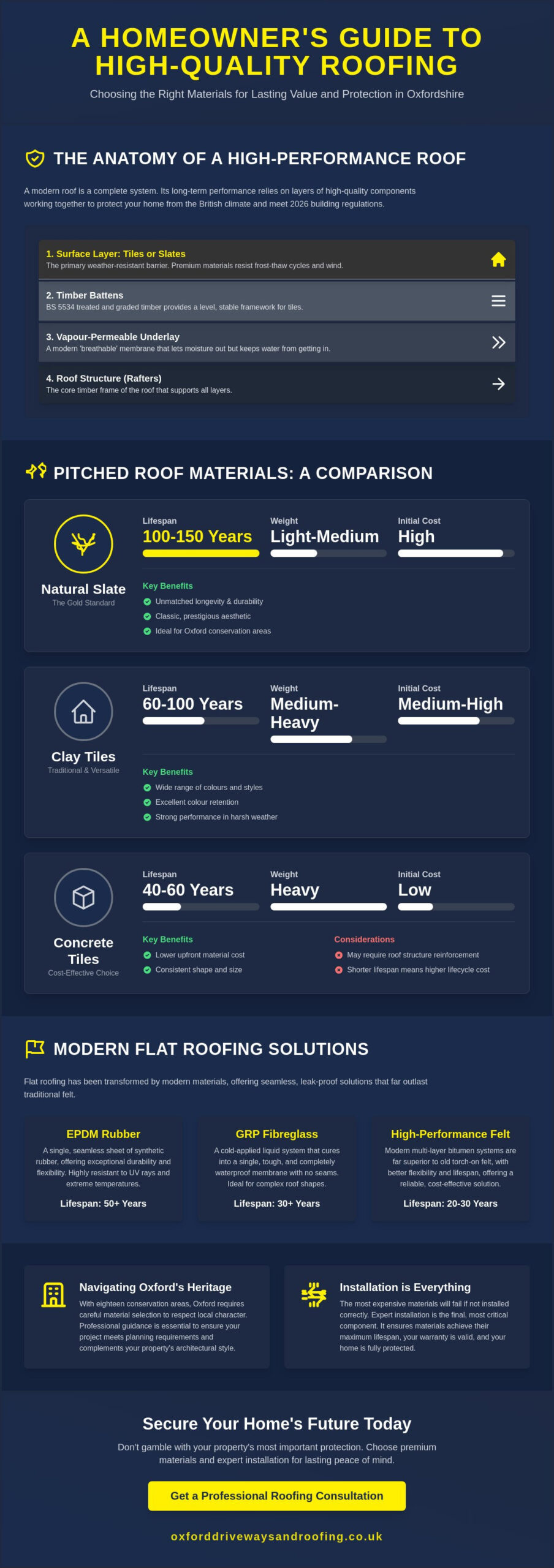
In 2026, the definition of a high-quality roof has shifted from simple aesthetics to a high-performance system. It isn’t just about the top layer you see from the street; it’s about how the entire structure manages heat, moisture, and environmental stress. A truly superior roof must now meet rigorous standards for thermal performance and sustainability, ensuring your Oxfordshire home remains energy-efficient whilst reducing its carbon footprint over its long lifespan. This holistic approach ensures that your investment protects your property for decades rather than just a few seasons.
Many homeowners are tempted by “builder grade” packages that look identical to premium options at first glance. However, the difference in material density and chemical treatment becomes apparent after only a few winters. Premium high quality roofing materials are engineered to resist the specific challenges of the British climate, such as the frequent frost-thaw cycles that can cause inferior tiles to crack. Choosing premium materials isn’t just a purchase; it’s a strategic investment in your property’s long-term value. A high-quality system typically includes:
- Vapour-permeable underlays for moisture control.
- Treated, graded timber battens for structural stability.
- High-performance ridge and valley systems to prevent leaks.
- Precision-engineered tiles or slates designed for wind resistance.
The Role of Breathable Membranes and Ventilation
High-quality membranes act as the second line of defence for your home. Unlike old-fashioned bitumen felt, which can trap moisture and lead to damp, modern vapour-permeable underlays allow internal condensation to escape whilst remaining completely waterproof from the outside. This is vital for meeting current UK building regulations, which prioritise airflow to prevent timber rot in the roof space. When reviewing commercially available roofing materials, it becomes evident that the performance of the outer layer is only as good as the membrane beneath it. We prioritise these breathable layers to ensure your roof remains healthy and dry.
Why Timber Batten Quality Dictates Roof Levelness
Structural integrity starts with the timber hidden beneath your tiles. We use only treated, graded timber that meets BS 5534 standards to ensure your roof remains perfectly level. Poor-quality battens are often prone to warping, knots, or rot, which cause the roofline to sag or dip over time. This isn’t just an aesthetic issue; it can compromise the way tiles interlock, leaving your home vulnerable to wind-driven rain. Oxford Driveways And Roofing Ltd. never compromises on structural timber. Using high quality roofing materials for the framework is the only way to guarantee a safe, stable, and visually pleasing result that lasts for generations.
Comparing Traditional Pitched Roof Materials: Slate vs. Clay vs. Concrete
Oxfordshire’s skyline is defined by its diverse architectural history, from the dreaming spires of the city centre to the suburban homes of Headington and Marston. When you’re selecting high quality roofing materials, your choice usually falls amongst the “Big Three”: natural slate, clay, and concrete. Each material offers a unique balance of aesthetic charm, weight, and structural performance. It’s vital to consider more than just the initial purchase price. You must account for how the material handles the weight on your rafters and how it will weather over the next twenty years.
Weight is a critical factor that many homeowners overlook. Concrete tiles are significantly heavier than natural slate or certain clay options. If you’re switching from a lighter material to a heavier one, your roof structure might require reinforcing to prevent sagging. A comprehensive National Roofing Contractors Association guide highlights how material choice dictates the long-term maintenance schedule of a property. Whilst concrete has a lower entry cost, its total lifecycle cost can be higher because it may need replacing twice in the time a single slate roof remains functional.
Natural Slate: The 100-Year Gold Standard
Natural slate is the pinnacle of longevity. Welsh slate is world-renowned for its purity and deep blue-grey hues, whilst Spanish slate offers a similar aesthetic with excellent durability. It’s the preferred choice for heritage and period properties across Oxford because it respects the city’s architectural integrity. Its “fire and ice” resistance is unmatched. Natural stone won’t warp in a heatwave or crack during a deep Oxfordshire frost, making it a truly permanent solution for those who prioritise stability. If you’re planning a New Roof Installation, slate provides a level of prestige that man-made alternatives struggle to match.
Clay and Concrete Tiles: Versatility and Value
Clay tiles are prized for their natural beauty and their ability to improve with age. They develop a rich patina over time and are naturally more resistant to moss growth than concrete. This makes them ideal for homes near wooded areas or damp river settings. Concrete tiles are the modern workhorse. They offer a vast array of colour options to match almost any neighbourhood style. Whether you need traditional plain tiles for a steep pitch or interlocking pantiles for a shallower slope, concrete provides a cost-effective path to a secure home. They’re durable and reliable, though the colour may soften slightly over several decades compared to the permanent pigments of natural clay.
Modern Flat Roofing Systems: EPDM, GRP, and High-Performance Felt
Flat roofs often evoke memories of peeling felt and recurring leaks. This historical reputation was largely earned by older bitumen systems that struggled with the UK’s temperature fluctuations and brittle joint failures. By 2026, however, advancements in chemical engineering have completely transformed how we protect these structures. Modern high quality roofing materials now offer seamless protection, effectively eliminating the joints where traditional roofs typically fail. These systems act as a continuous shield, providing a level of reliability that was once only possible with pitched roofs.
The primary challenge for any flat surface is thermal expansion. During a typical British summer, roof temperatures can soar, causing materials to stretch and then contract rapidly as the sun sets. Inferior materials crack under this repetitive stress. High-performance systems are engineered to remain flexible, absorbing these movements without losing their structural integrity. For a deep dive into technical specifications and local case studies, our guide on flat roof installation Oxfordshire provides a comprehensive breakdown of the options available for your property.
A U.S. Forest Service roofing overview explains that single-ply systems like EPDM have become a global standard for their resilience. These membranes are often installed in a single sheet, removing the risk of water ingress through seams. This transition from multi-layered felt to single-ply technology represents a significant leap in domestic property protection.
EPDM Rubber: The Durable, Flexible Favourite
EPDM rubber has become the “fit and forget” favourite for Oxford extensions. Because it’s installed as a single, cold-applied sheet, there are no joints to fail and no naked flames are required during the installation process. Industry standards now place the lifespan of these systems at up to 50 years, making it one of the most reliable high quality roofing materials on the market. It’s a stable, matte-black finish that blends quietly into residential environments whilst offering exceptional UV resistance.
GRP Fibreglass: The Toughest Surface for Balconies
GRP fibreglass is the premier choice when a roof needs to double as a balcony or walkway. It’s a rigid, incredibly tough resin system that provides a crisp, clean aesthetic. Unlike rubber, GRP is applied as a liquid that hardens into a single solid layer. This process requires professional, temperature-controlled installation to ensure the resin cures correctly and stays waterproof. It offers a level of impact resistance that other systems simply cannot match, providing peace of mind for roofs that see regular foot traffic or require a more industrial-strength finish.
Matching Materials to Your Oxford Property Type
Oxford’s aesthetic is a delicate balance of honey-coloured limestone, classic red brickwork, and crisp render. Choosing high quality roofing materials isn’t just about durability; it’s about architectural harmony. A roof that clashes with its surroundings can negatively impact your property’s value and kerb appeal. We focus on selecting materials that respect the local vernacular, ensuring that every ridge tile and chimney pot feels like an original part of the streetscape. This attention to detail ensures your home remains a cohesive part of its neighbourhood whilst benefiting from modern protection.
If your home sits within one of Oxford’s eighteen conservation areas, your choices are often governed by Article 4 Directions. These regulations restrict permitted development rights to preserve the city’s unique character. Before starting any work, it’s essential to seek pre-application advice from the Oxford City Council. We help homeowners select materials that satisfy these heritage requirements whilst providing 2026 levels of thermal performance. By matching the texture and colour of existing structures, we ensure your renovation is both compliant and beautiful.
If you’re ready to enhance your property’s value and protection, contact us for a New Roof Installation quote tailored to your local area.
Heritage and Period Homes in Oxfordshire
Victorian and Edwardian builds require a specific touch. Reclaimed slates or high-quality clay tiles are often essential to maintain the soul of these properties. Replacing a roof on a listed building involves navigating strict planning permissions, where the “like-for-like” rule usually applies. However, it’s still possible to maintain the Oxford character whilst upgrading to modern standards. We specialise in integrating high-performance insulation behind traditional facades, ensuring your period home remains warm and dry without losing its historical integrity. For a detailed look at how to approach maintenance on older properties, our guide to roof repairs for older homes Oxfordshire covers the specific challenges of preserving historic structures whilst meeting modern standards.
Modern Developments in Abingdon and Swindon
Newer estates in areas like Abingdon and parts of Swindon often favour efficiency and contemporary design. Large-format concrete tiles are a popular choice here, offering a clean look with faster installation times. A significant trend in 2026 is coordinating roof colours with anthracite grey or black window frames to create a sleek, modern finish. We also recommend integrating solar-ready fixings during any material upgrade. This allows you to install photovoltaic panels easily in the future without compromising the waterproof layer of your high quality roofing materials.
Why Expert Installation is the Final “High-Quality Material”
Even the most expensive high quality roofing materials can’t protect your home if they aren’t installed with precision. It’s a common industry tragedy: a homeowner invests in premium 50-year tiles, only to face significant leaks within five years because the lead flashing was poorly dressed or the valleys were incorrectly formed. The craftsmanship of the installer is just as critical as the durability of the tile itself. A roof is a complex system of overlapping components; if one element is out of place, the entire structure is compromised.
Choosing a local specialist ensures that you aren’t just buying a product, but a guaranteed outcome. When we undertake a project, we look beyond the surface. We assess the chimney masonry, the state of the guttering, and the integrity of the timber structure. This holistic approach prevents the “patchwork” repairs that often lead to recurring costs. To understand how these factors influence your budget, you can view our detailed breakdown of new roof cost Oxford for 2026.
The Oxford Driveways And Roofing Ltd. Standard
Our commitment to excellence begins with procurement. We use only BS-graded materials and proven techniques that have stood the test of time in the Oxfordshire climate. Being your neighbours means we provide a level of accountability that national contractors simply can’t match. Our integrated services, including chimney rebuilding and high-capacity guttering, ensure that every transition point on your roof is completely sealed. Oxford Driveways And Roofing Ltd. doesn’t just lay tiles; we build resilience through disciplined, careful work.
Securing Your Investment
The “cheapest quote” is often the most expensive choice in the long run. Choosing high quality roofing materials paired with expert installation provides a superior return on investment by eliminating the need for emergency repairs and premature replacements. It’s about peace of mind. You shouldn’t have to worry every time the wind picks up or a storm rolls across the Thames Valley. By investing in a high-standard installation today, you’re securing your home’s future for the next several decades. To keep that investment protected year after year, following a structured roof maintenance checklist for Oxford homeowners is the most effective way to catch minor issues before they become costly repairs.
Ready to protect your property with a roof built to last? Request your professional roofing consultation today and let our specialists guide you through the best options for your Oxfordshire home.
Protecting Your Oxfordshire Home for the Decades Ahead
Selecting the right roof is more than a simple cosmetic upgrade; it’s a strategic investment in your property’s resilience. We’ve explored how high quality roofing materials like natural slate, clay tiles, and EPDM rubber provide long-term stability, provided they are part of a correctly installed system. Whether you are navigating the strict requirements of an Oxford conservation area or upgrading a modern extension, the combination of premium components and disciplined craftsmanship is what ensures a leak-free future for your family.
As an Oxfordshire-based family business, we take pride in delivering results that stand the test of time. We are specialists in both heritage and modern systems, ensuring every project respects the local architectural vernacular whilst meeting 2026 thermal standards. Our fully guaranteed workmanship offers the peace of mind you need when making such a significant improvement to your home. We’re here to act as your steady guide through every technical decision. Once your new roof is in place, pairing it with a season-by-season roof maintenance plan for Oxford properties will help you preserve its performance and extend its lifespan for decades to come.
Get a Professional Roofing Quote for Your Oxford Home today to secure your property with a system built to last. We look forward to helping you achieve a safe and beautiful result for your Oxfordshire property.
Frequently Asked Questions
What is the longest-lasting roofing material for a UK home?
Natural slate is the longest-lasting material, with a typical lifespan ranging from 80 to 150 years. It outlasts almost every other option because it’s a natural stone that resists fire, frost, and chemical erosion. This exceptional longevity makes it a sustainable choice for Oxford homeowners who want a permanent solution that requires very little maintenance over several generations.
Do I need planning permission to change my roofing material in Oxford?
You will likely need planning permission if your property is located in one of Oxford’s eighteen conservation areas or if the building is listed. Outside these protected zones, replacing materials like-for-like usually falls under permitted development rights. However, if you’re changing the material type, weight, or colour significantly, you must check with Oxford City Council to ensure your project remains compliant.
Is slate significantly more expensive than concrete tiles in 2026?
Natural slate remains more expensive than concrete tiles due to the higher cost of the raw stone and the specialised labour required for installation. Whilst concrete is a cost-effective modern alternative, slate offers a much lower total lifecycle cost because it doesn’t need replacing for a century. Choosing high quality roofing materials like slate is a strategic investment in your property’s long-term value.
Can I install solar panels on any type of high-quality roofing material?
Yes, solar panels can be installed on most high-quality materials, including slate, clay, and concrete, provided the correct mounting systems are used. For flat roofs like EPDM or GRP, specialist fixings are required to maintain the waterproof seal. It’s best to integrate solar-ready fixings during a full roof replacement to avoid damaging the new surface or compromising the warranty later.
What is the best flat roofing material for a garage extension?
EPDM rubber is widely considered the best material for residential garage extensions due to its 50-year lifespan and seamless installation. It’s incredibly flexible, which allows it to handle the rapid thermal expansion common in British summers without cracking. If the garage roof will be used as a balcony or terrace, GRP fibreglass is the tougher, more rigid alternative that supports regular foot traffic.
How do I know if my existing roof structure can support heavier clay tiles?
You must have a professional structural assessment to determine if your roof timbers can support the additional weight of clay or concrete tiles. If your home originally had slate, switching to a heavier material might require reinforcing the rafters to prevent sagging. We always check the structural integrity of the battens and beams before recommending a material change to ensure your home’s stability.
Are modern “synthetic” slates as good as the natural stone versions?
Modern synthetic slates are a durable and lightweight alternative, but they don’t yet match the 100-year lifespan of natural stone. They are often made from recycled materials and offer excellent uniform aesthetics for modern builds. Whilst they are easier to install and cheaper than natural Welsh or Spanish slate, they may not be accepted in some of Oxford’s stricter heritage zones or listed buildings.
Why is breathability so important in modern British roofing systems?
Breathability is vital because it prevents condensation from building up in your roof space, which can lead to timber rot and damp. Modern UK building regulations require high quality roofing materials like vapour-permeable membranes to ensure moisture escapes whilst keeping rainwater out. This airflow is essential for maintaining the health and stability of your home’s structure and protecting your insulation’s thermal performance.