
Your chimney isn’t just a decorative feature sitting atop your roof; it’s one of the most weather-exposed elements of your entire property, and once the mortar joints begin to fail, the consequences reach far deeper than the brickwork itself. If you’ve been searching for reliable information on chimney repointing cost Oxford, you already understand the stakes. Crumbling mortar allows moisture to penetrate your chimney stack, and from there, damp spreads inward, damaging ceilings, walls, and the structural integrity of the building beneath.
It’s a concern that resonates with many Oxford homeowners, particularly those with older or heritage properties where the wrong mortar choice can cause as much harm as leaving the work undone entirely. The worry about scaffolding costs, lime versus cement mortars, and finding a tradesperson you can genuinely trust are all completely valid.
This guide is designed to give you a clear, honest picture of what influences the final price of chimney repointing in Oxford, what a properly specified job actually involves, and how the right approach protects your home from costly interior damp repairs for years to come.
Key Takeaways
- Understanding the true chimney repointing cost Oxford homeowners face requires looking beyond the labour itself — scaffolding alone can account for 40–60% of your total quote, making access one of the single biggest pricing variables.
- The mortar mix your tradesperson specifies matters enormously, particularly for older Oxford properties, where an overly rigid cement mortar can cause irreversible damage to the surrounding brickwork.
- Several visible warning signs — including white efflorescence on the brickwork and damp patches on interior ceilings — indicate that your chimney needs attention before the repair scope, and the cost, escalates significantly.
- A professionally executed repointing job follows a precise sequence of preparation, raking, and finishing stages that determines how long the restored mortar joints will last and how well they’ll protect against moisture ingress.
- Choosing a specialist with proven experience in both modern and heritage masonry techniques is the most reliable way to ensure your chimney receives the correct specification for its age, construction, and exposure.
What is Chimney Repointing and Why is it Essential in Oxford?
Chimney repointing is the process of carefully raking out deteriorated mortar from the joints between bricks or stone, then replacing it with fresh material matched to the correct specification for your chimney’s age and construction. It’s not a cosmetic fix. Done properly, repointing restores the structural integrity of the entire stack, seals out moisture, and extends the working life of your chimney by decades. Done poorly, or left undone entirely, it sets in motion a chain of damage that reaches far beyond the roofline.
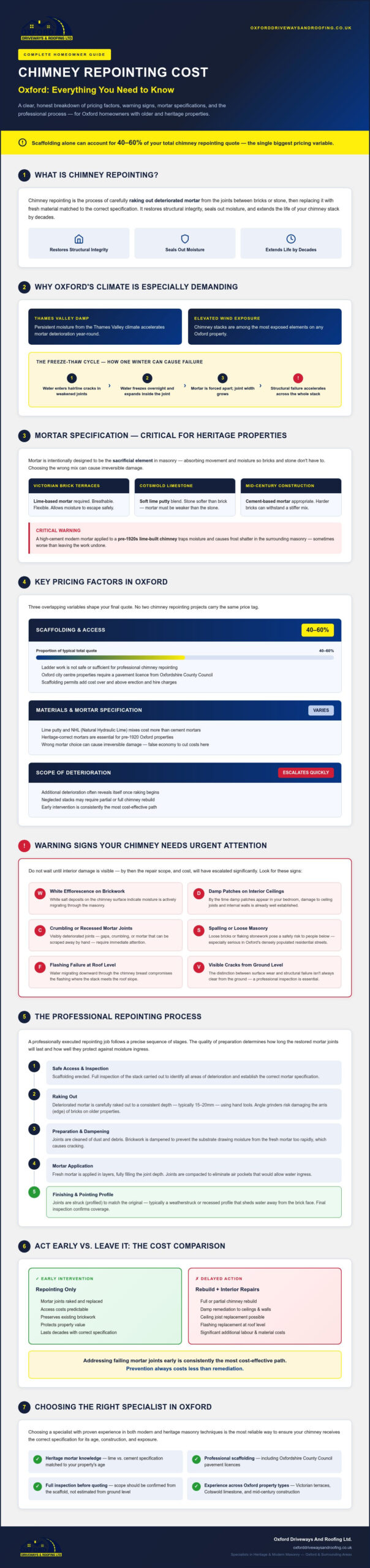
Oxford’s climate creates particularly demanding conditions for chimney mortar. The city experiences a combination of elevated wind exposure, significant temperature fluctuations between seasons, and the kind of persistent damp that characterises the Thames Valley. Freeze-thaw cycling is especially destructive: water enters hairline cracks in weakened joints, freezes overnight, expands, and forces the mortar apart. Repeat this process across a single winter and what began as surface wear accelerates into genuine structural failure.
The Role of Mortar in Oxford Architecture
Understanding mortar in masonry construction helps explain why specification matters as much as the labour itself. Mortar is intentionally designed to be the sacrificial element in a masonry structure, absorbing movement and moisture so that the bricks or stone around it don’t have to. Oxford’s built environment spans Victorian brick terraces, Cotswold limestone properties, and mid-century construction, each requiring a different mortar strength and composition. A mix that’s too rigid, particularly a high-cement modern mortar applied to a pre-1920s lime-built chimney, can trap moisture and cause frost shatter in the surrounding masonry. Breathability isn’t a preference for older Oxford properties; it’s a structural requirement.
The Hidden Dangers of Cracked Chimney Joints
Once water penetrates failing joints, it doesn’t stay in the stack. It migrates downward through the chimney breast, compromising the flashing at roof level and eventually saturating ceiling joists and internal walls. By the time damp patches appear on your bedroom ceiling, the damage is already well established.
There’s also a safety consideration that’s easily overlooked in densely populated Oxford residential streets. Loose or spalling masonry from a neglected chimney stack poses a real risk to anyone below. The distinction between cosmetic surface wear and structural failure isn’t always visible from ground level, which is precisely why a professional inspection matters before the scope of work, and with it the chimney repointing cost Oxford homeowners face, escalates into a full chimney rebuild.
Addressing failing mortar joints early is consistently the most cost-effective path. Repointing preserves the aesthetic character of your property, protects its value, and prevents the far larger expenditure that follows when deterioration is allowed to run unchecked.
Calculating Chimney Repointing Cost Oxford: Key Pricing Factors
No two chimney repointing projects carry the same price tag, and understanding why requires looking at the full picture rather than a single line item. The chimney repointing cost Oxford homeowners face is shaped by three overlapping variables: how your tradesperson gets to the stack safely, what materials the job genuinely requires, and how much work reveals itself once the raking begins. Each of these can shift your final quote considerably.
Access and Scaffolding Logistics
Scaffolding is, for many Oxford homeowners, the most surprising element of a repointing quote. It’s not unusual for access costs to account for 40 to 60 percent of the total project price, and there are good reasons for that. Ladder work is simply not a safe or sufficient method for professional chimney repointing. A tradesperson needs stable, two-handed access to rake joints properly and apply mortar with the precision the work demands. Anything less produces a result that won’t last.
Oxford city centre properties introduce an additional layer of complexity. Scaffolding erected over a public pavement requires a licence from Oxfordshire County Council, and the cost of that permit, combined with any traffic management requirements on narrower residential streets, adds directly to your quote. Properties with steeper roof pitches or chimney stacks positioned at gable ends rather than mid-roof also require more complex scaffold configurations, which increases both the material and labour time involved in the setup and strike.
Material and Labour Breakdown
The mortar specification your job requires is the second major pricing variable. Standard cement-based mortar is less expensive to source and faster to apply, making it a cost-effective choice for post-1950s brick chimneys. Traditional lime mortar, which is essential for pre-1920s Oxford properties built with softer brick or Cotswold limestone, carries a material premium and requires a slower, more careful application process. The breathability and flexibility lime provides aren’t optional for heritage construction; they’re what prevents the surrounding masonry from cracking under thermal movement.
A standard single-stack repointing project on a straightforward two-storey Oxford terrace typically takes a skilled team one to two days once access is in place. That timeframe extends if the inspection reveals damaged bricks that need replacing, or if the chimney pot has deteriorated and requires a new fitting. Both are common findings on older stacks and should be factored into your budget expectations from the outset rather than treated as unwelcome surprises mid-project.
- Scaffold access: Often the single largest cost component, particularly for city centre locations requiring pavement licences.
- Mortar specification: Lime mortar commands a premium over cement but is non-negotiable for heritage and pre-1920s properties.
- Chimney height and position: Gable-end stacks and taller chimneys require more complex access setups and longer labour time.
- Additional repairs: Damaged bricks, failed chimney pots, or deteriorated flaunching can extend both the scope and the cost.
Getting an accurate picture of your specific situation starts with a proper inspection rather than a ballpark figure. If you’re ready to understand exactly what your chimney requires, speak to a specialist who can assess the full scope before any work begins.
The Professional Chimney Repointing Process
Understanding what a properly executed job looks like helps you evaluate any quote you receive and sets realistic expectations for how long the work will take. The chimney repointing cost Oxford homeowners pay isn’t simply for mortar and labour; it reflects a precise sequence of preparation, execution, and finishing that determines whether the new joints will last decades or fail within a few years.
Before any raking begins, a professional team will protect the surrounding roof. Dust sheets are laid across the tiles and guttering to catch falling debris, preventing grit and mortar fragments from accumulating in your downpipes or dislodging ridge tiles during the work. It’s a straightforward step, but it’s one that separates a careful tradesperson from a rushed one.
Raking Out and Surface Preparation
Raking out the deteriorated mortar to a consistent depth of 15 to 20mm is the foundation of a lasting repair. Too shallow, and the new mortar won’t have sufficient depth to bond; too aggressive, and you risk damaging the brick faces themselves. Where mechanical tools are used to speed up the process, they must be handled with particular care on older Oxford brickwork. A grinder that slips even fractionally can score the brick arris, causing irreversible cosmetic and structural damage that no amount of repointing will correct.
Organic growth is addressed at this stage. Moss and lichen that have taken root between joints are removed thoroughly, because any biological material left behind will continue to retain moisture and undermine the new mortar’s adhesion. Once the joints are clean and dry debris has been brushed away, the masonry is dampened before the fresh mortar is applied. This prevents the surrounding brickwork from drawing moisture out of the new mix too quickly, which would weaken the bond before it has properly cured.
Application and Finishing Techniques
The joint profile applied at the finishing stage isn’t purely aesthetic. A weather-struck finish, which angles the mortar face to shed rainwater away from the joint, is often specified for exposed chimney stacks. A bucket-handle or flush finish suits different property styles and exposure levels. Matching the original profile also matters for heritage properties where planning considerations apply.
Curing conditions are equally important. Repointing carried out during freezing Oxfordshire winters risks frost damage before the mortar has set, which is why professional teams plan scheduling carefully around seasonal temperatures.
The final stage of any thorough job includes inspecting the lead flashing at the base of the stack and assessing the condition of the flaunching, the sloped mortar bed that holds the chimney pot in place. Both are common failure points that, if overlooked, will allow water ingress regardless of how well the repointing itself has been executed.
Signs Your Oxford Chimney Needs Urgent Attention
Early detection is consistently the most reliable way to keep your chimney repointing cost Oxford manageable. Catching deterioration in its early stages means a targeted repointing job rather than a partial rebuild, and the difference in scope between those two outcomes is significant. The challenge is that chimney failure rarely announces itself dramatically. It tends to develop quietly, through a series of warning signs that are easy to dismiss until the damage has already spread inward.
One of the clearest early indicators is efflorescence: the white, powdery deposits that appear on the surface of brickwork when soluble salts are carried outward by moisture moving through the masonry. It’s not a structural failure in itself, but it’s a reliable signal that water is actively penetrating the chimney stack. Similarly, check your gutters and downpipes after heavy rainfall. Sandy debris or small fragments of mortar collecting in your guttering indicate that the joints are actively breaking down and shedding material with every weather event.
Inside the property, pay attention to the chimney breast wall. Damp patches, peeling wallpaper, or a persistent musty smell in rooms adjacent to the stack are all signs that moisture has already migrated inward. By the time these symptoms are visible, the deterioration at the chimney itself is typically well advanced.
Visual Inspection from the Ground
A pair of binoculars is a genuinely useful tool for any Oxford homeowner. From ground level, you can identify open joints where mortar has receded or disappeared entirely, spot chimney pots that are sitting at an angle rather than sitting flush, and look for any visible lean in the stack itself. Frost heave, where repeated freeze-thaw cycling causes the chimney crown to lift and shift, can destabilise the entire upper section of the stack and represents an immediate safety concern rather than a maintenance item to schedule at leisure. Loose masonry on a residential Oxford street is a risk that warrants urgent professional attention.
The Link Between Chimney Health and Roofing Integrity
A failing chimney rarely fails in isolation. The joints between the stack and the surrounding roof covering are a known weak point, and once moisture finds a route past deteriorated mortar, it typically compromises the flashing and the tiles immediately below. This is precisely why roofing repairs in Oxfordshire and chimney work so often need to be addressed together rather than separately.
With scaffolding already erected for repointing, it makes practical and financial sense to carry out a full inspection of the ridge tiles, lead flashings, and any surrounding roof sections whilst access is in place. Dismantling and re-erecting scaffold for a follow-up job adds cost that a combined inspection avoids entirely. A thorough exterior maintenance check at this stage is a straightforward way to protect the full investment you’re making in the chimney itself.
If any of these warning signs are present on your property, don’t wait for the symptoms to worsen. Contact our team to arrange a professional chimney inspection before the scope of work escalates further.
Choosing Oxford Driveways And Roofing for Your Restoration
There’s a false economy that catches many Oxford homeowners out: accepting the lowest quote without scrutinising what it actually includes. A cheap repointing job that uses the wrong mortar specification, skips proper raking depth, or cuts corners on access will fail within a few years, leaving you to pay for the same work again, plus the interior damp repairs that follow. The chimney repointing cost Oxford homeowners pay to get it right the first time is consistently less than the combined cost of doing it twice.
Oxford Driveways And Roofing Ltd. brings decades of hands-on experience to every property maintenance services Oxford project we undertake. That experience spans both modern construction and heritage masonry, which matters enormously in a city where Victorian brick terraces sit alongside Cotswold limestone cottages and mid-century builds. We don’t apply a single mortar specification across every job. We assess the age, construction, and exposure of your chimney and specify accordingly, because the right material for your property is the only material worth using.
A Trusted Specialist Approach
Every project begins with premium-grade materials selected to withstand the specific demands of the British climate, including the freeze-thaw cycling and persistent damp that Oxford’s Thames Valley position creates. Our workflow is organised to minimise disruption: scaffolding is erected efficiently, the work is carried out in a planned sequence, and the site is left clean on completion. Our broader expertise in exterior care, including our work as block paving specialists Oxford homeowners rely on, reflects the same disciplined, detail-oriented approach we bring to every chimney restoration. Every project Oxford Driveways And Roofing Ltd. completes is backed by our workmanship guarantee, giving you confidence that the result is built to last rather than built to pass a visual inspection.
Request Your No-Obligation Quote
Our process starts with a local site survey carried out by an experienced member of our team. We assess your chimney’s height, condition, mortar specification requirements, and access complexity before providing a fixed-price quote with no hidden scaffolding additions or provisional sums that inflate after the work begins. What we quote is what you pay.
Every solution we propose is bespoke to your property’s specific situation. There’s no template, no guesswork, and no pressure. If your chimney needs attention now, acting sooner protects both your property and your budget.
Contact Oxford Driveways And Roofing Ltd. today to arrange your professional chimney inspection and secure your home against the seasons ahead.
Protect Your Home Before the Next Season Takes Its Toll
Chimney deterioration doesn’t pause whilst you’re weighing up your options. The freeze-thaw cycles that characterise an Oxfordshire winter will continue working on weakened mortar joints until the damage reaches your ceilings, walls, and structural timbers. Acting early is consistently the more affordable path.
The chimney repointing cost Oxford homeowners face is shaped by access complexity, mortar specification, and the condition of the stack itself. Getting those variables assessed properly, before work begins, is what separates a well-managed project from an escalating one. Pair that with the right contractor and the right materials, and the result is a chimney that’s genuinely protected for years ahead.
Oxford Driveways And Roofing Ltd. brings proven expertise in both modern and heritage masonry, premium-grade weather-resistant materials, and fully guaranteed workmanship to every project we undertake. You don’t have to navigate the process alone.
Get a professional chimney repointing quote from Oxford Driveways And Roofing Ltd. and take the first step towards a home that’s properly protected from the outside in.
Frequently Asked Questions About Chimney Repointing in Oxford
How much does chimney repointing cost in Oxford on average?
Chimney repointing cost in Oxford varies considerably depending on access complexity, mortar specification, and the condition of your stack. Scaffolding, mortar type, chimney height, and any additional repairs such as replacing damaged bricks or fitting a new chimney pot all influence the final figure. The most reliable way to understand your specific costs is to have a professional carry out a site survey before any work begins, so there are no unexpected additions once the project is underway.
Do I always need scaffolding for chimney repointing?
In almost all cases, yes. Safe, professional chimney repointing requires stable two-handed access to rake joints accurately and apply mortar with the precision the work demands. Ladder work doesn’t provide that stability and creates a genuine safety risk. For Oxford city centre properties, scaffolding over a public pavement also requires a licence from Oxfordshire County Council, which adds to the access cost but is a legal requirement rather than an optional extra.
How long does chimney repointing usually take?
A standard single-stack repointing job on a typical two-storey Oxford property takes a skilled team one to two days once scaffolding is in place. That timeframe extends if the inspection reveals damaged bricks requiring replacement, deteriorated flaunching, or a chimney pot that needs refitting. Scaffolding erection and strike add time around the repointing itself, so it’s sensible to plan for the full access period when coordinating with your contractor.
What is the best time of year to repoint a chimney in Oxfordshire?
Late spring through early autumn generally offers the most favourable conditions. Mortar needs adequate temperature and dry conditions to cure properly; work carried out during freezing temperatures risks frost damage before the mix has set, which compromises the bond and shortens the lifespan of the repair. That said, experienced teams plan scheduling carefully around weather windows, so don’t assume winter work is impossible. Discuss timing with your contractor based on the specific forecast rather than the calendar month alone.
Can I repoint my own chimney to save on costs?
Chimney repointing isn’t a realistic DIY project for most homeowners. Safe access alone requires professional scaffold equipment, and incorrect raking depth or the wrong mortar specification can cause more damage than leaving the joints alone. Applying a rigid cement mix to an older lime-built chimney, for example, can cause frost shatter in the surrounding brickwork. The cost of correcting a failed DIY attempt, combined with any additional damage caused, typically far exceeds the original professional quote.
Is lime mortar necessary for my Oxford heritage home?
For pre-1920s Oxford properties built with softer brick or Cotswold limestone, lime mortar isn’t a preference; it’s a structural requirement. Lime’s flexibility and breathability allow the masonry to absorb thermal movement and release moisture without cracking. A harder cement mortar applied to heritage construction traps moisture and forces stress into the surrounding bricks rather than the joint, accelerating deterioration. Getting the specification right from the outset is what determines whether your repointing lasts decades or fails prematurely.
Will repointing my chimney stop a leak in my living room?
Repointing addresses one of the most common causes of chimney-related damp, but it’s not always the sole source of a leak. Deteriorated lead flashing at the base of the stack and failed flaunching around the chimney pot are equally common failure points that allow water ingress regardless of how well the joints themselves have been restored. A thorough professional inspection will assess all three elements together, ensuring the work carried out actually resolves the source of the moisture rather than simply treating part of it.
How long will professional repointing last?
A professionally executed repointing job using correctly specified materials, applied to a properly prepared surface, can protect your chimney for twenty to thirty years under normal Oxfordshire weather conditions. The key variables are mortar specification, raking depth, and curing conditions at the time of application. Cutting corners on any of these shortens that lifespan considerably. Oxford Driveways And Roofing backs its workmanship with a guarantee, giving you confidence that the result is built to endure rather than simply pass an initial visual check.