
The true strength of a garden boundary isn’t found in the decorative finish of a panel, but in the structural foundation that keeps your oxford fencing standing during a heavy storm. Many homeowners in our city have experienced the frustration of waking up to a collapsed boundary after a night of high winds, or the slow realisation that timber posts have begun to rot beneath the soil. It’s a common struggle to balance the need for total privacy with the desire for a style that actually suits Oxford’s unique architectural heritage.
We understand that selecting a new boundary can feel like a daunting task amidst a sea of conflicting advice and rising material costs. This guide is designed to provide you with peace of mind by highlighting the most durable and stylish options available in 2026, from traditional closeboard to elegant decorative trellis. You’ll learn how to choose materials that offer long-term stability and how professional installation techniques prevent common failures. We will walk through the best solutions for securing your property, improving its kerb appeal, and ensuring your new fence remains a permanent, reliable fixture of your home for years to come.
Key Takeaways
- Understand how Oxford’s unique geography, including wind corridors and heavy clay soil, affects the long-term stability of your garden boundary.
- Compare the most popular styles of oxford fencing to find the perfect balance between high security, privacy, and local architectural charm.
- Identify why concrete posts and gravel boards are the superior choice for preventing timber rot and ensuring your fence survives decades of British winters.
- Clarify the essential planning permission rules regarding fence heights for both front and rear gardens to avoid potential legal complications.
- Learn how a professional, integrated approach to landscaping can significantly increase your property’s value whilst providing a secure and maintenance-free perimeter.
Choosing the Right Garden Fencing in Oxford: Local Considerations
High-quality oxford fencing does more than mark a boundary; it’s a vital investment in property security and aesthetic value for 2026. Whilst some searches for this term might lead you towards local sports clubs, for the homeowner, it represents the first line of defence against the elements and intruders alike. If you’re wondering what is a fence in the context of Oxfordshire’s unique landscape, it’s a structural solution designed to provide privacy whilst withstanding specific environmental pressures. A well-chosen boundary should offer a safe and guaranteed outcome for your property maintenance plan.
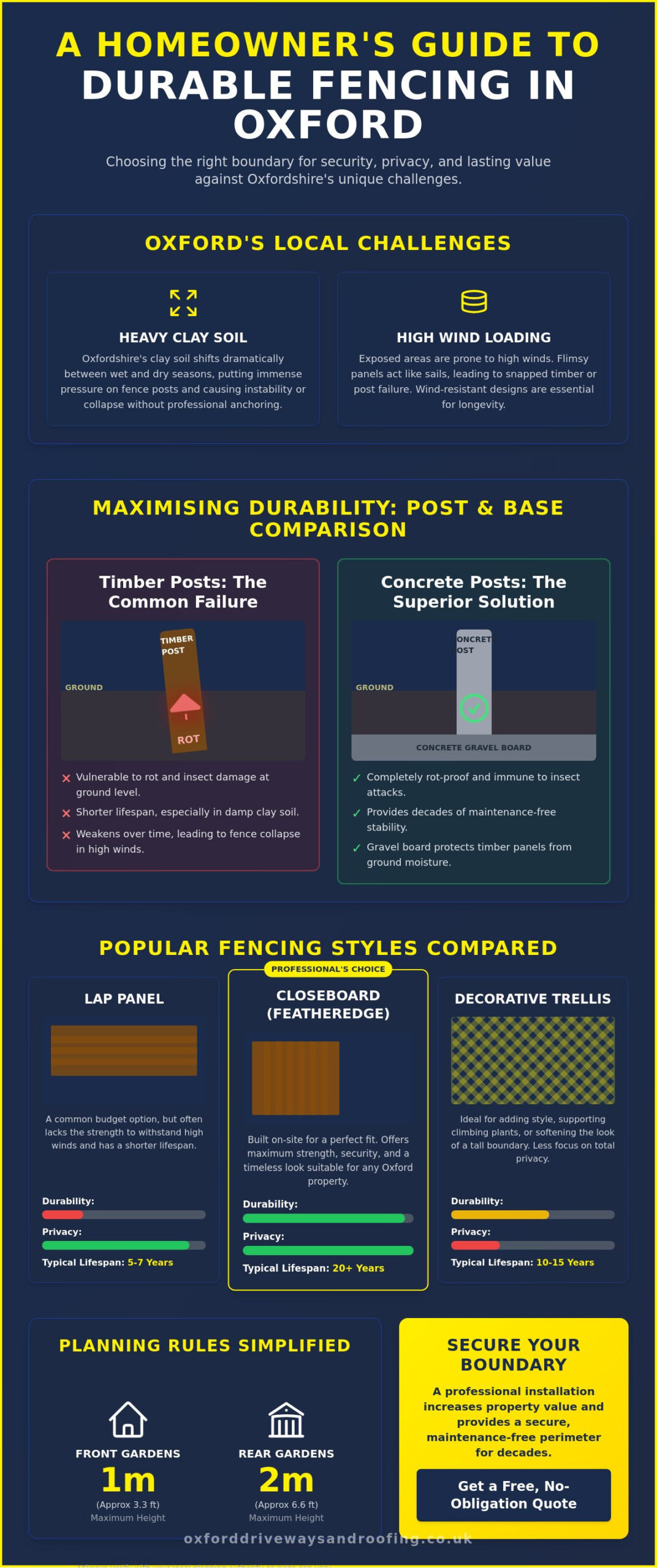
Oxfordshire’s geography presents challenges that many generic guides overlook. The heavy clay soil found in many parts of our county can shift significantly between wet winters and dry summers. This movement puts immense pressure on fence posts. Without professional installation, even the most expensive panels will lean or collapse as the ground settles. We prioritise building trust by ensuring your boundary is anchored correctly for these specific soil conditions. It’s about providing stability in a field where homeowners often feel overwhelmed by the choice of materials.
Oxfordshire Weather and Your Boundary
The UK storm seasons are becoming more unpredictable. Standard lap panels often fail because they act like sails in the wind, catching every gust until the timber snaps or the post fails. For homeowners in exposed areas like Botley or Faringdon, understanding “wind-loading” is essential. This term describes the force exerted by the wind on the surface of your fence. We recommend using pressure-treated timber that resists the damp Oxfordshire climate. This professional intervention prevents further damage or costly failure during the next big storm. It’s a logical approach to long-term property care.
Aesthetic Harmony with Oxford Architecture
Matching your boundary to the local environment is a key part of successful front garden transformations Oxford. Whether you live in a red-brick Victorian terrace in East Oxford or a modern development in Abingdon, the style must complement the existing masonry. For example, traditional closeboard fencing offers a sturdy, timeless look that pairs well with Cotswold stone. Conversely, decorative trellis can soften the appearance of a tall boundary in more compact city gardens. Balancing the need for privacy with an “open” feel requires a thoughtful approach to design. We act as a guide to help you simplify this decision-making process, ensuring the final result enhances your home’s kerb appeal.
A Roundup of Popular Fencing Styles for Oxford Gardens
Selecting the right style for your oxford fencing project requires a balance between aesthetic appeal and structural resilience. Whilst budget-friendly lap panels are a common sight, they often lack the durability required to withstand the test of time in Oxfordshire’s variable climate. In contrast, premium installations offer a significantly better cost-to-longevity ratio. Understanding the differences between these options helps you make an informed decision that secures your property for years to come. A well-built fence acts as a steady, reliable anchor for your entire outdoor space.
The lifespan of a boundary is largely dictated by its construction method. Standard panels might last five to seven years before the timber begins to warp or the thin slats break under pressure. Professional-grade solutions, however, are designed to remain functional and attractive for decades. By choosing higher-quality materials from the outset, you alleviate the stress of frequent repairs and provide a safe and guaranteed outcome for your property maintenance budget.
Closeboard Fencing: The Durable Oxford Standard
Closeboard fencing, often referred to as featheredge, remains the preferred choice for professional contractors across the county. Unlike pre-made panels that can be flimsy, true closeboard is constructed on-site using individual overlapping vertical boards. This method allows for a more precise fit, especially on gardens with uneven gradients or awkward corners. Because it’s built from the ground up, it offers maximum security and a much longer lifespan than standard store-bought alternatives. Investing in this style provides a sense of stability for homeowners who prioritise strength and privacy.
Decorative Fencing and Trellis Work
For smaller urban spaces or more formal garden designs, decorative panels and trellis work provide an elegant alternative. Trellis is particularly effective for adding height to a boundary without completely blocking out the natural light that Oxford’s narrow gardens often crave. Many homeowners are now opting for modern horizontal slatted fencing to achieve a contemporary look that mirrors high-end city developments. These styles integrate beautifully with other landscape features, such as those provided by resin bound patio installers, creating a seamless transition from the ground to your perimeter.
When planning your next oxford fencing installation, it’s vital to consider the legal framework surrounding garden boundaries. You should consult the official Planning Permission for fences to ensure your chosen style complies with height restrictions. Generally, rear garden fences can reach up to two metres, but front garden installations are typically limited to one metre. If you’re unsure which style best suits your property’s needs, our team at Oxford Driveways And Roofing Ltd. can guide you through the selection process with expert precision.
Maximising Durability: Concrete vs Timber Posts and Gravel Boards
The longevity of your oxford fencing depends almost entirely on the components that remain hidden beneath the surface. While a high-quality panel provides the visual appeal, the posts and gravel boards serve as the structural backbone. The most frequent cause of boundary failure is not the wind itself, but the silent progression of post rot at the ground level. When timber is in direct contact with damp earth, it eventually loses its structural integrity and snaps. Choosing the right support system is a logical step toward ensuring a safe and guaranteed outcome for your garden project.
Concrete posts are often considered the “fit and forget” solution for Oxfordshire properties. They are impervious to rot, insects, and moisture, making them an incredibly stable choice for a permanent boundary. For homeowners who prefer the natural aesthetic of wood, modern alternatives like UC4 treated timber or PermaPosts offer significantly improved resistance compared to standard pressure-treated options. These products are specifically engineered to withstand ground-contact conditions, providing a reliable middle ground between traditional looks and modern durability. We focus on these high standards to prevent the stress of premature failure.
The Problem with Clay Soil in Oxfordshire
Heavy clay soil is prevalent across many parts of Oxford, and it presents a unique challenge for timber longevity. Clay retains water for much longer than sandy soils. This means fence posts are often sitting in a saturated environment for months on end. This constant moisture accelerates the decay process significantly. To counter this, we utilise deeper post holes and specific aggregate mixes that facilitate better drainage away from the timber. A professional installation also includes a “weathering” finish on the concrete footings. This is a sloped surface that directs rainwater away from the base of the post. It’s a precise detail that prevents water from pooling and causing damage.
Gravel Boards: Small Cost, Big Protection
A gravel board is a sacrificial barrier that extends panel life by up to 50% by preventing the timber from touching the damp ground. These boards are installed at the very base of the fence, taking the brunt of the moisture and debris that would otherwise rot the bottom of your expensive panels. Whilst timber gravel boards are available for a uniform look, concrete versions provide the ultimate protection against the elements. It’s a small additional investment that offers immense peace of mind. As you finalise your design, it is also worth reviewing the UK planning permission for fences to ensure your total height, including the gravel board, remains within legal limits. This structured approach to construction ensures your boundary remains a disciplined and careful addition to your home.
Planning Permission and Boundary Rules in Oxford
Establishing a new boundary requires more than just choosing the right materials; it involves navigating the legal framework that governs oxford fencing. Many homeowners feel uncertain about where their rights end and their neighbour’s responsibilities begin. We prioritise building trust by acting as a steady guide through these regulations, ensuring your project meets all local requirements. Adhering to these rules provides peace of mind and prevents the stress of future disputes or enforcement notices from the local authority.
In most residential areas across Oxfordshire, you generally do not need planning permission for a fence that is up to 2 metres in height for a rear garden. However, this limit is reduced to 1 metre if the fence is adjacent to a highway or a footpath used by vehicles. This restriction is primarily in place to maintain visibility splays for road safety, ensuring that motorists and pedestrians have a clear line of sight. If your property is a Listed Building or situated within one of Oxford’s many Conservation Areas, such as Headington or Jericho, stricter rules often apply. In these instances, professional intervention is essential to ensure the character of the local architecture is preserved whilst securing your property.
Legal Height Restrictions and Planning
To ensure your project remains compliant, follow these three essential steps:
- Step 1: Always measure the height of your proposed fence from the highest ground level immediately adjacent to the boundary to ensure it stays within the 2-metre allowance.
- Step 2: Check for specific planning constraints if your property borders a public highway, as visibility requirements are strictly enforced by the council.
- Step 3: Consult with Oxford City Council if you are unsure about local bylaws, especially if you intend to exceed standard height limits or live in a protected area.
Neighbourly Relations and Boundary Disputes
Boundary ownership is a frequent source of confusion. You should first consult your property deeds; a “T” mark on the plan usually indicates which party is responsible for maintaining that specific boundary. There is also the age-old debate regarding the “good side” of the fence. Whilst it is traditional for the finished face to look towards the neighbour, modern oxford fencing designs often look identical from both sides, providing a balanced aesthetic for everyone involved. Although the Party Wall Act typically applies to masonry, the same spirit of mutual agreement should apply to any shared timber boundary.
We recommend notifying your neighbours well in advance of any work beginning. This courtesy helps maintain privacy and prevents friction during the construction phase. You might even find that your neighbour is willing to organise a shared project, allowing you to split the costs fairly whilst achieving a consistent look along the entire line. If you are ready to secure your boundary with a professional installation, contact Oxford Driveways And Roofing Ltd. to discuss your project requirements.
Professional Oxford Fencing and Landscaping by Oxford Driveways And Roofing
At Oxford Driveways And Roofing Ltd., we treat every boundary as a critical component of your home’s structural integrity. Our “Trusted Specialist” approach ensures that your oxford fencing doesn’t just look impressive on the day of completion but continues to provide security through a decade of harsh UK winters. We prioritise stability and long-term results by using proven methods that have been refined over years of local service. This grounded and helpful guidance aims to alleviate the stress of property maintenance, providing you with a safe and guaranteed outcome for every project we undertake.
Integrating your garden boundaries into a wider property maintenance plan is a logical way to ensure consistency across your exterior. Many of our clients find significant value in using a single, reliable contractor to manage both their landscaping and their driveway requirements. By working with block paving specialists Oxford, you can achieve a seamless transition between your hard landscaping and your new fence. This holistic approach ensures that the precision and craftsmanship found in our paving work are mirrored in the installation of your garden boundary, creating a unified look whilst maintaining the highest standards of quality. For homeowners looking to take this coordination even further, our guide to patios and driveways explains how to create a seamless architectural statement across your entire exterior whilst meeting the latest 2026 drainage regulations.
Why Choose a Local Oxford Contractor?
Our team possesses extensive knowledge of the local terrain and weather patterns across Abingdon, Swindon, and Faringdon. This regional expertise allows us to anticipate challenges like heavy clay soil or high-wind corridors before they cause a structural failure. When you choose a local specialist, you are investing in reliable, guaranteed work that is tailored specifically to the Oxfordshire landscape. Beyond fencing, our clients benefit from our full range of property solutions, including professional flat roof installation Oxfordshire. This breadth of expertise means we can identify and address potential issues across your entire property, from the roofline down to the garden gate. Homeowners who want to understand the full scope of exterior improvements available to them will find our overview of services as patio and driveway specialists Oxford homeowners trust an invaluable resource for planning a complete property transformation.
Get Your Fencing Quote for 2026
The process of securing your property begins with a thorough site survey and a transparent, detailed quote. We walk you through every step of the installation, explaining the importance of each material and technique used to ensure longevity. Our team handles the entire project, including the responsible disposal of your old fence and comprehensive site clearance. This methodical and thorough communication rhythm ensures you remain informed and confident throughout the build. To start your project with a seasoned professional, Book your Oxford fencing consultation today with Oxford Driveways And Roofing Ltd. and experience the peace of mind that comes with expert craftsmanship.
Securing Your Oxfordshire Boundary for the Future
Investing in high-quality oxford fencing is about more than just aesthetics; it’s about providing long-term security and stability for your home. By choosing the right materials, such as premium-grade timber and concrete posts, you ensure your boundary withstands the unpredictable UK weather whilst adhering to local planning regulations. We’ve explored how a professional installation prevents the common pitfalls of ground rot and storm damage, ultimately adding tangible value to your property. These structural choices provide the peace of mind that your garden remains a safe and private sanctuary.
Our team brings expert local knowledge to every project, ensuring your new boundary complements the unique architecture found across Oxfordshire. With our fully guaranteed workmanship and commitment to using only premium-grade materials, you can rest assured that your investment is built to last. Whether you’re looking for traditional closeboard or decorative trellis, we’re here to guide you through every step of the process with transparency and care. A well-constructed fence is a disciplined addition to any home maintenance plan.
Request a Free Fencing and Landscaping Quote from Oxford Driveways And Roofing to begin your garden transformation today. We look forward to helping you create a secure and beautiful outdoor space that you can enjoy for many years to come.
Frequently Asked Questions
Do I need planning permission for a 6ft fence in Oxford?
In most residential areas of Oxford, you don’t need planning permission for a 6ft fence in a rear garden because it falls under the 2-metre height limit. However, if the fence is in a front garden or borders a public highway, the legal limit is reduced to 1 metre. Homeowners in conservation areas or listed buildings should always consult the local council before starting any oxford fencing project to ensure compliance with specific heritage regulations.
Which is better for Oxford gardens: timber or concrete posts?
Concrete posts are generally the superior choice for Oxfordshire gardens due to the heavy clay soil found across the region. Whilst timber posts offer a traditional aesthetic, they are prone to rotting at the ground level where moisture accumulates in the clay. Concrete posts provide a safe and guaranteed outcome for your boundary, as they are impervious to rot and provide a steady, reliable foundation that withstands high winds and ground movement.
How much does professional fencing installation cost in Oxfordshire?
The cost of a professional installation depends on several factors, including the total length of the boundary, the chosen materials, and the complexity of the ground conditions. Site access and the need to dispose of old materials also play a role in the final investment. We provide transparent, detailed quotes following a thorough site survey, ensuring you understand the value of using premium-grade materials and expert installation techniques for a long-lasting result.
How long should a well-installed garden fence last?
A professionally installed fence using pressure-treated timber and concrete posts should reliably last between 15 and 25 years. In contrast, budget lap panels installed with timber posts often fail within 5 to 7 years due to rot and wind damage. By choosing high-quality components and proven construction methods, you alleviate the stress of frequent repairs and ensure your boundary remains a permanent and stable fixture of your property maintenance plan.
What is the most secure type of fencing for a residential property?
Closeboard fencing, often called featheredge, is the most secure option for residential properties. Its solid construction consists of overlapping vertical boards that provide total privacy and are difficult for intruders to climb. When installed as part of a professional oxford fencing solution, it creates a robust and formidable barrier. For maximum security, we recommend combining closeboard panels with concrete gravel boards to prevent any gaps from forming at the base over time.
Can I install a fence myself, or should I hire an Oxford professional?
Whilst DIY installation is an option, hiring a seasoned professional ensures the structural integrity of the boundary. Professionals possess the expertise to handle Oxford’s specific soil challenges, ensuring post holes are dug to the correct depth and filled with the right aggregate mix. This professional intervention prevents the common issue of fences leaning or collapsing during the first heavy storm, providing you with a reliable result that amateur efforts often struggle to achieve.
What happens if my fence borders a public footpath or road?
Fences bordering a public highway or footpath are subject to stricter height restrictions to maintain visibility for drivers and pedestrians. Generally, these boundaries must not exceed 1 metre in height without obtaining specific planning permission. Ignoring these regulations can lead to enforcement notices from the local authority. It’s a logical step to seek expert advice to ensure your new boundary meets all safety requirements whilst still providing the security your home needs.
How do I maintain my fence to prevent rot and weather damage?
The most effective way to prevent rot is to ensure timber components are never in direct contact with damp soil. Using concrete gravel boards creates a sacrificial barrier that protects the main panels from moisture. Regularly clearing away wet leaves and debris from the base of the fence also prevents decay. Applying a high-quality timber treatment every few years will help the wood resist the damp Oxfordshire climate and maintain its structural strength against the elements.