
After the heavy winds of Storm Claudia swept through Oxfordshire in November 2025, many homeowners looked up at their rooflines and saw nothing but intact tiles, unaware that the real damage was already quietly compromising their rafters. It’s natural to feel a sense of relief when your home appears to have weathered a gale unscathed, but the stress of hidden leaks and the confusion of insurance paperwork can quickly become overwhelming. You shouldn’t have to guess whether your property is truly safe or worry about the long-term effects of progressive structural decay.
This guide will show you how to identify the subtle signs that necessitate a professional storm damage roof repair before they turn into costly internal rot. We’ll provide a clear plan to help you navigate the repair process with confidence, ensuring you have the documentation needed for a successful claim. By the end of this article, you’ll understand how to secure your Oxfordshire home and achieve the peace of mind that comes from a guaranteed, watertight result.
Key Takeaways
- Learn why immediate professional inspections are essential to prevent hidden water ingress from turning into progressive structural decay within your home’s timber frame.
- Discover the specific risks high winds and torrential rain pose to different Oxfordshire roof types, from traditional pitched tiles to modern flat systems.
- Master the essential safety steps and temporary measures to protect your interior whilst waiting for a specialist assessment.
- Understand how to effectively document damage to satisfy UK insurance requirements and decide whether you need a minor storm damage roof repair or a more comprehensive overhaul.
- Gain peace of mind by learning how premium materials and proven local expertise ensure your property remains watertight and structurally sound for the long term.
Spotting Storm Damage: Visible Signs and Hidden Risks
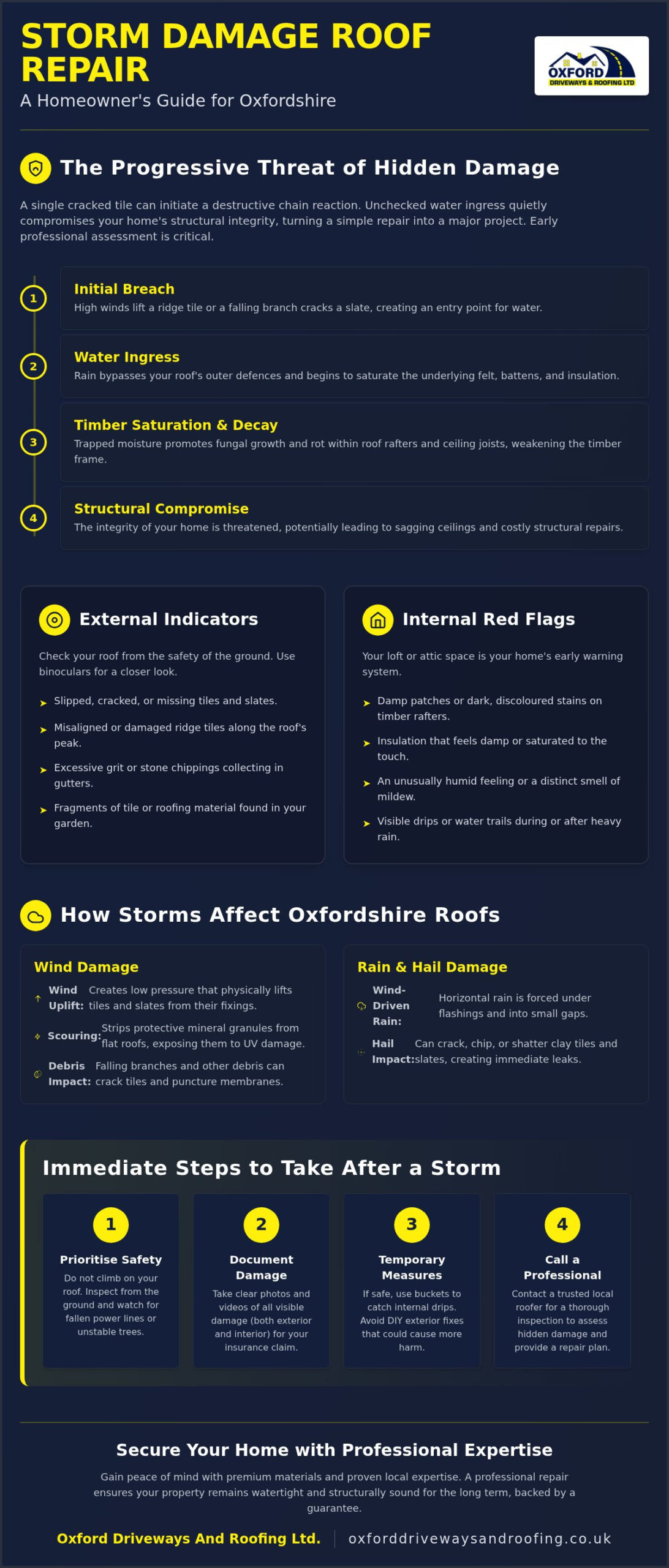
The aftermath of a severe Oxfordshire storm often leaves homeowners scanning their property for obvious signs of destruction, such as fallen branches or shattered windows. Yet, the most significant threats to your home’s longevity are often the ones you can’t see from the driveway. A swift assessment is crucial because water ingress follows a predictable, destructive timeline. Once moisture bypasses your tiles, it begins to saturate the wooden battens and rafters. If left unaddressed, this dampness triggers fungal growth and timber decay, turning a simple fix into a major structural project. Securing a professional storm damage roof repair early ensures these hidden risks are neutralised before they compromise your home’s integrity.
Structural threats aren’t always loud. Whilst a missing slate is a clear problem, a hairline crack in a ridge tile can be just as dangerous over time. These small breaches allow water to seep into the internal wall cavities, often bypassing or overwhelming your property’s existing damp proofing measures. When water travels down the inside of a cavity wall, it can lead to rising damp and ruined plasterwork far from the original leak site. Our approach prioritises identifying these progressive threats early, using precision and proven methods to restore your roof’s protective envelope.
External Indicators: What to Look for from the Ground
You don’t need to climb a ladder to spot the first signs of trouble. Use a pair of binoculars to inspect your roofline for slipped, cracked, or missing clay tiles and slates. Pay close attention to the ridge tiles along the very top of the roof; if these appear misaligned, the mortar bond has likely failed, leaving the rest of the structure vulnerable to the next gust of wind. It’s also wise to check your gutters for an unusual amount of grit or stone chippings. This debris often indicates that your roofing materials are degrading, sometimes accelerated by hail damage to roofs during particularly violent weather events. If you see fragments of tile in the garden, your roof’s primary defence is already compromised.
Internal Red Flags: When the Damage Reaches the Loft
The loft is your home’s early warning system. During or immediately after heavy Oxfordshire rainfall, take a torch into the roof space to look for damp patches on the rafters. You might not see a steady drip; instead, look for dark, discoloured stains on the timber or the underside of the felt. Saturated insulation is another critical sign of a failing structure. Fibreglass and mineral wool insulation act like a sponge, trapping moisture against the ceiling joists for weeks after the rain has stopped. This hidden moisture is a primary cause of internal rot and can eventually lead to sagging ceilings if the storm damage roof repair is delayed. If your loft feels unusually humid or smells of mildew, the roof is no longer airtight.
How Different Storms Affect Oxfordshire Roofs
Oxfordshire’s geography within the Thames Valley creates unique environmental pressures that can test even the most robust roofing structures. In November 2025, Storm Claudia demonstrated how quickly local weather can escalate, with wind speeds frequently exceeding the 55 mph threshold that many UK insurers use to define a storm event. These conditions don’t just cause random damage; they exploit specific vulnerabilities in your home’s exterior. Whether you own a modern townhouse in Abingdon or a heritage property in the centre of Oxford, understanding how these forces interact with your roof is the first step toward a successful storm damage roof repair.
Wind Damage: Lifting, Scouring, and Debris
High-velocity gusts create a phenomenon known as wind uplift. As air moves rapidly over the peak of a roof, it creates a zone of low pressure that can physically lift tiles or slates away from the wooden battens. This effect is particularly pronounced on older pitched roofs where mechanical fixings may have weakened over decades. Beyond dislodging ridge tiles, wind also causes ‘scouring’ on flat surfaces. This process involves the wind stripping away the protective mineral granules or stone chippings from the surface, leaving the underlying membrane exposed to UV damage and premature failure. Falling branches from Oxfordshire’s many mature trees further increase the risk, as even a small impact can crack a clay tile and provide a direct path for water ingress.
Rain and Hail: Ingress and Impact
Torrential rain brings its own set of challenges, specifically through ‘wind-driven rain’. Unlike a vertical downpour, wind-driven rain is forced horizontally, allowing it to bypass traditional lead flashings and enter gaps that would normally remain dry. Following official government advice on property maintenance can help you prepare, but the sheer volume of water seen during the May and June 2025 storms can easily overwhelm older guttering systems. When gutters fail to clear water quickly enough, the liquid often backs up under the eaves, saturating the fascia boards and the ends of your structural rafters.
Temperature fluctuations immediately following a storm often accelerate these issues. In the UK, a heavy rainstorm is frequently followed by a sharp drop in temperature. If water has penetrated a small crack in a tile or chimney stack, the subsequent freezing causes the water to expand, widening the breach and necessitating a more extensive storm damage roof repair. For those with older outbuildings or extensions, ensuring your flat roof systems are inspected after such events is vital to maintain the stability of the entire structure. Period properties across Oxfordshire are especially at risk, as traditional materials like lime mortar can be washed away by consistent, heavy impact, leaving chimney stacks and ridge lines unstable.
Assessing the Damage: Repair, Overhaul, or Insurance Claim?
Deciding between a targeted storm damage roof repair and a complete overhaul is a balance of immediate cost and long-term security. Whilst a few dislodged tiles might seem like a minor inconvenience, they often signal a broader failure of the mechanical fixings across an ageing roof. Homeowners must also navigate the complexities of UK building insurance, where the distinction between sudden storm impact and ‘fair wear and tear’ determines whether a claim is successful. If a roof has been poorly maintained, insurers may argue that the storm merely accelerated an inevitable failure, potentially invalidating your cover. Addressing small issues immediately is essential; ignoring minor leaks now can lead to rejected claims in the future if the damage is deemed to have become progressive through negligence.
Repair vs. Replacement: Making the Right Choice
A simple tile replacement is often sufficient if the surrounding structure remains sound and the damage is isolated to a specific impact. However, patching can become a false economy if the roof has reached the end of its natural lifespan. If you find yourself frequently commissioning small repairs after every gust of wind, it’s a sign that the underlying materials have lost their integrity. In England, it’s also worth noting that if you replace more than 50% of your roof, you will likely need Building Regulations approval. A full installation using modern, high-performance materials offers a far better return on investment through improved energy efficiency and the peace of mind that comes with a comprehensive guarantee. We focus on providing a clear, honest assessment to help you choose the most stable path forward for your property.
Winning the Insurance Battle
Securing a successful claim requires methodical documentation and evidence of the storm’s severity. Insurers typically define a storm as an event with wind speeds exceeding 55 mph, such as those recorded during Storm Claudia. To support your case, you should take clear photographs of the damage from the ground as soon as it’s safe to do so. Obtaining a professional storm damage roof repair quote that includes a detailed roofer’s report is often the deciding factor in a claim’s approval. This report should distinguish between the sudden impact of the weather and the general condition of the roof. Additionally, you have a duty to perform ’emergency mitigation’. This means taking reasonable steps, such as arranging for a temporary waterproof covering, to prevent further internal water damage. Doing so demonstrates to your insurer that you’re actively protecting the property, which helps safeguard your right to a full payout.
Immediate Steps to Take After a Storm in Oxford
The silence following a major storm is often misleading. Whilst the winds may have died down, the structural integrity of your property remains under threat until a specialist assessment is complete. Your immediate priority is to ensure the safety of everyone in the building whilst taking practical steps to limit further damage. A professional storm damage roof repair is a methodical process that begins with stabilization. By acting quickly and calmly, you can prevent a minor leak from escalating into a significant structural failure that could compromise your home’s safety and value.
Safety and First Response
Safety is paramount. You should never climb onto a storm-damaged roof yourself. High winds can leave tiles loose and the underlying structure weakened, making it extremely dangerous to walk on. Instead, conduct a safe visual survey from ground level using a pair of binoculars. Look for obvious signs of distress, such as dislodged ridge tiles or leaning chimney stacks. These are considered dangerous structures and require immediate professional attention. If you observe a ceiling sagging or see water pouring through light fittings, you should evacuate that room immediately and turn off the electricity at the mains. Structural ceiling concerns are a serious red flag that the roof’s weight-bearing capacity is compromised.
Securing Your Property
Once you’ve ensured everyone is safe, focus on securing the interior of your property. If you have active leaks, use buckets or waterproof tarpaulins internally to catch water and protect your flooring and furniture. This simple act of ’emergency mitigation’ is vital for your insurance claim, as it shows you’ve taken reasonable steps to protect the property. From the ground, check that your guttering and downpipes are clear of debris. Blocked gutters cause water to pool and overflow back into the eaves, which often leads to rot in the fascia boards and rafters.
Organising a professional inspection is the next logical step. Finding a reliable roofer with a strong local Oxford reputation is essential. A local specialist will be familiar with the specific clay tiles and heritage materials common in Oxfordshire, ensuring the storm damage roof repair is sympathetic to the original build. They will provide the detailed documentation required by UK insurers whilst ensuring the repairs meet the latest Building Safety Act 2022 standards. For a thorough assessment and peace of mind, you should book a professional roofing inspection as soon as possible to secure your home’s future.
Professional Storm Damage Repairs with Oxford Driveways and Roofing
Restoring your home after a significant weather event requires more than just a quick fix; it demands a methodical approach that addresses both visible damage and underlying structural risks. At Oxford Driveways And Roofing Ltd., we act as a steady partner for homeowners across Oxfordshire, providing the expert intervention needed to halt progressive decay. Our process for a storm damage roof repair is rooted in precision and transparency. We move from a thorough assessment to the deployment of proven techniques, ensuring that every component of your roofline, from the ridge tiles to the guttering, is returned to its most resilient state.
We understand that property maintenance can feel overwhelming, especially when dealing with the aftermath of high winds or heavy rain. By positioning ourselves as a trusted specialist, we aim to alleviate that stress through clear communication and high standards of craftsmanship. We don’t believe in temporary patches that fail during the next seasonal gale. Instead, we focus on long-term results that protect your investment and provide your family with a safe, watertight environment for years to come.
Our Roofing Expertise in Oxford and Abingdon
Our team brings local expertise to every project, whether you’re managing a traditional pitched roof in Abingdon or one of the modern flat roof systems found in newer Oxford developments. We recognise that a storm doesn’t just affect tiles; it often compromises the stability of your chimney stacks and the efficiency of your drainage. Our comprehensive service includes:
- Specialised Pitched Roof Repairs: Realigning slipped slates and replacing cracked clay tiles using materials that match your property’s existing aesthetic.
- Expert Chimney Rebuilding: Restoring the structural integrity of stacks that have been weakened by wind uplift or mortar erosion.
- Integrated Guttering Care: Ensuring your guttering and downpipes are perfectly aligned and clear to handle the volume of future Oxfordshire downpours.
- Ridge Tile Security: Using high-quality mortar or dry-fix systems to ensure your roof’s peak remains stable against scouring winds.
The Oxford Driveways And Roofing Ltd. Guarantee
Stability is at the core of everything we do. We use only premium-grade materials for every storm damage roof repair, ensuring that the components we install are built to last amongst the unpredictable UK climate. This commitment to quality is why we can offer fully guaranteed workmanship on our projects. We want you to feel confident that once we leave your property, the work is finished to a standard that exceeds basic requirements.
A professional repair is an investment in your home’s future. By choosing a firm with a proven reputation in Oxford, Abingdon, and Swindon, you ensure that your property benefits from disciplined, detail-oriented construction. If you’re concerned about the state of your roof following recent weather, don’t leave it to chance. Contact us today for a reassuring assessment and let our specialists restore the strength and longevity of your home.
Securing Your Home Against Future Storms
Your property is your most significant investment, and its roof is the primary line of defence against the unpredictable Oxfordshire weather. We’ve explored how identifying hidden water ingress and documenting damage for insurance claims are vital steps in the recovery process. Ignoring minor issues today only invites progressive structural decay tomorrow. Engaging a professional for a storm damage roof repair is the most effective way to protect your property’s integrity and long-term value.
As local Oxfordshire specialists, we prioritise your peace of mind by using premium-grade materials and providing fully guaranteed workmanship on every project. Whether you’re dealing with dislodged ridge tiles or a failing flat roof system, our methodical approach ensures a durable and watertight result. Don’t let the stress of recent weather linger or compromise your safety. Secure your home today with a professional roof inspection from Oxford Driveways and Roofing. Taking proactive steps now provides the stability your home needs to weather whatever the next season brings.
Frequently Asked Questions
How much does a typical storm damage roof repair cost in Oxford?
The cost of a storm damage roof repair depends on the severity of the weather impact and the specific materials required for the restoration. Industry data for 2026 indicates that minor repairs in the UK typically fall between £200 and £600, whilst more substantial structural work can exceed £1,000. Because every property is unique, we provide a methodical assessment to ensure you receive a precise plan for your home’s recovery.
Will my buildings insurance cover the cost of roof repairs after a storm?
Most UK buildings insurance policies cover damage resulting from sudden, extreme weather events, provided the property has been well-maintained. Insurers often define a storm as an event with wind speeds exceeding 55 mph, such as those seen during Storm Claudia in November 2025. It’s essential to provide clear documentation and a professional roofer’s report to distinguish the sudden damage from general wear and tear.
How quickly can Oxford Driveways and Roofing respond to a leak?
We understand the stress that a failing roof causes and aim to schedule inspections as quickly as possible to prevent progressive internal damage. Whilst we don’t offer a 24/7 emergency call-out service, our local presence in Oxford and Abingdon allows us to be responsive to the needs of our community. Our priority is to stabilize your property and provide a guaranteed, long-term solution rather than a temporary patch.
Can I repair a storm-damaged roof myself using DIY kits?
You should not attempt to repair a storm-damaged roof yourself, as the risks to your safety and the property’s integrity are significant. DIY kits often provide a false sense of security and fail to address hidden structural issues like saturated insulation or timber decay. Professional repairs ensure your home meets the Building Safety Act 2022 standards and help maintain the validity of your home insurance policy.
What is the difference between storm damage and general wear and tear?
Storm damage is characterized by sudden, identifiable destruction such as dislodged ridge tiles, debris impact, or tiles lifted by wind uplift. General wear and tear is a gradual process involving the natural degradation of materials over decades, such as crumbling mortar or thinning felt. Insurers will look for evidence of a specific weather event to confirm that the damage was sudden rather than a result of neglected maintenance.
Should I replace my entire roof if only a few tiles are missing?
A full replacement is rarely necessary for a few missing tiles if the underlying structure and remaining materials are in good condition. However, if the storm has revealed widespread failure of the mechanical fixings or if you’re replacing more than 50% of the roof area, Building Regulations approval is required in England. We provide an honest evaluation to help you choose between a targeted storm damage roof repair and a complete overhaul.
How do I know if my chimney stack has been damaged by high winds?
You can often identify chimney damage by conducting a visual survey from ground level with binoculars. Look for leaning stacks, cracked masonry, or lead flashing that has been pulled away from the brickwork. High winds can compromise the mortar bond, creating a dangerous structure that requires expert chimney rebuilding to prevent it from collapsing and causing further damage to your roofline.
Does a flat roof suffer more storm damage than a pitched roof?
Both systems face unique risks; neither is inherently more vulnerable, but the nature of the damage differs. Pitched roofs are susceptible to tile lifting and ridge failure, whilst flat roof systems often suffer from ‘scouring’ where wind strips away protective granules. Additionally, torrential rain can cause water to pool on flat surfaces if the drainage is compromised, leading to membrane stress and leaks that require specialist intervention.