
Imagine standing by your window during a heavy British downpour, only to see a steady waterfall drenching your exterior masonry instead of flowing safely into the drains. For many local residents, the complex system of guttering and downpipes Oxford properties require is something they only notice when it begins to fail, leading to preventable damp and the stress of potential structural damage. It’s entirely natural to feel overwhelmed when gutters overflow or when you don’t know if your heritage home needs a specific material match to maintain its historic character.
This guide provides you with the expert knowledge needed to master your roof’s drainage system, from identifying subtle leaks before they escalate to choosing between modern uPVC and durable metal options. A dry home starts with a reliable system. You will learn how to establish a clear maintenance schedule that provides peace of mind and keeps your property dry throughout the seasons. By understanding the essentials of material longevity and proper installation, you can make informed decisions that protect your investment and ensure your home remains a secure, damp-free environment for years to come.
Key Takeaways
- Understand how a cohesive rainwater management system prevents costly water ingress to your home’s foundations and masonry.
- Discover the ideal materials for guttering and downpipes Oxford properties require, comparing the longevity of traditional metals with the affordability of modern uPVC.
- Learn to distinguish between simple blockages and structural failures using a specialist diagnostic checklist to determine when to repair or replace.
- Establish a reliable seasonal inspection routine for Spring and Autumn to ensure your roofline remains clear and functional throughout the year.
- Gain insights into the comprehensive professional approach to roof drainage, ensuring every installation is precise and built to last.
Understanding the Importance of Guttering and Downpipes in Oxford
The system of guttering and downpipes Oxford homes rely on is a precisely engineered rainwater management network. It’s designed to protect every layer of your house, from the topmost tiles to the deepest foundations. When we view these components as a single, cohesive unit, it becomes clear that a failure in one area quickly compromises the rest. Oxford’s unique environment, characterised by heavy autumn leaf fall and sudden winter frosts, places immense pressure on these systems. If water remains trapped in a gutter during a freeze, it expands with enough force to split seams or pull brackets from the masonry. Over time, the long-term consequences of such neglect include timber rot in the rafters and the slow creep of internal dampness through the walls.
Maintaining a functional drainage system isn’t just about aesthetics; it’s a fundamental part of property preservation. A well-designed system ensures that water is captured at the roofline and transported through a controlled path to the ground-level drainage. This process prevents the “waterfall effect” where cascading water hits the ground with enough force to splash back onto the walls or erode the soil around your footings. By managing this flow, you protect the structural integrity of your home and avoid the stress of unexpected, large-scale repairs.
The Role of Effective Drainage in Property Preservation
Correctly installed downpipes perform the vital task of redirecting thousands of litres of water away from the base of your property. If this water is allowed to spill over or leak directly onto the ground, it saturates the soil and can eventually penetrate the masonry. This saturation is a primary cause of structural issues, often leading to the requirement for damp proofing for walls Oxford homeowners must address to protect their interiors. A fundamental part of Understanding Rain Gutter Systems is the realisation that professional alignment is non-negotiable. Our specialists ensure that every run has a consistent “fall” towards the outlet. Without this precision, water begins “pooling” in the mid-section, creating stagnant traps that increase weight and accelerate the degradation of the entire system.
Common Guttering Issues Facing Oxfordshire Homeowners
Oxfordshire’s abundance of trees and moss-prone tiles means local drainage systems face constant blockages. Moss is particularly troublesome; it acts as a sponge, slowing down the speed of water flow and trapping debris that would otherwise wash away. Beyond blockages, temperature fluctuations cause uPVC to expand and contract. If the system wasn’t fitted with the correct expansion gaps, these joints eventually fail and leak. These high-level failures are particularly dangerous for other architectural features. For instance, overflowing water can saturate the brickwork around your roofline, which often exacerbates the need for chimney rebuilding Oxfordshire residents might need to restore their home’s structural safety.
- Foundation Protection: Directing water to soakaways prevents soil erosion and foundation movement.
- Masonry Preservation: Keeping walls dry prevents “spalling,” where brick faces crumble due to freeze-thaw cycles.
- Roofline Integrity: Functional gutters protect the fascia boards and rafter ends from rot.
Selecting the Right Guttering Materials for Your Property
Choosing the correct setup for guttering and downpipes Oxford homeowners select depends heavily on the specific architectural demands of their property. A Victorian terrace in Jericho requires a vastly different approach than a modern development in Headington. When we select materials, we focus on three pillars: structural compatibility, aesthetic harmony, and long-term maintenance. It’s vital that any new installation adheres to the UK Roof Drainage Standards to ensure the system can manage the anticipated hydraulic load during peak rainfall. Precision in these early stages prevents water from bypassing the system and damaging your exterior walls.
A 20-year maintenance cycle looks different for every material. Whilst uPVC is often the most cost-effective initial investment, it may require more frequent inspections of the rubber seals and brackets due to thermal expansion. In contrast, metals like aluminium or cast iron offer superior longevity but come with their own care requirements, such as periodic repainting for iron to prevent oxidation. Colour matching is equally critical; ensuring your gutters complement existing fascias and soffits creates a seamless look that preserves your home’s kerb appeal. If you’re considering an upgrade, a bespoke material consultation can help you identify the most durable option for your specific roofline.
Modern uPVC Guttering: Efficiency and Low Maintenance
uPVC remains the most frequent choice for modern Oxford developments due to its versatility and resistance to corrosion. It’s lightweight, which reduces the stress on your roofline, and the clip-together components allow for a precise, leak-resistant installation. For properties with larger roof pitches, we often recommend “deep-flow” systems. These profiles have a higher capacity than standard half-round gutters, significantly reducing the risk of overspill during heavy summer storms. The smooth internal surface of plastic also helps debris wash away more effectively, reducing the likelihood of stubborn blockages.
Heritage Solutions: Cast Iron and Aluminium Systems
Oxford’s historic and listed buildings demand a higher level of care to maintain their aesthetic integrity. Cast iron is the traditional choice for these period homes, offering a robust, heavy-duty solution that can last over 50 years if correctly maintained. It provides a level of character that plastic simply cannot replicate. However, many homeowners are now opting for seamless aluminium. This modern alternative provides the classic look of traditional iron but is naturally rust-proof and significantly lighter. Aluminium systems are often finished in a polyester powder coating, which ensures the colour remains vibrant without the need for regular painting. This makes it an excellent middle ground for those wanting a heritage look with modern, low-maintenance performance.
- uPVC: Best for budget-conscious projects and modern homes; requires minimal cleaning and no painting.
- Cast Iron: Essential for listed buildings; provides unmatched strength and period-correct aesthetics but requires regular painting.
- Aluminium: A durable, rust-free option that balances heritage style with modern longevity and high capacity.
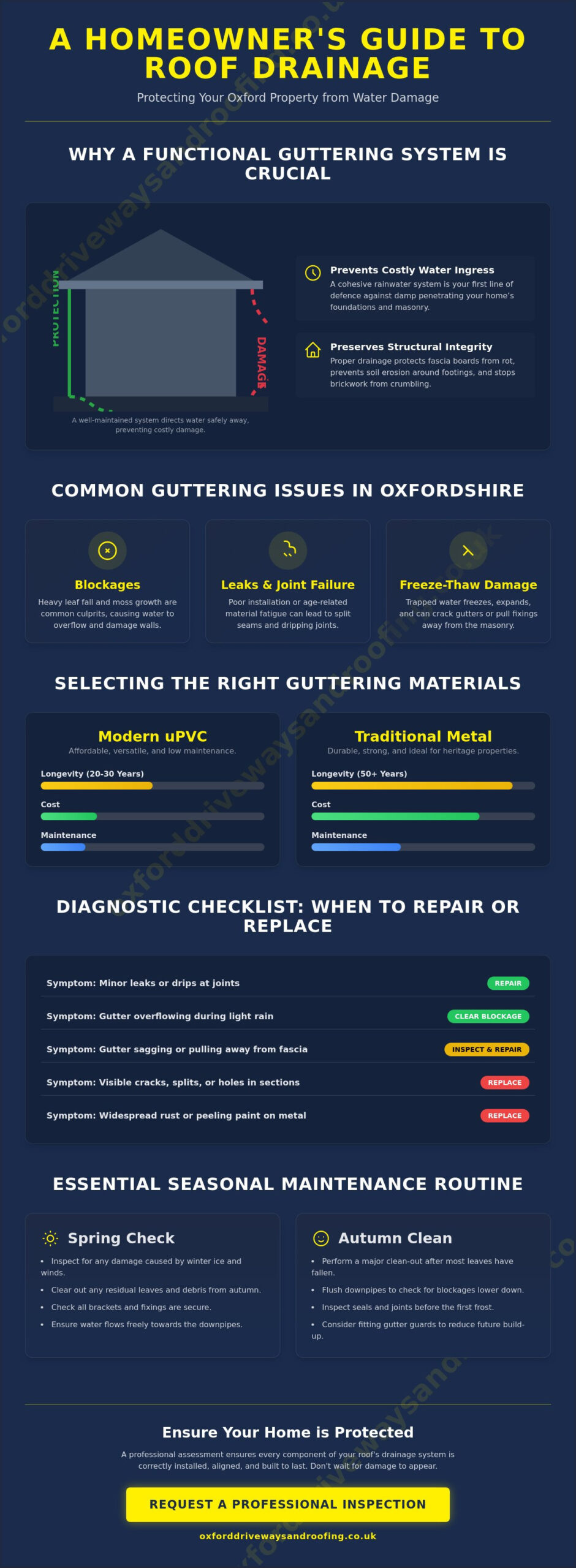
Assessing Gutter Damage: When to Repair or Replace
Determining whether your drainage system requires a simple clean or a full overhaul is a common challenge for many residents. When inspecting the system of guttering and downpipes Oxford homes utilise, it’s essential to distinguish between a temporary blockage and a fundamental structural failure. A blockage is usually a localized issue, such as a clump of moss or a stray tennis ball, which can often be resolved by following AXA’s guide to cleaning gutters. However, structural failure involves cracked profiles, perished seals, or warped sections that no longer maintain the necessary “fall” toward the downpipe. Ignoring these signs can lead to the “waterfall effect,” where water bypasses the gutter entirely during storms, putting your foundations at risk.
Safety is a primary concern when assessing damage. Attempting DIY repairs on high-reach areas or complex flat roof installation Oxfordshire sites carries significant risk without professional-grade ladders and fall-protection equipment. A specialist survey provides a safe, thorough diagnostic that identifies not just the visible leaks, but the underlying causes of the failure.
Identifying Early Signs of Gutter Failure
You don’t always need to wait for a storm to spot trouble. One of the most common indicators is the presence of “tiger stripes,” which are dark, vertical stains on the exterior of the guttering caused by pollutants bonding to the surface through small, persistent overflows. You should also look for sagging sections or brackets that have pulled away from the fascia, often a result of the weight of trapped water or snow. On the ground, check for soil erosion or “pitting” directly beneath the roofline. These small depressions in your garden or driveway suggest that water is consistently dripping from a failed joint above. If you’re also planning to improve your property’s exterior, understanding how proper drainage integrates with hardstanding areas is essential — our guide to block paving Abingdon installation and maintenance explains how to manage rainwater effectively across your entire driveway surface.
The Cost-Benefit Analysis of Replacement vs. Patching
Whilst a quick application of sealant might seem like a cost-effective fix, it’s often a false economy for older uPVC systems. As discussed previously, uPVC expands and contracts with the temperature; a patch of sealant rarely bonds permanently to a moving surface and will likely fail within a single season. Replacing the entire run ensures a consistent flow rate and eliminates the weak points created by mismatched old and new components. Beyond the functional benefits, modern, well-aligned guttering significantly enhances the kerb appeal and resale value of your property, giving potential buyers confidence that the home has been meticulously maintained.
- Joint Leaks: Persistent dripping from a union or corner piece usually indicates a perished rubber seal.
- Misalignment: If water pools in the middle of a run, the brackets may have shifted or been incorrectly spaced.
- Cracked Profiles: Visible splits in the material, often caused by freezing water, require immediate part or full replacement.
How to Maintain Your Guttering and Downpipes: A Step-by-Step Guide
Maintaining the system of guttering and downpipes Oxford residents rely on requires a proactive approach. It’s far easier to clear a handful of leaves in October than it is to repair a collapsed section in the middle of January. To begin, you’ll need a stable ladder, heavy-duty gloves, a small trowel or gutter scoop, and a bucket. Safety remains our absolute priority. Always ensure your ladder is on level ground and, if possible, have a second person to steady the base. Working at height carries inherent risks; if you feel at all uncertain about your reach or the stability of the structure, it’s time to step down and seek assistance.
Once you’ve cleared the visible debris, testing the system’s efficiency is straightforward. Use a garden hose to run water into the gutter at the furthest point from the downpipe. This allows you to observe the flow and ensure there’s no “pooling” in the mid-section, which we previously identified as a sign of bracket failure. It also lets you check for leaks at the joints whilst the system is under a simulated hydraulic load. If the water doesn’t reach the downpipe quickly, it suggests the “fall” or angle of the gutter has shifted and needs professional adjustment.
Seasonal Cleaning and Inspection Routine
A robust routine involves two main inspections: late Spring and late Autumn. In Spring, you’re looking for damage caused by winter frosts, such as split uPVC or loosened clips. During Autumn, the focus shifts to Oxford’s heavy leaf fall. Pay close attention to the “swan neck”, the curved section of the downpipe, where twigs often snag and create hidden dams. Additionally, inspect the “stop-ends” and outlets. These are common failure points where rubber seals can perish or become displaced, leading to the persistent drips that eventually cause masonry damage. A thorough Spring inspection should also extend to the very peak of your roof, as the freeze-thaw cycle that damages gutters can equally compromise the mortar bedding on your ridge tiles — our guide to ridge tile replacement Oxfordshire homeowners rely on explains how to identify and address these vulnerabilities before they escalate.
Addressing Minor Leaks and Blockages Safely
If you spot a minor leak, it might simply be a slipped joint. Carefully unclip the section, clean away any grit from the seal, and re-seat it firmly into the fitting. You should also clear the “shoe” at the base of the downpipe. If this area is blocked, water will pool at ground level, potentially saturating your foundations and leading to the damp issues we discussed earlier. However, if you discover cracked profiles or if the system remains misaligned despite your efforts, it’s best to stop the DIY attempt. For complex repairs or complete replacements, you can book a professional guttering and downpipe survey to ensure a guaranteed, long-term result.
- Spring Check: Inspect for frost damage, cracked brackets, and moss growth.
- Autumn Check: Clear leaves and debris to prevent winter blockages.
- Hose Test: Verify the flow and check for leaks in every joint.
- Downpipe Shoe: Ensure the exit point is clear to prevent ground-level saturation.
Professional Guttering and Downpipe Services in Oxford
Oxford Driveways And Roofing Ltd. stands as the trusted specialist for the high-quality installation of guttering and downpipes Oxford homeowners require for long-term property protection. We don’t just replace parts; we provide a methodical rainwater management strategy tailored to the specific architecture of your home. Our process begins with a thorough survey to identify current drainage failures and ends with a precision installation using premium-grade materials. These components are selected for their durability, ensuring they remain resilient against the harshest British winter frosts and heavy seasonal downpours.
By integrating guttering with our wider range of services, such as damp proofing or new roof installations, we offer a “one-stop” solution that simplifies your home maintenance. This holistic approach ensures that every element of your property’s exterior works in harmony to prevent water ingress and structural decay. We prioritise building trust through transparency, providing a clear path from the initial assessment to a guaranteed, high-standard finish.
Why Expert Installation Outperforms DIY
The difference between a DIY fix and a professional installation lies in the mathematical precision of the “fall.” A gutter must have a subtle, consistent pitch toward the downpipe outlet. If this angle is off by even a few millimetres, water will stagnate, increasing the weight on the brackets and inviting moss growth. Our specialists calculate these gradients precisely to ensure rapid drainage even during peak rainfall. We don’t guess; we measure to ensure the system performs exactly as intended.
We also ensure that bracket spacing is optimised for the specific material and anticipated load. During heavy snowfall or ice accumulation, the weight on a gutter run increases significantly. Professional spacing prevents the system from sagging or pulling away from the fascia boards. Choosing a professional also provides the security of comprehensive insurance and long-term guarantees. This gives you the peace of mind that your investment is protected by proven methods and high industry standards, ensuring a safe and predictable outcome for your project.
Comprehensive Roofline Solutions from Oxford Driveways And Roofing Ltd.
A functional drainage system is most effective when the surrounding roofline is in peak condition. We often combine gutter replacement with the restoration of fascias and soffits. This doesn’t just provide a fresh, clean look for your property; it ensures the timber or uPVC backing for your new gutters is structurally sound and rot-free. A complete roofline assessment should also account for the condition of the ridge at the very apex of your roof; compromised mortar bedding can allow water to track down into the roof structure and overwhelm even a perfectly functioning gutter system, which is why professional ridge tile replacement Oxfordshire specialists recommend addressing both elements together. We understand that home improvements can be intrusive, which is why our team is committed to a tidy and efficient workflow. We manage every aspect of the project with minimal disruption to your daily routine, leaving your site clean and your home secure.
If you’ve noticed overflowing water, damp patches on your masonry, or sagging sections of pipework, it’s time for a professional intervention. Contact Oxford Driveways And Roofing Ltd. today for a professional guttering survey to secure the future of your home.
- Precision Pitch: Expertly calculated “fall” to prevent stagnant water and debris build-up.
- Structural Integrity: Correct bracket spacing to withstand the heavy weight of snow and ice.
- Integrated Care: Combined gutter, fascia, and soffit services for a complete roofline overhaul.
- Guaranteed Results: Long-term protection backed by professional insurance and expert craftsmanship.
Securing Your Home’s Future with Reliable Drainage
A functional rainwater system is the most effective shield your property has against the unpredictable Oxfordshire weather. Throughout this guide, we’ve explored how the right choice of guttering and downpipes Oxford homes require can prevent structural dampness and preserve masonry. Whether you’ve opted for the modern efficiency of uPVC or the timeless strength of cast iron, maintaining a consistent inspection routine is the key to longevity. By identifying minor leaks early and ensuring your system’s “fall” remains precise, you protect your home’s foundations from the risks of water ingress and erosion.
When repairs become complex or it’s time for a full system upgrade, the team at Oxford Driveways And Roofing Ltd. is here to help. With decades of experience and a commitment to using only premium-grade, weather-resistant materials, we ensure every installation is built to last. All our work is fully guaranteed, providing you with the peace of mind that your property is in professional hands. Don’t wait for the next storm to test your roofline’s integrity. Request a Free Guttering Quote in Oxford today and take the first step towards a drier, more secure home. We look forward to helping you safeguard your investment with precision and care.
Frequently Asked Questions
How often should I have my gutters cleaned in Oxford?
You should aim to have your gutters professionally cleaned at least twice a year, typically in late Spring and late Autumn. Oxford’s abundance of mature trees and the prevalence of moss on older roof tiles mean that debris accumulates quickly. Regular cleaning prevents the blockages that lead to the “waterfall effect” and protects your masonry from persistent dampness during the wetter winter months.
What is the best material for gutters on a period Oxford home?
Cast iron or seamless aluminium are the superior choices for preserving the character of a period or listed building. Cast iron provides an authentic heritage look and exceptional strength, whilst seamless aluminium offers a rust-proof, low-maintenance alternative that replicates the traditional aesthetic. These materials ensure your property remains historically accurate while benefiting from modern durability and precision engineering.
Can I replace just a section of my guttering or do I need a full system?
You can replace a single section if the rest of the system is structurally sound and the seals are intact. However, it’s often difficult to match older uPVC profiles with new components due to manufacturer changes and natural weathering. If multiple joints are failing, a full replacement is usually the most cost-effective way to ensure a consistent flow rate and a guaranteed, leak-free result.
Why is water leaking from the back of my gutter onto the wall?
This issue is usually caused by a significant blockage or a failed rear seal that prevents water from flowing toward the downpipe. When water pools and has nowhere to go, it spills over the back edge of the gutter directly onto your exterior masonry. This is a serious problem that can lead to internal dampness and timber rot if the alignment isn’t corrected by a specialist.
How long does a professional gutter installation usually take?
A standard semi-detached house in Oxford typically takes one full day for a complete installation. More complex properties or those requiring traditional materials like cast iron may require two days to ensure every bracket is perfectly aligned and the “fall” is mathematically precise. We always aim to complete the work efficiently with minimal disruption to your daily routine while maintaining our high standards of craftsmanship.
Do I need scaffolding for a gutter repair on a two-storey house?
Scaffolding isn’t always necessary as our team uses specialist high-reach ladders and safety equipment for most standard residential repairs. However, if your property has restricted access, a particularly steep roof pitch, or requires extensive work on a flat roof system, we’ll assess the site first. Safety is our absolute priority, and we’ll only recommend scaffolding if it’s essential to protect our team and your property.
What are the signs that my downpipe is blocked underground?
The most common sign of an underground blockage is water backing up and overflowing from the “shoe” or gully at the base of the pipe. If your gutters are clear but the downpipe still overflows during heavy rain, the obstruction is likely located where the pipe connects to the soakaway or main drain. This requires professional attention to prevent water from saturating the soil around your home’s foundations.
Are uPVC gutters better than aluminium for the UK climate?
Aluminium is generally considered the superior choice for the UK climate because it’s naturally rust-proof and doesn’t suffer from the thermal expansion issues that affect plastic. Whilst uPVC is a popular and affordable option for modern developments, aluminium offers greater longevity and strength. It’s an excellent investment for the high-quality system of guttering and downpipes Oxford homeowners expect for long-term property preservation.