
Would you feel confident sleeping through a heavy Oxfordshire gale if you knew the only thing keeping your chimney upright was decades-old, crumbling mortar? For many homeowners, the sight of a persistent damp patch on an upstairs ceiling or a pile of grit in the hearth brings a genuine sense of dread. It’s often frustrating to receive conflicting advice from different tradespeople, leaving you to wonder if a quick patch-up is enough or if the situation is actually more serious. Understanding the necessity of professional chimney rebuilding Oxfordshire is the first step toward securing your home against the elements and ensuring your family’s safety.
We believe that maintaining your property shouldn’t feel like a guessing game. It’s natural to want a solution that is both permanent and aesthetically pleasing. This guide will help you discover exactly when your chimney requires more than a simple repair and how a specialist rebuild protects your home for decades to come. We’ll explore how to identify structural failure, the importance of matching heritage brickwork to maintain property value, and how a properly executed project provides a 100% watertight result. You’ll gain the clarity needed to move from uncertainty to the peace of mind that comes with a structurally sound, guaranteed home.
Key Takeaways
- Learn to spot early warning signs of structural failure, such as the “Oxford Lean” and spalling bricks, before they lead to hazardous conditions.
- Distinguish between simple preventative repointing and a necessary chimney rebuilding Oxfordshire to ensure your property receives the most appropriate level of care.
- Discover the importance of using matched masonry and professional leadwork to maintain your home’s heritage value and achieve a completely watertight finish.
- Understand the methodical process involved in a safe restoration, including the use of drone technology for accurate site surveys and stability assessments.
- Find out how a specialist approach to chimney restoration provides a durable, long-term solution that withstands the unique environmental challenges of the Thames Valley.
Signs Your Property Needs Chimney Rebuilding in Oxfordshire
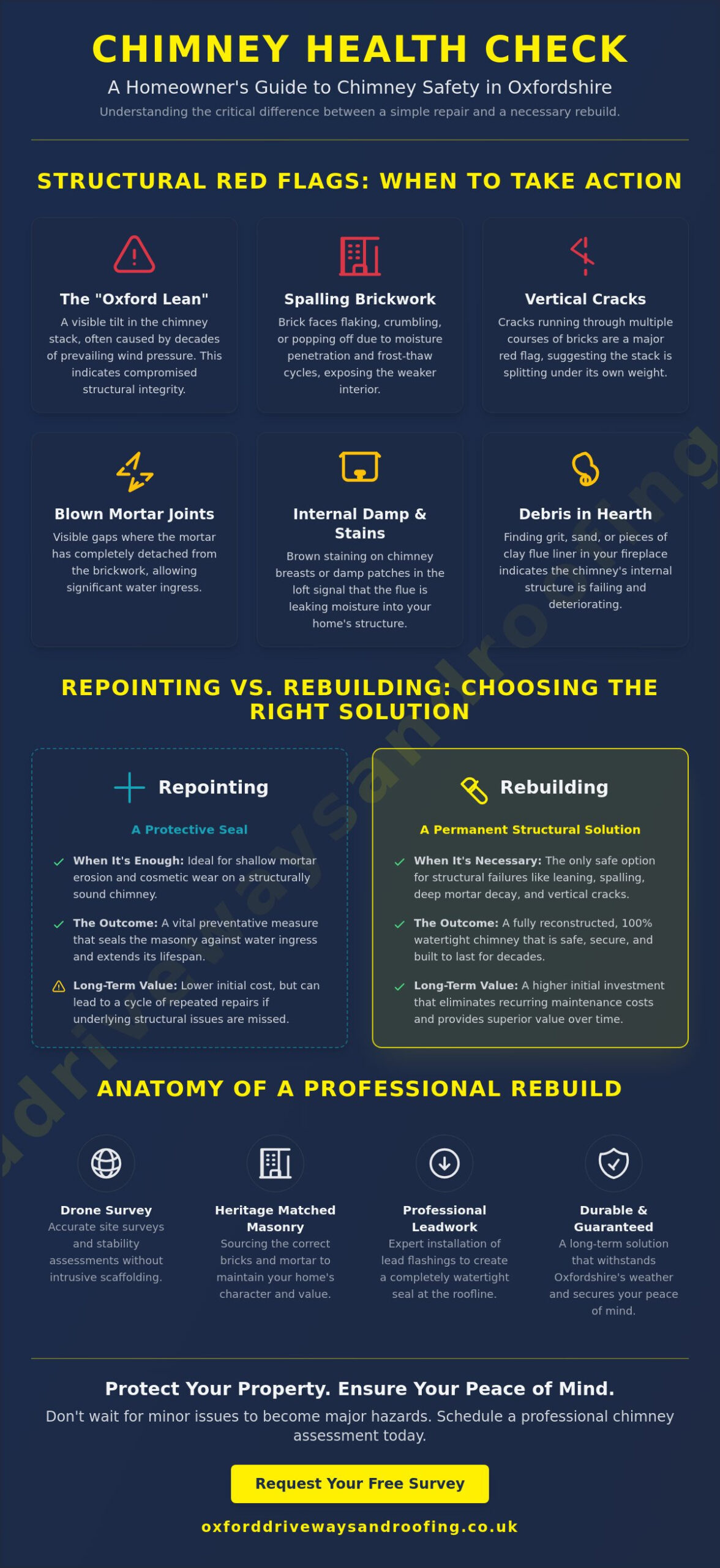
Many homeowners across the Thames Valley notice a subtle tilt in their masonry, a phenomenon often referred to as the “Oxford Lean.” This isn’t just a quirk of age; it’s usually the result of prevailing south-westerly winds that exert constant pressure on exposed stacks. Over decades, this pressure causes the mortar on the windward side to compress whilst the leeward side stretches, eventually compromising the stack’s centre of gravity. When this happens, a simple patch-up won’t suffice. Professional chimney rebuilding Oxfordshire becomes a structural necessity to prevent total collapse and protect your roof from catastrophic impact.
Beyond the lean, you should look for spalling brickwork. This occurs when moisture penetrates the brick’s surface and then freezes. As the ice expands, it pops the “face” off the brick, leaving the porous interior exposed to the elements. This cycle accelerates rapidly, turning a solid chimney into a crumbling safety hazard. You might also notice “blown” mortar joints, where the pointing has detached from the brick entirely. Understanding The Anatomy of a Professional Chimney Rebuild helps illustrate why these external failures often signal deeper internal issues. If you spot brown staining on chimney breasts inside the home or damp patches in the loft, the internal flue may already be leaking moisture into your living space. Persistent moisture ingress of this kind can also affect your walls, and understanding damp proofing for walls in Oxford can help you address the full extent of water damage to your property.
The Impact of Oxfordshire Weather on Masonry
Oxfordshire’s geography plays a significant role in masonry degradation. The high rainfall common in the Cotswolds and the damp conditions of the Oxford basin keep masonry saturated for longer periods. This moisture is the primary catalyst for frost-thaw cycles that destabilise traditional lime mortar. In areas like Abingdon or Faringdon, proximity to mature trees increases moss growth. Moss acts like a sponge, holding water against the stack, and its roots can actually pry mortar joints apart over time. This constant environmental assault means that chimneys in our region often require more frequent inspections than those in drier parts of the country.
Structural Red Flags vs. Cosmetic Wear
It’s vital to distinguish between minor wear and a genuine emergency. Horizontal erosion in bed-joints is often cosmetic and can be solved with repointing. However, vertical cracking that runs through multiple courses of brick is a major red flag. It suggests the stack is splitting under its own weight. If you find grit or bits of clay liner in your fireplace, or if you can actually see daylight through the stack from your loft, the internal structure has failed. These aren’t just maintenance issues; they’re clear indicators that chimney rebuilding Oxfordshire is the only safe path forward for your home’s longevity.
Chimney Rebuilding vs. Repointing: Choosing the Right Solution
Deciding between a minor repair and a major restoration is often the most challenging part of property maintenance. Whilst repointing is a vital preventative measure, it’s not a universal cure for every ailment a stack might face. We categorise chimney work into three distinct levels: repointing, partial rebuilds, and full reconstruction. Repointing acts as a protective seal for chimneys with sound internal structures, whereas a partial rebuild typically involves restoring the stack from the roofline upwards to address localised weathering. When the damage extends below the roof tiles into the building’s fabric, a full reconstruction becomes the only viable path to safety.
From a financial perspective, a professional chimney rebuilding Oxfordshire often represents superior value over a twenty-year period. Homeowners frequently fall into a trap of repeated patching, spending significant sums on scaffolding and minor repairs every few years. A comprehensive rebuild resets the clock on your masonry, providing a permanent solution that eliminates recurring maintenance costs. If the core of the chimney is failing, continuing to apply fresh mortar to the surface is effectively throwing good money after bad. Investing in a structural solution ensures the stack remains 100% watertight and secure for the next generation.
When is Repointing Enough?
Repointing is an excellent choice when your chimney’s brickwork remains dense and the lead flashings are in good condition. If the mortar loss is shallow and there are no signs of a lean or internal damp, a fresh application of lime or cement mortar can extend the life of the stack significantly. However, repointing is a skin-deep fix that cannot correct structural instability or internal decay. For many Oxfordshire properties older than 80 years, the original mortar has often perished so deeply that simple repointing can no longer provide the necessary grip to keep the bricks secure. If you are unsure about the state of your masonry, a specialist chimney inspection can help determine if the structure is sound enough for a standard repair.
The Case for Full Chimney Reconstruction
A full rebuild is often necessitated by “hollow stack” syndrome, where the internal bricks have literally turned to dust due to decades of exposure to acidic flue gases. This internal collapse leaves the outer skin of the chimney unsupported, creating a major safety risk. Reconstruction is also the only way to correct the “Oxford Lean” mentioned previously, as the bricks must be physically realigned to restore a safe centre of gravity. Modern rebuilds allow us to integrate a high-quality Damp Proof Course (DPC), a feature many older chimneys lack, which provides a definitive barrier against moisture ingress. Understanding Permitted development rights for chimneys is also useful, as most reconstructions fall under these guidelines, ensuring your home remains compliant with current building standards whilst restoring its historic character.
The Anatomy of a Professional Chimney Rebuild
A professional chimney rebuild is far more than a simple exercise in masonry. It’s a complex structural project that requires a sophisticated layering of materials, each designed to work in harmony to protect your home. For a successful chimney rebuilding Oxfordshire project, we focus on four critical components: the masonry, the leadwork, the internal damp proofing, and the termination. Each element must be specified correctly to ensure the stack remains stable against the high winds and heavy rains common in the Thames Valley.
We prioritise sourcing high-grade masonry, often using reclaimed bricks or local Oxford stone to ensure the new work blends perfectly with your home’s original character. One of the most significant upgrades in a modern rebuild is the installation of a Damp Proof Course (DPC) tray. Older chimneys often lack this feature, which allows water to soak down through the porous brickwork into the ceilings below. By installing a lead or polymer DPC tray during the rebuild, we create a permanent physical barrier against downward water migration, solving the root cause of many persistent damp issues. For homeowners dealing with related moisture problems throughout their property, our guide to damp proofing for walls in Oxford explains how to address structural dampness from the ground up.
Leadwork and Waterproofing Essentials
The junction where the chimney meets the roof is the most vulnerable point for leaks. We exclusively use Code 4 lead for its superior durability and thickness, ensuring it can withstand decades of thermal expansion and contraction without cracking. We install a combination of step flashings, which follow the line of the roof tiles, and apron flashings at the front and back. These components work together to shed water away from the masonry and onto the roof surface. Professional leadwork is a precision skill; it’s the most common point of failure in amateur repairs because it requires expert bossing and welding to remain 100% watertight.
Masonry and Mortar Selection
Choosing the right mortar is as important as the bricks themselves. For the many heritage properties in Oxfordshire, we often use lime-based mortars. Unlike modern cement, lime allows the building to “breathe,” letting moisture escape rather than trapping it inside the bricks where it can cause frost damage. We take great care in matching the colour and texture of local Oxfordshire brickwork, ensuring the finish is seamless and maintains your property’s value. Finally, we apply “flaunching,” a strong cement-based cap at the top of the stack. This holds the chimney pots in place and provides a sloped surface to shed water away from the flues. We also help you select the correct cowls to provide essential ventilation whilst preventing birds from nesting in your newly restored stack.
The Rebuilding Process: What Homeowners Should Expect
The success of a chimney rebuilding Oxfordshire project relies on a methodical, step-by-step approach that prioritises safety and structural precision. We begin every project with a comprehensive site survey, often utilising high-resolution drone technology. This allows us to inspect the stack’s stability and the condition of the masonry at close range without the immediate need for ladders. Once we’ve identified the exact extent of the degradation, we provide a clear plan of action. This transparency ensures you understand the work required before any physical deconstruction begins on your property.
Deconstruction is handled with extreme care. We don’t simply knock bricks down; we remove them course by course. This controlled process prevents debris from damaging your roof tiles and allows us to inspect the internal flue as we go. During the reconstruction phase, we integrate the modern waterproofing elements discussed earlier, such as the DPC tray and Code 4 lead flashings. We also ensure any new flue liners are correctly positioned to meet modern safety standards. Finally, we conduct a thorough site clearance, removing all rubble and leaving your driveway and garden exactly as we found them. If you’re concerned about the stability of your stack, you can book a professional chimney survey today to receive an expert assessment.
Scaffolding and Site Safety in Residential Areas
Managing the logistics of scaffolding is a critical part of our service, especially in narrow Oxford streets or the busy Abingdon town centre. We coordinate the installation to ensure it provides a safe working platform whilst minimising disruption to your daily life. Our teams follow strict Health and Safety regulations for working at height, ensuring the structure is secure against the wind. We also take specific measures to protect your existing roof, whether it’s made of delicate Welsh slate or traditional clay tiles, by using protective boards and weight-distributing walk-boards throughout the deconstruction and rebuilding phases.
Planning Permissions and Building Regulations
Most chimney rebuilds are considered “Permitted Development,” but structural changes often require Building Control approval. The primary regulations governing this work are found in Approved Document J, which covers the requirements for flues, ventilation, and chimney construction. For example, the internal flue diameter for a standard wood-burning stove must be at least 150mm to comply with safety standards. If your home is a Grade II listed building, we must also navigate the requirements for Listed Building Consent. This often involves using specific lime mortars and matching historic brick bonds to satisfy conservation officers whilst ensuring the new stack meets modern fire safety heights.
Why Choose Oxford Driveways And Roofing for Your Chimney Restoration?
Oxford Driveways And Roofing Ltd. stands as a reliable specialist in a sector where homeowners often feel overwhelmed by conflicting advice. Our deep understanding of Oxfordshire’s unique architecture allows us to approach every chimney rebuilding Oxfordshire project with precision and care. Whether your property is a period cottage in Witney, a Victorian terrace in Oxford, or a modern home in Swindon, we possess the local expertise required to restore your chimney to its former glory whilst ensuring it meets modern safety standards. We don’t just fix bricks; we preserve heritage.
We offer a truly comprehensive service that simplifies the entire restoration process for you. You won’t need to coordinate multiple contractors or worry about logistics. We handle everything from the initial safe scaffolding installation to the final specialist leadwork. By managing every phase in-house, we maintain total control over the quality of the workmanship and the materials used. We only select premium materials specifically designed to withstand the unpredictable UK climate. This ensures that your restored stack remains a durable and attractive feature of your home for decades.
Our Commitment to Quality and Safety
Your peace of mind is our priority. Every project we undertake is backed by comprehensive insurance and a long-term guarantee on our workmanship. We believe in total transparency. Our quotes are clear and itemised; you won’t find hidden costs for scaffolding or waste removal. Our methodical approach ensures that your property is protected throughout the works, and we always leave the site spotless. For those looking to address other aspects of their home’s protection, our expertise also extends to broader Roofing Repairs Oxfordshire, providing a holistic solution for all your maintenance needs.
Total Exterior Property Care
A chimney rebuild often reveals other necessary maintenance tasks that are best handled while scaffolding is in place. We can seamlessly integrate your restoration with guttering and downpipes Oxford repairs or ridge tile replacement to ensure your entire roofline is secure. If you are considering wider property improvements, such as a Flat Roof Installation Oxfordshire, we can provide expert consultation on the best systems for your specific building. Our goal is to act as your trusted guide, simplifying decisions through clear communication and proven methods. Don’t leave your home’s safety to chance. Contact Oxford Driveways And Roofing for a Free Chimney Survey and let our seasoned professionals restore the structural integrity of your property.
Securing Your Home’s Future Against the Elements
Addressing structural issues early is the most effective way to prevent costly damage and ensure the long-term safety of your property. By understanding the difference between surface wear and genuine instability, you can make informed decisions that protect your home’s value. A professional chimney rebuilding Oxfordshire project doesn’t just restore a stack; it integrates modern waterproofing and precision masonry to create a permanent shield against the Thames Valley’s challenging weather.
As local Oxfordshire contractors, we take pride in our heritage brick matching and fully guaranteed workmanship. We believe every homeowner deserves the peace of mind that comes from a project executed with skill and transparency. Whether you’ve noticed a slight lean or persistent damp, taking action now prevents minor issues from becoming structural emergencies. Book Your Free Chimney Inspection with Oxford Driveways And Roofing today to receive an expert assessment from our seasoned specialists. We look forward to helping you maintain a safe and beautiful home for many years to come.
Frequently Asked Questions
How long does it take to rebuild a chimney stack?
A professional chimney rebuilding Oxfordshire project typically takes between two and four working days to complete from start to finish. This timeframe accounts for safe scaffolding erection, careful deconstruction of the old masonry, and the methodical rebuilding of the new stack. Larger projects or those requiring complex leadwork might take longer. We always monitor local weather forecasts to ensure the masonry is protected from rain whilst the mortar cures.
Do I need planning permission to rebuild my chimney in Oxfordshire?
You generally don’t need planning permission for a like-for-like chimney rebuild as it falls under Permitted Development rights. However, if your property is a Grade II listed building or situated within a designated Conservation Area, you must consult your local planning authority first. Changes to the height or external appearance of the stack usually require specific consent to ensure the work remains sympathetic to the surrounding Oxfordshire architecture.
Can I still use my fireplace during the rebuilding process?
You cannot use your fireplace whilst the chimney is being rebuilt. Using the appliance during construction poses a severe risk of carbon monoxide poisoning and fire, as the flue is often blocked or partially dismantled. We recommend waiting until the final inspection is complete and the mortar has fully hardened. Once the new pots and cowls are installed, your fireplace will be safe for regular use again.
What is the average cost of chimney rebuilding in the UK?
The cost of chimney rebuilding Oxfordshire varies significantly based on several logistical factors. The height of the stack, the number of pots, and the choice of materials, such as reclaimed bricks or lime mortar, all influence the final investment. Scaffolding requirements also play a major role, particularly in areas with restricted access. We provide detailed, transparent quotes that cover every aspect of the project without hidden fees.
Will the new bricks match my existing house?
We prioritise matching new bricks to your existing property to maintain its aesthetic value and character. Our team specialises in heritage brick matching, sourcing materials that replicate the colour, texture, and size of your original masonry. This is particularly important for period homes where a mismatch would be highly visible. By using traditional mortar colours, we ensure the new stack blends seamlessly with the rest of the building.
Is it possible to rebuild only the part of the chimney that is visible above the roof?
It is possible to perform a partial rebuild from the roofline upwards if the internal structure remains sound. This approach is ideal for addressing localised weathering or the “Oxford Lean” caused by wind exposure. However, we always conduct a thorough inspection to ensure the bricks below the tiles are structurally capable of supporting the new work. If we find internal decay, a full reconstruction is the safer, more durable option.
What happens if I ignore a leaning chimney stack?
Ignoring a leaning chimney stack significantly increases the risk of a sudden, catastrophic collapse during high winds. A falling stack can cause extensive damage to your roof, parked vehicles, or even neighbouring properties. Beyond the immediate physical danger, a neglected lean allows water to penetrate the building’s structure, leading to rot in roof timbers and damp in living areas. Early intervention is always the most cost-effective way to ensure safety.
Does a chimney rebuild include a new flue liner?
A chimney rebuild doesn’t automatically include a new flue liner, but it’s the most logical time to install one. If your existing liner is cracked or made of outdated materials, replacing it during the rebuild ensures your heating system complies with modern safety regulations. We assess the condition of your flue during the deconstruction phase and advise whether a new liner is necessary to prevent smoke leakage and improve appliance efficiency.