
Why do some driveways in Oxfordshire look pristine after a decade, whilst others begin to sink and crack within just two years? It is a common concern for anyone considering block paving Abingdon, especially when the local weather and heavy usage put constant pressure on your property’s exterior. You likely want a finish that enhances your home’s kerb appeal without the stress of future structural failure or confusing drainage issues.
We understand that the technical side of groundworks and SuDS regulations can feel complex for any homeowner. This checklist is designed to give you total peace of mind by detailing exactly what a professional installation requires to remain stable for twenty to thirty years. You will discover how to oversee the initial groundworks, manage rainwater effectively, and implement a simple maintenance routine to keep weeds and moss at bay. By the end of this guide, you will have a clear, step-by-step plan for a beautiful driveway that is built to last.
Key Takeaways
- Identify why the structural integrity of your driveway depends on a precise 200mm to 250mm excavation depth and a high-quality MOT Type 1 sub-base.
- Discover why the interlocking herringbone pattern offers the highest load-bearing strength for heavy vehicles whilst other bonds are better suited for decorative paths.
- Learn how to protect your investment with a “No-Pressure” washing rule that prevents the erosion of essential jointing sand and maintains stability.
- Gain clarity on how to vet a specialist for block paving Abingdon by distinguishing between manufacturer product warranties and professional labour guarantees.
- Understand the importance of SuDS compliance to ensure your new driveway manages surface water effectively and meets local drainage regulations.
Why Block Paving is Abingdon’s Favourite Driveway Choice
Abingdon’s streets showcase a unique blend of historical charm and modern suburban growth. This architectural variety is why Block paving has become the preferred choice for local homeowners seeking a balance of beauty and resilience; it is a staple of high-quality block paving Abingdon projects. It isn’t just a surface; it’s a sophisticated, flexible, multi-unit system that adapts to its environment. Each block is a separate component that interlocks to form a unified, heavy-duty carpet. Unlike a single slab of concrete, these individual units work together to provide a surface that is both incredibly strong and aesthetically versatile, making it the ideal solution for the diverse homes found across the town.
In the Vale of White Horse property market, first impressions are everything. A professionally installed driveway using block paving Abingdon can significantly enhance a home’s resale value by providing an immediate sense of quality. Potential buyers recognise the craftsmanship and the promise of longevity that high-quality paving offers. One of the most practical advantages is the ability to perform “invisible repairs.” If a single block becomes stained by oil or damaged, it can be lifted and replaced without disturbing the rest of the driveway. This modular nature ensures that your investment remains protected, as you won’t need to resurface the entire area for the sake of one small blemish.
Durability in the Oxfordshire Climate
The Thames Valley is known for its heavy clay soils, which can expand and contract significantly based on moisture levels. Rigid surfaces like standard concrete often crack under this pressure because they cannot move with the earth. Flexible block paving is superior because the sand-filled joints allow for microscopic movements without compromising the structural integrity. During cold UK winters, this flexibility also resists “frost heave,” where frozen ground moisture pushes upwards. By choosing a flexible system, you ensure your driveway remains level and stable regardless of the temperature fluctuations or the challenging local soil conditions.
Kerb Appeal and Character
A well-designed entrance has a profound psychological impact on how a property is perceived by visitors and neighbours alike. It signals that the home is well-cared for and maintained to a high standard. We focus on matching block colours to the traditional Abingdon stone or the varied brickwork common in newer developments. By using contrasting borders and edgings, we can help you organise your outdoor space and define clear boundaries between your driveway and garden.
- Charcoal or Grey: These sleek tones complement modern, minimalist architecture and provide a clean, sharp look.
- Brindle or Buff: These warmer shades harmonise perfectly with traditional Oxfordshire stone and older cottage-style homes.
- Intricate Borders: Framing the driveway with a different colour or texture creates a polished, high-end finish that stands out.
The Installation Checklist: Ensuring Structural Integrity
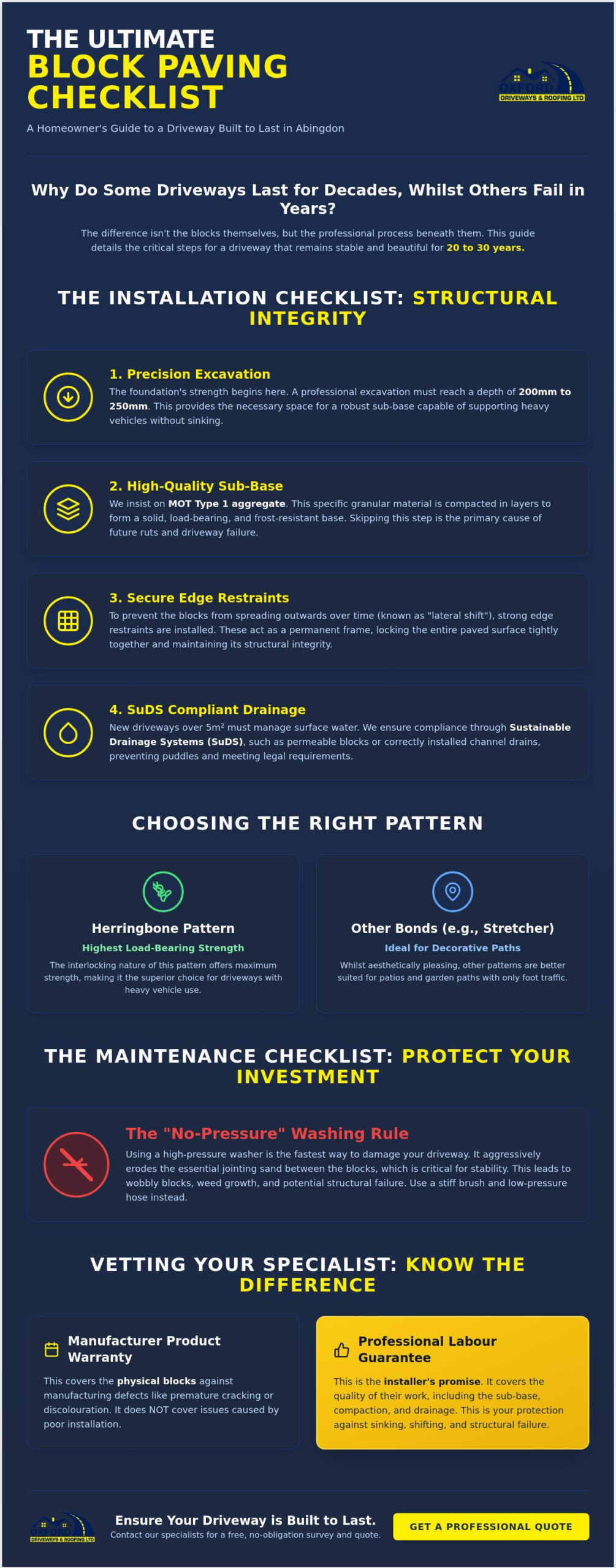
A driveway’s longevity is determined long before the first block is laid. For a successful project involving block paving Abingdon, the professional standard for excavation depth is typically between 200mm and 250mm. This depth allows for a substantial foundation that can support the weight of modern vehicles without shifting. We rely on MOT Type 1 aggregate for the sub-base, which is a granular material that compacts into a solid, load-bearing layer. Without this specific material, the driveway risks sinking or developing ruts over time. Once the base is prepared, edge restraints are installed to prevent “lateral shift.” These restraints act as a frame, keeping the blocks tightly packed and preventing the edges from spreading outwards into flowerbeds or lawns. To ensure everything is perfectly level and stable, we use a heavy-duty plate compactor at multiple stages of the process.
Drainage and SuDS Compliance
Many homeowners are unaware that drainage is a legal requirement. According to official government guidance, any new driveway over five square metres must manage surface water runoff to avoid the need for planning permission. This is achieved through Sustainable Drainage Systems (SuDS). You might choose permeable blocks that allow water to soak through the joints, or you can install traditional drainage channels. It is also vital to ensure your guttering and downpipes Oxford are correctly integrated to prevent water from pooling at the base of your property walls. Managing water effectively is the best way to protect your home’s foundations and the integrity of your block paving Abingdon installation.
The Laying Course and Jointing
The final surface relies on a precise laying course of sharp sand, which provides a level bed for the blocks. Unlike soft building sand, sharp sand has a gritty texture that doesn’t compress easily under load. Once the blocks are positioned, we apply kiln-dried sand to the joints. This sand must be bone dry to flow into every crevice. When the driveway is compacted one last time, this sand creates a powerful “interlock.” It is this friction between the blocks, rather than cement, that holds the entire structure together. If you want to ensure your installation follows these rigorous standards, you can view our full range of paving services to see how we prioritise structural integrity.
Choosing the Right Block Paving Patterns and Colours
The pattern you choose dictates both the visual rhythm and the structural resilience of your driveway. For most block paving Abingdon projects, we advocate for the herringbone pattern. When blocks are laid at a 45-degree or 90-degree angle to one another, they create a superior interlock. This specific arrangement is the strongest choice for handling heavy vehicle traffic because it spreads the load across multiple units and resists the “shunting” forces caused by braking or turning wheels. Stretcher bond and basketweave patterns, whilst visually appealing, are better suited for garden paths or decorative patios where heavy vehicles won’t be parked.
Colour selection is where you can truly express your property’s personality. Charcoal blocks offer a sleek, high-contrast look that works well with white or light-coloured rendering. Brindle and autumn hues provide a more blended, natural appearance that hides dirt and tyre marks effectively. We often suggest using a multi-toned block for the main area to ensure that minor stains don’t stand out. According to Interpave’s guide to block paving installation and maintenance, the aesthetic success of a project often relies on these subtle design choices. Finishing the area with a contrasting header course, perhaps in a solid dark tone, provides a crisp boundary that frames the entire installation.
Matching Your Home’s Era
Abingdon’s architectural history is diverse. If you live on one of the town’s more historic streets, tumbled blocks are an excellent choice. These blocks undergo a secondary process to distress the edges, giving them a weathered, “period” look that complements traditional stonework. Conversely, contemporary developments in areas like Botley are often better served by smooth-faced, clean-cut blocks with sharp lines. Using multi-coloured blocks in these settings can also be a clever way to mask the inevitable oil drips from modern vehicles.
Functional Design Features
A professional design should be as practical as it is beautiful. We incorporate recessed manhole covers that allow the paving pattern to continue uninterrupted, making utility access almost invisible. If your property requires improved accessibility, we can integrate gentle slopes, custom steps, and non-slip textures to ensure safety for all residents. For a final touch of sophistication, many homeowners now include kerb-side LED lighting. These low-voltage lights increase safety during dark Oxfordshire evenings and highlight the craftsmanship of your block paving Abingdon project.
The Maintenance Checklist: Keeping Your Driveway Fresh
Maintaining your block paving Abingdon installation is the most effective way to ensure your twenty-year investment does not fall victim to the elements. Many homeowners make the mistake of using high-pressure washers on a high setting to clear grime. Whilst it provides instant gratification, it actually erodes the kiln-dried sand that creates the essential interlock between blocks. This “No-Pressure” rule is vital; a gentle hose and a stiff broom are usually all that is required to keep the surface clean without compromising the structural stability of the laying course.
An annual weed audit is another pillar of long-term care. Rather than pulling weeds once they have already taken root and disturbed the sand bed, we recommend a preventative treatment applied twice a year. If you notice the sand levels dropping between the blocks, which typically occurs every two years, you should top them up with fresh kiln-dried sand. This simple task prevents the blocks from shifting and stops debris from filling the gaps where seeds might otherwise germinate. By staying ahead of these small tasks, you prevent the need for more costly remedial work in the future.
Oil spills require immediate, decisive action to prevent permanent staining. If you spot a leak from a vehicle, blot it up immediately with an absorbent cloth or clay-based cat litter. Avoid the temptation to scrub the area, as this can push the oil deeper into the porous surface of the block. For stubborn stains, always opt for a specialist block paving cleaner rather than harsh household chemicals that might discolour the units.
Seasonal Care for Oxfordshire Homes
Oxfordshire’s damp climate presents specific challenges throughout the year. In autumn, clear fallen leaves promptly to prevent tannins from leaching out and staining lighter-coloured blocks. Winter requires caution with de-icing salts; whilst they are effective for safety, excessive use can eventually degrade the surface of some concrete blocks. During the damp spring months, keep an eye out for algae or moss in shaded areas. A simple wash with a mild soapy solution usually prevents these from becoming a slip hazard or an eyesore. The same freeze-thaw cycles that threaten your driveway’s jointing sand can also compromise your roofline; if you notice cracking or displacement at the peak of your home, professional ridge tile replacement Oxfordshire specialists can address the issue before it leads to costly structural timber decay.
Structural Health Checks
Regularly check for signs of “rutting” or areas where the blocks have begun to sink, as this usually indicates a sub-base issue or heavy point-loading. If caught early, these can be repaired by lifting only the affected units. It is also wise to inspect where the driveway meets your home. If you notice rising damp or salt deposits near the ground level, you may need to investigate damp proofing for walls Oxford to ensure water is not being bridged into your property’s structure. Finally, inspect your edge restraints for any movement or cracking, as these are the only components keeping the entire paving system in place. If you have concerns about the condition of your current surface, speak with our professional paving team for a thorough health check.
Selecting Block Paving Specialists in Abingdon
Choosing the right contractor for your block paving Abingdon project is the final, most critical step in ensuring your investment stands the test of time. A specialist’s local experience is invaluable; you should always ask to see completed projects in Abingdon or Botley. Driving past a three-year-old installation allows you to see how the blocks have weathered and whether any sinking has occurred. A reputable contractor will be proud to share these locations. You should also distinguish between a product warranty and a labour guarantee. Whilst a manufacturer might cover the blocks against fading, it is the installer’s guarantee that protects you against structural failures like shifting or drainage issues.
One of the most significant red flags in the industry is a request for a large upfront deposit. Reputable contractors usually have the established cash flow and supplier credit to begin a project without asking for payment before a single spade has touched the ground. You should also look for a team that possesses a broad understanding of property maintenance. A contractor who understands the intricacies of chimney rebuilding Oxfordshire or complex roofing nuances is more likely to respect the “whole building envelope.” They will ensure that your new driveway doesn’t just look good, but also interacts safely with your home’s damp proofing and drainage systems.
The Importance of a Written Quote
A “handshake deal” represents a significant risk to your property value and legal protection. A professional, written quote should be transparent and exhaustive. It must specify the exact depth of the excavation, the type of MOT Type 1 sub-base to be used, and the specific material specifications of the blocks. It should also clearly state how waste removal will be handled, as skip hire and soil disposal are major components of the work. When you compare quotes, look beyond the bottom line; a significantly cheaper price often indicates that the contractor is cutting corners on the invisible sub-base work we discussed in earlier sections. Just as you would scrutinise a quote for roofing repairs Oxfordshire homeowners rely on, the same diligence applied to your driveway quote will help you identify contractors who prioritise quality over cost-cutting.
Why Oxford Driveways And Roofing Ltd?
We pride ourselves on being a steady, reliable expert for homeowners across the region. Our team is committed to using only premium-grade materials that meet or exceed British Standards, ensuring that every installation is built for longevity. Because we are multi-skilled professionals, we understand how a new driveway impacts your entire property, from the kerb to the roofline. This holistic approach allows us to provide peace of mind and a guaranteed outcome for every homeowner we serve. If you are ready to transform your home’s entrance with precision and care, you can get your free, no-obligation block paving quote in Abingdon today.
Secure Your Property’s Future with Expert Paving
Investing in a new driveway is about more than just immediate kerb appeal. It’s about ensuring structural stability that lasts for decades. By prioritising a deep sub-base and a consistent maintenance schedule, you protect your home from sinking and poor drainage. A successful block paving Abingdon project relies on this blend of technical precision and high-quality materials to withstand the unique challenges of the local climate.
As local specialists with over 20 years of experience, we understand how to build trust through transparency and craftsmanship. We use only premium-grade materials on every project. All our work is fully guaranteed for your total peace of mind. Our team’s here to guide you through every stage, ensuring a result that adds lasting value to your property.
Ready to take the next step? Request a Free Professional Site Survey in Abingdon today to discuss your vision with our expert team. We look forward to helping you create an entrance you can be proud of for years to come.
Frequently Asked Questions
Do I need planning permission for block paving in Abingdon?
You don’t usually need planning permission for a new driveway if the surface is permeable or if rainwater is directed to a lawn or border within your property. Standard installations using permeable jointing materials generally meet these Sustainable Drainage Systems (SuDS) requirements. However, if your property is located amongst one of Abingdon’s conservation areas, you should check with the Vale of White Horse District Council before starting work.
How long does a block paving driveway take to install?
A typical two-car driveway usually takes between five and seven working days to complete from start to finish. This schedule allows for thorough excavation, the installation of a high-quality MOT Type 1 sub-base, and the precise laying of the blocks. Larger projects or those requiring complex drainage solutions or significant landscaping will naturally take longer to ensure a professional result.
Why is my block paving sinking in certain areas?
Sinking is almost always the result of a failure in the sub-base or inadequate ground preparation. If the initial excavation wasn’t deep enough or the foundation layers weren’t compacted with a heavy-duty plate compactor, the ground will eventually shift under the weight of your car. Choosing a specialist for block paving Abingdon ensures that these invisible structural layers are built to the correct professional standards.
Can block paving be laid over an existing concrete driveway?
Whilst it’s technically possible to lay blocks over concrete, we strongly advise against it for a long-term installation. This method often creates issues with threshold heights at your front door and can lead to poor drainage. For a result that is guaranteed to last, it’s far better to excavate the old concrete and install a fresh, flexible sub-base that allows for natural ground movement.
How do I stop weeds from growing between my paving blocks?
Weeds actually grow from seeds that land in the jointing sand rather than pushing up from the soil beneath. The best way to prevent growth is to keep your joints topped up with kiln-dried sand and apply a preventative weed treatment twice a year. Regular sweeping with a stiff broom also helps by disrupting any small seedlings before they have the chance to establish a root system.
What is the best colour block paving for a red brick house?
Charcoal or dark grey blocks are excellent choices for red brick homes because they provide a clean, modern contrast that makes the architecture stand out. If you prefer a more traditional aesthetic, brindle blocks contain subtle red and orange tones that harmonise with the existing brickwork. We often suggest using a different colour for the border to create a crisp, professional finish.
Is block paving more expensive than a resin driveway?
The cost of any driveway depends on the total area and the amount of groundworks required to ensure a stable finish. Block paving is highly valued for its durability and the unique advantage of being able to replace individual blocks if they become damaged. Resin bound driveways Oxford homeowners are increasingly considering offer a different aesthetic; we evaluate each property individually to provide the most reliable and cost-effective solution for your specific needs.
How soon can I park my car on a newly paved driveway?
You can usually park your vehicle on the driveway as soon as the final compaction is complete and the kiln-dried sand has been swept into the joints. The interlocking nature of the blocks provides immediate structural strength. We recommend avoiding sharp steering manoeuvres whilst the car is stationary for the first few days to allow the jointing sand to settle firmly into place.