What if the most cost-effective surfacing for your home was also the most resilient and visually versatile? Many homeowners feel hesitant about tarmac driveways Abingdon because they fear an industrial look or worry about thin, poor-quality surfacing from unreliable contractors. You want a front entrance that looks polished and stays level for decades, not a surface that cracks after the first heavy frost. Quality always starts with a professional foundation.
We understand that property maintenance can feel overwhelming, especially when you’re trying to balance long-term durability with a strict budget. This guide promises to demystify the entire process, helping you customise your installation with high-performance materials and decorative finishes that enhance your home’s kerb appeal. We’ll walk you through the essential technical steps, including current SUDS drainage regulations and the benefits of modern SMA technology, so you can plan your 2026 project with total peace of mind.
Key Takeaways
- Understand the critical three-layer engineering system required to prevent sinking and ensure your new surface withstands heavy daily use.
- Explore customisation options beyond standard black, including heritage tones and decorative borders that significantly boost kerb appeal.
- Ensure your project meets local standards for tarmac driveways Abingdon by following our guide to SUDS drainage regulations and legal compliance.
- Use our professional five-point checklist to evaluate contractor quotes, focusing on essential details like excavation depth and material quality.
- Discover how a holistic approach to property maintenance manages water from your roof to your driveway to prevent long-term damage.
Why Choose Tarmac Driveways in Abingdon for Your Property?
Selecting a new surface for your home often feels like a balancing act between visual appeal and practical budget constraints. For many homeowners considering tarmac driveways Abingdon, the primary goal is finding a solution that offers long-term stability without the premium price tag of natural stone. Modern tarmacadam is a highly engineered bitumen-bound aggregate designed specifically to withstand residential weight loads. It is often referred to technically as asphalt concrete, a term that highlights its structural strength and its ability to provide a reliable, uniform finish.
There is an outdated perception that tarmac is purely “industrial” or looks like a public car park. In reality, the sleek residential finishes used across Oxfordshire today are designed to complement domestic architecture. The result is a smooth, jet-black surface that provides a clean, sharp contrast to traditional brickwork and garden greenery. It remains the most cost-effective long-term surfacing for larger drives, offering a level of durability that loose aggregates simply cannot match whilst maintaining a premium feel.
The Evolution of Residential Tarmacadam
The industry has moved far beyond traditional tar. We now utilise advanced polymer-modified bitumen, which acts as a flexible binder within the mix. This is a crucial improvement for local properties because it prevents the surface from softening or “bleeding” during the increasingly hot UK summer heatwaves. These modern surfaces also feature “smooth-wear” courses. These are finer aggregates that create a tighter, more uniform finish, providing that distinctive high-end domestic appearance rather than the coarse, open texture found on public highways.
Tarmac vs Other Surfaces: A Quick ROI Comparison
When compared to block paving Abingdon, tarmac is significantly faster to install. Most projects are completed with impressive speed; a standard driveway can often be surfaced in just one day once the essential groundworks are finished. This reduces labour costs and minimises disruption to your daily routine. Unlike gravel, which requires constant raking and weeding, a sealed tarmac surface is incredibly low maintenance. It also offers a strategic advantage for future upgrades; a well-installed tarmac base provides the perfect foundation for resin bound driveways Oxford should you decide to further enhance your home’s exterior in the years to come.
The Anatomy of a Durable Tarmac Surface: From Sub-base to SMA
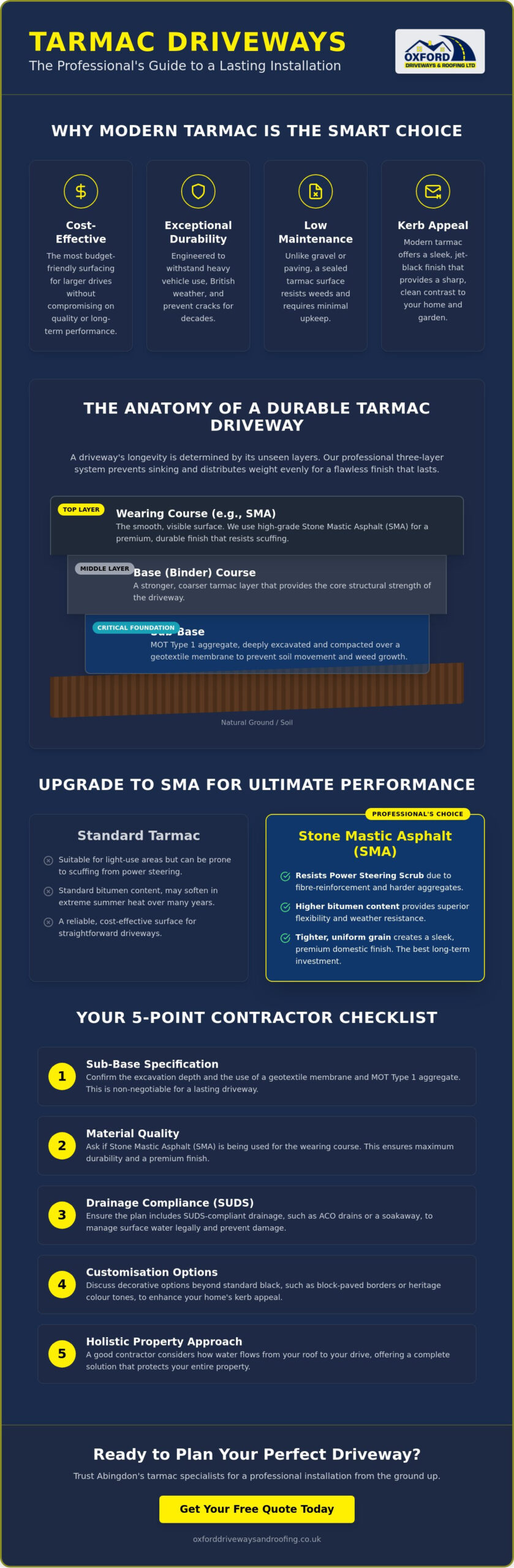
A driveway’s longevity is dictated by what lies beneath the surface. For tarmac driveways Abingdon, we implement a strict three-layer system: the sub-base, the base course, and the final wearing course. This structure ensures that the weight of modern vehicles is distributed evenly, preventing the common issues of sinking or rutting that plague poorly installed drives. When these layers are correctly compacted using heavy-duty vibrating rollers, they form a solid, engineered slab that withstands the test of time.
Why the Sub-base is the Most Critical Layer
Abingdon’s local geography typically consists of clay-heavy soils that expand and contract with changing moisture levels. To counteract this movement, we perform a deep excavation followed by the installation of a geotextile membrane. This layer prevents soil migration and stops weeds from compromising the structure from below. We then lay MOT Type 1 crushed aggregate, which serves as the industry-standard foundation for all high-performance drives in the area. Following UK Government guidance on ground preparation ensures that the drainage and stability of your property remain intact for decades.
Stone Mastic Asphalt (SMA): The Professional’s Choice
While standard tarmac is suitable for some applications, Stone Mastic Asphalt (SMA) is the superior choice for residential durability. SMA is a fibre-reinforced material that uses a higher bitumen content and harder aggregates to resist “power steering scrub,” which is the damage caused when cars turn their wheels whilst stationary. Beyond its strength, SMA offers a tighter, more uniform grain that provides a sleek, premium finish. If you have concerns about the technical requirements of your site, the team at Oxford Driveways And Roofing Ltd. can provide a detailed assessment of the best material specifications for your project.
Maximising Kerb Appeal: Customising Your Abingdon Tarmac Driveway
Many homeowners worry that choosing tarmac means sacrificing style for utility. This is a common misconception that often stems from seeing poorly finished industrial patches. Modern tarmac driveways Abingdon can be as visually striking as they are durable when you incorporate thoughtful design elements. By treating the surface as a canvas rather than just a functional slab, you can create an entrance that significantly boosts your property’s market value whilst maintaining the resilience you expect from a bitumen-bound surface. Customisation isn’t just about vanity; it’s about making the installation look like an intentional part of your home’s architecture.
Decorative Edging and Border Options
Decorative edgings are the secret to a high-end finish. Natural stone setts or concrete block paving borders create a sharp contrast that defines the driveway’s shape and separates it from lawns or flowerbeds. Beyond aesthetics, these borders provide a vital functional benefit by preventing “edge crumble” and lateral shift. This ensures the tarmac remains structurally contained. For a truly professional transition to the public pavement, we often recommend “bullnose” kerbs which provide a clean, rounded edge that meets local highways standards.
Colour and Texture Variations
The “only black” myth is easily debunked by modern material options. Red tarmac is a popular choice for heritage properties in Oxfordshire, offering a warm, traditional entrance feel that complements red-brick facades. Alternatively, heritage grey provides a subtle, modern alternative to jet black. For those seeking a more natural look, surface dressing with coloured aggregates can be rolled into the final layer. This technique is particularly effective when trying to complement Abingdon’s local limestone architecture, providing a textured finish that looks like gravel but remains perfectly stable.
Design doesn’t stop at the surface colour. Drainage is a legal necessity, but it doesn’t have to be an eyesore. Integrated drainage channels can be masked with decorative cast-iron or stainless-steel grates that look like design features. Whilst customising the look, we ensure all designs align with official government guidance regarding water runoff. To achieve a truly cohesive look, it’s worth coordinating your drive with your existing garden features. As patio and driveway specialists Oxford, we often design projects where the driveway edgings match the stone used in the rear garden, creating a unified and professional property aesthetic from front to back.
The Abingdon Homeowner’s Buying Guide: Costs, Planning, and Regulations
Planning a new driveway involves more than just picking a colour. For homeowners considering tarmac driveways Abingdon, understanding the local regulatory framework is essential to avoid future legal complications or drainage failures. Since 2008, the UK has enforced strict rules regarding surface water runoff to prevent flooding in residential areas. This means your project must be designed with long-term environmental stability in mind, ensuring water is managed effectively within your property boundaries.
Understanding SUDS and Drainage Law
In Abingdon, the Vale of White Horse District Council follows national Sustainable Urban Drainage Systems (SUDS) standards. You don’t usually need planning permission if your new driveway uses a permeable surface or if rainwater is directed to a lawn or border to drain naturally. However, any new drive over 5sqm must manage its own water runoff if the surface is impermeable. If you intend to direct water onto a public road, you’ll need to apply for formal permission. If your project requires a new dropped kerb, you must contact Oxfordshire County Council; they currently charge a £113.00 enquiry fee to determine if planning permission is required for the access point.
How to Spot a High-Quality Tarmac Quote
A professional quote should be transparent and detailed. It’s not enough to simply see a price per square metre. You need to know the specifics of the groundwork. We recommend using this five-step checklist to evaluate any proposal:
- Excavation depth: Is the contractor digging deep enough to reach stable ground and install a proper sub-base?
- Tonnage and material type: Does the quote specify the use of Stone Mastic Asphalt (SMA) for the wearing course?
- Drainage plan: How exactly will the system comply with SUDS regulations, such as using soakaways or channel drains?
- Edging and kerbing: Are the borders clearly defined and included in the price to prevent the edges from crumbling?
- Written guarantee: Does the company provide a clear, written warranty for both their workmanship and the materials used?
Be wary of door-to-door “tarmac cowboys” claiming to have leftover material from a nearby road project. This material is usually too cold to compact properly, leading to a surface that will crack and fail within months. High-quality installation also depends on the weather. We recommend scheduling tarmac driveways Abingdon during the spring or autumn when temperatures are moderate. Extreme heat can make the bitumen difficult to manage, whilst freezing conditions prevent the layers from bonding correctly. If you want a reliable assessment of your site, you can request a professional site survey to ensure your project meets all local standards.
Why Oxford Driveways And Roofing Ltd. is Abingdon’s Trusted Tarmac Specialist
Choosing a contractor for tarmac driveways Abingdon requires finding a specialist who understands the entire structural envelope of your home. Whilst many surfacing firms focus solely on the top layer, our unique background in both groundworks and roofing repairs Oxfordshire provides a distinct advantage. We don’t just see a driveway; we see a critical component of your property’s water management system. This dual expertise ensures that every installation is built with a deep understanding of how environmental factors affect your home’s long-term stability.
The Holistic Property Care Advantage
Our “total property protection” approach ensures that your new driveway works in harmony with your existing infrastructure. We understand how water moves, from the moment it leaves your roof tiles to the point it enters a driveway soakaway. If your guttering is poorly maintained or incorrectly aligned, the resulting overflow can saturate the ground beneath your drive, leading to the sub-base shifting and sinking discussed earlier. By coordinating your drainage systems, we ensure that surface water is managed effectively, protecting both your new investment and your property’s foundations from moisture-related damage.
Our Commitment to Abingdon Homeowners
We pride ourselves on a transparent, professional service that eliminates the stress of property maintenance. Our quoting process is thorough and honest, ensuring there are no hidden fees for extra materials or labour. We also recognise that residential streets in Abingdon can be narrow and busy, so we organise our work programmes with methodical precision to minimise disruption. Our team at Oxford Driveways And Roofing Ltd. is dedicated to providing high-quality results that stand the test of time, giving you total peace of mind in your home’s exterior transformation.
Request your free, no-obligation tarmac survey in Abingdon today to see how our seasoned, expert approach can enhance and protect your property for years to come.
Investing in a Durable Future for Your Abingdon Home
Selecting a high-performance driveway is a long-term investment in your property’s structural health. By moving beyond the “industrial” stigma and embracing modern SMA technology, you ensure a surface that remains level and jet-black for decades. We’ve detailed how a professional installation, from the MOT Type 1 sub-base to decorative stone borders, balances cost-effectiveness with a premium aesthetic that stands up to the UK’s changing climate.
At Oxford Driveways And Roofing Ltd., we provide the seasoned expertise required to manage water from the roofline to the road. Our holistic approach ensures that your project meets all local SUDS regulations whilst significantly enhancing your home’s kerb appeal. For those seeking reliable tarmac driveways Abingdon, we offer the stability of fully guaranteed workmanship and the precision of a trusted local specialist. Every project is an opportunity to provide you with a safe, durable, and beautiful entrance that is truly built to last.
Book Your Professional Tarmac Survey in Abingdon today to secure a guaranteed outcome for your property’s exterior transformation.
Frequently Asked Questions
How long does a tarmac driveway take to set before I can drive on it?
You can usually walk on a new surface within 24 hours, but we recommend waiting at least three to five days before parking a vehicle on it. During warmer summer months, the bitumen remains soft for longer, so it’s safer to wait a full week to avoid tyre indentations. This curing period ensures the material has reached the necessary structural hardness to support heavy daily loads without deforming.
Is tarmac cheaper than block paving for an Abingdon driveway?
Tarmac is generally a more cost-effective option than block paving, especially for larger surface areas. This price difference is primarily due to the lower material costs and a significantly faster installation timeline, which reduces the total labour hours required. It remains a popular choice for homeowners who want a durable, high-performance finish that balances budget with long-term resilience.
Can I lay new tarmac over my existing concrete or gravel drive?
We don’t recommend laying tarmac directly over loose gravel because it lacks the stable foundation required to prevent the surface from cracking. Whilst it is technically possible to overlay existing concrete if the base is perfectly sound, it often leads to reflective cracking where the joints of the concrete beneath eventually show through the new surface. For a guaranteed result, a full excavation and a fresh MOT Type 1 sub-base are always the safest options.
How do I prevent weeds from growing through my tarmac surface?
The most effective prevention method is the installation of a heavy-duty geotextile membrane beneath the sub-base during the initial groundworks phase. This barrier prevents roots from penetrating the surface from below. Maintaining a smooth, well-compacted finish also ensures that airborne seeds don’t find a place to take root in small surface gaps, keeping your driveway looking pristine for years.
Does a tarmac driveway add value to my Abingdon home?
A professionally installed driveway significantly enhances the kerb appeal and marketability of your property. In residential areas where off-street parking is a priority, high-quality tarmac driveways Abingdon provide a clean, organised entrance that suggests a well-maintained home. This practical upgrade offers an excellent return on investment by improving the first impression for potential buyers and providing a durable parking solution.
What is the difference between tarmac and asphalt for residential use?
Whilst the terms are often used interchangeably, modern residential projects typically utilise Stone Mastic Asphalt (SMA) rather than traditional tarmacadam. Traditional tarmac used tar as a binder, whereas modern asphalt uses bitumen. SMA is the superior choice for domestic drives because it is fibre-reinforced and contains a higher bitumen content, making it far more resistant to the “power steering scrub” caused by modern vehicles.
How often should I seal or maintain my tarmac driveway?
You don’t need to seal a brand-new driveway immediately as the bitumen needs several months to cure and weather naturally. We generally suggest considering a restorative seal every three to five years to replenish the surface oils and maintain the deep black colour. Regular maintenance is simple; just sweep away organic debris and wash off any oil spills promptly to prevent the binder from softening.
Will my new tarmac driveway require planning permission from the council?
You won’t usually need planning permission if your driveway uses a permeable surface or if the water is directed to a lawn or soakaway within your property boundary. However, if the surface is impermeable and exceeds five square metres, you must manage the water runoff to comply with SUDS regulations. If you intend to direct water onto a public road or need a new dropped kerb, you will need to consult with the local highways authority.